LenGaki’s JLPT N5 grammar list has 82 points in 19 groups; the biggest are particles (20), verb forms (18), expressions (10) and adjectives (7). There is no official JLPT grammar list, so every N5 list is a compilation. This one is the complete N5 library from lengaki.com, with each point’s meaning and one example sentence in Japanese, romaji and English.
How to read the list
- The number beside each point is its place in LenGaki’s grammar path, the order we suggest learning them in. Related points are grouped together, so the numbers jump inside a group.
- Every pattern links to its own page. Without an account the grammar library lists 30 points per level, but every point’s page is free to read, which is why each pattern here links straight to it.
- Three forms come up twice: いる / ある (19 and 60), ない Form (35 and 58) and た Form (36 and 59). The path meets each one early, then returns to it later with new examples.
Jump to: the full list · study order · common mix-ups · four-week plan · the book · FAQ
How many grammar points are in JLPT N5?
There is no official number. Until its 2010 revision, the JLPT published Test Content Specifications with lists of vocabulary, kanji and grammar items. It no longer does (the official JLPT FAQ explains why), so every N5 grammar list, this one included, is compiled by a textbook, a teacher or a website.
That is why the counts differ. Lists split patterns differently: one counts です (desu) and だ (da) as a single point, another as two; one treats the て-form (te-form) as one entry, another gives てください (te kudasai, “please do”), ています (te imasu, “is doing”) and てもいい (te mo ii, “may”) a point each. LenGaki counts です and だ as one point and gives each て-pattern its own, which is how the list comes to 82.
What the JLPT does publish is a summary of each level. N5 is “the ability to understand some basic Japanese”: reading sentences written in hiragana, katakana and basic kanji, and following short, slowly spoken conversations about daily life and the classroom. The grammar below is the toolkit for exactly that. Here is how LenGaki’s 82 points divide up:
| Group | Points | Includes |
|---|---|---|
| Particles | 20 | は · が · を · に · で · +15 more |
| Verb Forms | 18 | ます · ました · ています · てください · う-Verbs · +13 more |
| Copula | 1 | です / だ |
| Adjectives | 7 | い-Adjectives · な-Adjectives · い-Adjective Conjugation Core · な-Adjective Conjugation Core · 色 · +2 more |
| Existence | 2 | いる / ある |
| Expressions | 10 | たい · てもいい · に行く · 天気 · 家族 · +5 more |
| Questions | 1 | Question Words |
| Conjunctions | 4 | けれども / けど · てから · 前に · ので |
| Prohibition | 1 | てはいけない |
| Adverbs | 3 | まだ / もう · Frequency Adverbs · Degree Adverbs |
| Ability | 1 | できます |
| Comparison | 3 | もっと / 一番 · より · 同じ |
| Giving & Receiving | 2 | あげる / もらう · くれる |
| Demonstratives | 1 | ここ / そこ / あそこ |
| Location | 2 | 上 / 下 / 前 / 後ろ · 右 / 左 |
| Counters | 1 | Counters |
| Preferences | 3 | 好き / 嫌い · のが好き · のが上手 / 下手 |
| Weather | 1 | 季節 |
| Conditionals | 1 | もし |
| Total | 82 | 19 groups |
What are all 82 JLPT N5 grammar points?
Here is every point, grouped as the LenGaki grammar library groups them and in path order within each group. The pattern links to its full page, and the example is the first one on that page, with romaji and English. The same list is the Library tab of LenGaki’s grammar section, next to the interactive grammar path.
Particles (20)
Particles are the short words after a noun that mark its job in the sentence: topic, subject, object, place, time, direction. This group also holds two transport patterns: travelling by something (で, de) and getting on and off (に ni, を o). The hardest pair has its own guide: は vs が, finally solved.
| # | Pattern and meaning | Example |
|---|---|---|
| 1 | は (wa)Topic & Contrast Particle | 私は学生です。Watashi wa gakusei desu.I am a student. |
| 2 | が (ga)Subject Marker & Exhaustive Listing | 雨が降っています。Ame ga futte imasu.It is raining. |
| 3 | を (o)Direct Object & Traversal | 本を読みます。Hon o yomimasu.I read a book. |
| 4 | に (ni)Target, Time, and Existence Location | 日曜日に学校に行きます。Nichiyoubi ni gakkou ni ikimasu.I go to school on Sunday. |
| 5 | で (de)Context of Action (Location, Means, Condition) | 図書館で勉強します。Toshokan de benkyou shimasu.I study at the library. |
| 6 | と (to)And (Exhaustive), With, and Quotation | パンと卵を買います。Pan to tamago o kaimasu.I buy bread and eggs. |
| 7 | か (ka)Question, Or, and Uncertain Identity | それは本当ですか?Sore wa hontou desu ka?Is that true? |
| 8 | の (no)Possession, Modification, & Nominalization | これは私の本です。Kore wa watashi no hon desu.This is my book. |
| 9 | も (mo)Also, Too, Both/And, Emphasized Quantity | 山田さんは学生です。私も学生です。Yamada-san wa gakusei desu. Watashi mo gakusei desu.Mr. Yamada is a student. I am also a student. |
| 10 | から (kara)Starting Point, Origin, & Reason | 9時から働きます。Kuji kara hatarakimasu.I work from 9 o'clock. |
| 11 | まで (made)Endpoint & Limit | 5時まで働きます。Goji made hatarakimasu.I work until 5 o'clock. |
| 22 | へ (e)The Direction Particle | 北へ向かう。Kita e mukau.To head toward the north. |
| 23 | や (ya)Non-Exhaustive Listing Particle | カバンにペンや本があります。Kaban ni pen ya hon ga arimasu.In my bag there are pens, books, and things like that. |
| 24 | でも (demo)"Even" / "~ or something" / "any-" | そんなこと、子供でも分かります。Sonna koto, kodomo demo wakarimasu.Even a child understands that. |
| 25 | だけ (dake)"Only" (Neutral Limit) | 現金だけ使えます。Genkin dake tsukaemasu.We only take cash. |
| 26 | しか (shika)"Only" (with Negative, Insufficiency) | 財布には百円しか入っていない。Saifu ni wa hyakuen shika haitte inai.There's only 100 yen in my wallet. |
| 27 | など (nado)"Etc. / and so on" | スポーツが好きです。テニスや野球など。Supootsu ga suki desu. Tenisu ya yakyuu nado.I like sports — things like tennis, baseball, and so on. |
| 28 | よ / ね (yo / ne)Sentence-Ending Emotion Markers | このラーメンは辛いよ。Kono raamen wa karai yo.This ramen is spicy, you know. |
| 69 | 乗り物と で (norimono to de)Means of Transport | 電車で会社に行きます。Densha de kaisha ni ikimasu.I go to work by train. |
| 70 | 乗る / 降りる (noru / oriru)Getting On and Off | バスに乗ってください。Basu ni notte kudasai.Please get on the bus. |
Verb Forms (18)
How N5 verbs change: the polite ます (masu) family, the three verb groups, the て-form (te-form), and the plain dictionary, ない (nai) and た (ta) forms, plus invitations and the verbs for putting on clothes. The whole system is laid out in our verb conjugation guide.
| # | Pattern and meaning | Example |
|---|---|---|
| 12 | ます (masu)Polite Non-Past (Present & Future) | 毎朝コーヒーを飲みます。Maiasa koohii o nomimasu.I drink coffee every morning. |
| 13 | ました (mashita)Polite Past Tense | 昨日映画を見ました。Kinou eiga o mimashita.I watched a movie yesterday. |
| 14 | ています (te imasu)Continuous Action & Resulting State | 今、ご飯を食べています。Ima, gohan o tabete imasu.I am eating a meal right now. |
| 15 | てください (te kudasai)Polite Request / Instruction | ちょっと待ってください。Chotto matte kudasai.Please wait a moment. |
| 30 | う-Verbs (Godan / Group 1)Also called Godan ("five-step") verbs. | 書く → 書きます / 書かない / 書いたKaku → kakimasu / kakanai / kaitaWrite: polite / negative / plain past |
| 31 | る-Verbs (Ichidan / Group 2)Called Ichidan ("one-step") because the stem never changes. | 食べる → 食べます / 食べない / 食べた / 食べてTaberu → tabemasu / tabenai / tabeta / tabeteEat: polite / negative / past / te-form |
| 32 | Irregular Verbs: する / くる (Group 3)Japanese has just two truly irregular verbs: する (to do) and くる (to come). | する → します / しない / した / してSuru → shimasu / shinai / shita / shiteDo: polite / negative / past / te-form |
| 33 | ません / ませんでした (masen / masen deshita)Polite Negative | お酒は飲みません。Osake wa nomimasen.I don't drink alcohol. |
| 34 | て-Form (te)The Connector | 起きて、食べて、寝る。Okite, tabete, neru.I wake up, eat, and sleep. |
| 35 | ない Form (nai)Plain Negative | 行かない。Ikanai.I'm not going. |
| 36 | た Form (ta)Plain Past | きのう、彼に会った。Kinou, kare ni atta.I met him yesterday. |
| 37 | なかった Form (nakatta)Plain Past Negative | あの本は読まなかった。Ano hon wa yomanakatta.I didn't read that book. |
| 40 | ましょう (mashou)The Polite "Let's" | 乾杯しましょう!Kanpai shimashou!Let's toast / cheers! |
| 41 | ませんか (masen ka)The Polite Invitation | 今夜、飲みに行きませんか?Konya, nomi ni ikimasen ka?Won't you go out for a drink tonight? |
| 57 | Dictionary FormThe Plain Base | 明日、アニメを見る。Ashita, anime o miru.I'll watch anime tomorrow. |
| 58 | ない Form (nai)Plain Negative (Full Rules) | 何も聞かない。Nani mo kikanai.I won't ask/hear anything. |
| 59 | た Form (ta)Plain Past | あの本、読んだ?Ano hon, yonda?Did you read that book? |
| 75 | 着る・履く・かぶる (kiru / haku / kaburu)Verbs for Wearing | シャツを着て、靴を履いて、帽子をかぶる。Shatsu o kite, kutsu o haite, boushi o kaburu.Put on a shirt, put on shoes, and put on a hat. |
Copula (1)
です (desu) and だ (da): the “is” that ends a noun sentence.
| # | Pattern and meaning | Example |
|---|---|---|
| 16 | です / だ (desu / da)The Declarative Copula | これは辞書です。Kore wa jisho desu.This is a dictionary. |
Adjectives (7)
The two adjective types and how each one changes for the past and the negative, plus colours, taste and health words that behave like adjectives.
| # | Pattern and meaning | Example |
|---|---|---|
| 17 | い-Adjectives (i-adj)True Conjugating Adjectives | 面白い映画を見ました。Omoshiroi eiga o mimashita.I watched an interesting movie. |
| 18 | な-Adjectives (na-adj)Nominal Adjectives | 静かな図書館で勉強します。Shizuka na toshokan de benkyou shimasu.I study in a quiet library. |
| 46 | い-Adjective Conjugation Core (i-adj)い-adjectives carry their own tense and negation (like verbs). | 暑い → 暑くない / 暑かった / 暑くなかったatsui → atsukunai / atsukatta / atsukunakattahot → not hot / was hot / was not hot |
| 47 | な-Adjective Conjugation Core (na-adj)な-adjectives behave like nouns: they have no built-in tense. | 暇 → 暇です / 暇じゃない / 暇でした / 暇じゃなかったhima → hima desu / hima ja nai / hima deshita / hima ja nakattafree (not busy) → am free / am not free / was free / was not free |
| 72 | 色 (iro)Colors: Adjective vs Noun | 赤い車が好きです。Akai kuruma ga suki desu.I like red cars. |
| 74 | 美味しい/まずい (oishii / mazui)Tasting Good or Bad | このラーメンはまずい!Kono raamen wa mazui!This ramen tastes terrible! |
| 77 | 元気/病気 (genki / byouki)Health as Adjective vs Noun | お元気ですか?Ogenki desu ka?Are you doing well? |
Existence (2)
いる (iru) and ある (aru), the two verbs for “there is”: one for people and animals, one for everything else.
| # | Pattern and meaning | Example |
|---|---|---|
| 19 | いる / ある (iru / aru)The Verbs of Existence | 公園に子供がいます。Kouen ni kodomo ga imasu.There are children in the park. |
| 60 | いる / ある (iru / aru)Verbs of Existence | 宇宙人がいる!Uchuujin ga iru!Aliens exist! |
Expressions (10)
Ready-made patterns: wanting (たい, tai), permission (てもいい, te mo ii), going somewhere to do something, probability (でしょう, deshou), asking for things, set polite phrases, and everyday topics such as weather, family, food and pain.
| # | Pattern and meaning | Example |
|---|---|---|
| 20 | たい (tai)Expressing Desire | 日本に行きたいです。Nihon ni ikitai desu.I want to go to Japan. |
| 38 | てもいい (te mo ii)Giving/Asking Permission | これを食べてもいいですか?Kore o tabete mo ii desu ka?May I eat this? |
| 45 | に行く (ni iku)Go (in order) To Do | スーパーに野菜を買いに行きました。Suupaa ni yasai o kai ni ikimashita.I went to the supermarket to buy vegetables. |
| 67 | 天気 (tenki)Talking About the Weather | 今日はいい天気ですね。Kyou wa ii tenki desu ne.It's nice weather today, isn't it? |
| 71 | 家族 (kazoku)In-Group vs Out-Group Family Terms | 父は銀行員です。Chichi wa ginkouin desu.My father is a bank employee. |
| 73 | を + 食べる/飲む (o + taberu / nomu)Eating and Drinking | 朝ごはんにパンを食べます。Asagohan ni pan o tabemasu.I eat bread for breakfast. |
| 76 | 〜が痛い (ga itai)Expressing Pain | 頭が痛いです。Atama ga itai desu.My head hurts. (I have a headache.) |
| 78 | だろう/でしょう (darou / deshou)Probability & Seeking Agreement | 明日は雨でしょう。Ashita wa ame deshou.It will probably rain tomorrow. |
| 79 | Set Polite PhrasesSocial Lubricants | いただきます。Itadakimasu.I humbly receive (said before eating). |
| 82 | をください / をお願いします (o kudasai / o onegai shimasu)Please give me | コーヒーをください。Koohii wo kudasai.Please give me coffee. / Coffee, please. |
Questions (1)
The question words (what, who, where, when and the rest) and how a question is built around them.
| # | Pattern and meaning | Example |
|---|---|---|
| 21 | Question Words (疑問詞, gimonshi)The core interrogatives used to ask for missing information. | それは何ですか?Sore wa nan desu ka?What is that? |
Conjunctions (4)
Joining two clauses: “but” (けど, kedo), “after” (てから, te kara), “before” (前に, mae ni) and “because” (ので, node).
| # | Pattern and meaning | Example |
|---|---|---|
| 29 | けれども / けど (keredomo / kedo)The Soft "But" | 高いけれども、品質がいいです。Takai keredomo, hinshitsu ga ii desu.It is expensive, but the quality is excellent. |
| 42 | てから (te kara)Only After (Sequence) | 手を洗ってから、食べなさい。Te o aratte kara, tabenasai.Eat after you wash your hands. |
| 43 | 前に (mae ni)Before (Doing) | 買う前に値段をチェックする。Kau mae ni nedan o chekku suru.I check the price before buying. |
| 81 | ので (node)Reason / Cause (soft, polite) | 電車が遅れたので、遅刻しました。Densha ga okureta node, chikoku shimashita.Because the train was delayed, I was late. |
Prohibition (1)
“Must not”: てはいけない (te wa ikenai).
| # | Pattern and meaning | Example |
|---|---|---|
| 39 | てはいけない (te wa ikenai)The Absolute Wall | ここで写真を撮ってはいけません。Koko de shashin o totte wa ikemasen.You must not take pictures here. |
Adverbs (3)
まだ (mada, still or not yet) and もう (mou, already or no longer), and the adverbs for how often and how much.
| # | Pattern and meaning | Example |
|---|---|---|
| 44 | まだ / もう (mada / mou)Still vs Already / Not Yet vs Not Anymore | まだ生きています。Mada ikite imasu.I am still alive. |
| 55 | Frequency AdverbsHow Often | 私はいつも早く起きます。Watashi wa itsumo hayaku okimasu.I always wake up early. |
| 56 | Degree AdverbsHow Much | とても美味しかったです。Totemo oishikatta desu.It was very delicious. |
Ability (1)
Saying what you can do with できます (dekimasu).
| # | Pattern and meaning | Example |
|---|---|---|
| 48 | できます (dekimasu)Can Do / Be Able (Nouns) | 私は英語ができます。Watashi wa eigo ga dekimasu.I can speak English. |
Comparison (3)
More and most (もっと motto, 一番 ichiban), “than” (より, yori) and “the same” (同じ, onaji).
| # | Pattern and meaning | Example |
|---|---|---|
| 49 | もっと / 一番 (motto / ichiban)More / The Most | もっと安いのはありますか?Motto yasui no wa arimasu ka?Do you have a cheaper one? |
| 50 | より (yori)Than (Comparison Standard) | 今日は昨日より暑い。Kyou wa kinou yori atsui.Today is hotter than yesterday. |
| 62 | 同じ (onaji)'The Same' | 私のカバンは田中さんのと同じです。Watashi no kaban wa Tanaka-san no to onaji desu.My bag is the same as Tanaka's. |
Giving & Receiving (2)
Who gives to whom. Japanese uses a different verb when something comes to you or your side.
| # | Pattern and meaning | Example |
|---|---|---|
| 51 | あげる / もらう (ageru / morau)Giving and Receiving | 妹にお菓子をあげた。Imouto ni okashi o ageta.I gave sweets to my little sister. |
| 52 | くれる (kureru)Someone Gives to Me/Us | 彼が指輪をくれました。Kare ga yubiwa o kuremashita.He gave me a ring. |
Demonstratives (1)
Here, there and over there: ここ, そこ, あそこ (koko, soko, asoko).
| # | Pattern and meaning | Example |
|---|---|---|
| 53 | ここ / そこ / あそこ (koko / soko / asoko)Here / There / Over There | ここはどこですか。Koko wa doko desu ka.Where is this place? / Where am I? |
Location (2)
Position words: on, under, in front of, behind, right and left.
| # | Pattern and meaning | Example |
|---|---|---|
| 54 | 上 / 下 / 前 / 後ろ (ue / shita / mae / ushiro)Spatial Anchors | ベッドの下に猫がいる。Beddo no shita ni neko ga iru.There is a cat under the bed. |
| 61 | 右 / 左 (migi / hidari)Right and Left | 銀行の右に郵便局があります。Ginkou no migi ni yuubinkyoku ga arimasu.There is a post office to the right of the bank. |
Counters (1)
Counting things with the right counter word. Our counters guide goes further.
| # | Pattern and meaning | Example |
|---|---|---|
| 63 | CountersCounting Objects | ビールを三本ください。Biiru o sanbon kudasai.Three (bottles of) beer, please. |
Preferences (3)
Likes and dislikes (好き suki, 嫌い kirai), liking to do something, and being good or bad at it (上手 jouzu, 下手 heta).
| # | Pattern and meaning | Example |
|---|---|---|
| 64 | 好き / 嫌い (suki / kirai)Like and Dislike | 猫が好きです。Neko ga suki desu.I like cats. |
| 65 | のが好き (no ga suki)Liking to Do Actions | 映画を見るのが好きです。Eiga o miru no ga suki desu.I like watching movies. |
| 66 | のが上手 / 下手 (no ga jouzu / heta)Being Good/Bad at Doing | 田中さんは歌うのが上手です。Tanaka-san wa utau no ga jouzu desu.Tanaka is good at singing. |
Weather (1)
The four seasons. Talking about the weather itself (天気, tenki) sits under Expressions.
| # | Pattern and meaning | Example |
|---|---|---|
| 68 | 季節 (kisetsu)The Four Seasons | 日本の夏は蒸し暑いです。Nihon no natsu wa mushiatsui desu.Summers in Japan are hot and humid. |
Conditionals (1)
もし (moshi), “if”, and the conditional endings it pairs with.
| # | Pattern and meaning | Example |
|---|---|---|
| 80 | もし (moshi)The Hypothetical Marker | もし雨が降ったら、行きません。Moshi ame ga futtara, ikimasen.If it rains, I won't go. |
A list is the first pass. In LenGaki’s grammar path each of these points becomes a short lesson: an explanation, examples, multiple choice, sentence building and comparisons. You can try three patterns without an account; a free account opens N5 units 1–4, and Pro opens the full path from N5 to N2.
Open the grammar pathIn what order should you study N5 grammar?
Not alphabetically. A pattern sticks when you can use it straight away with the ones you already know, so order matters more than speed. A sequence that works:
- The sentence skeleton. です, は, の (no) and か (ka) give you これは私の本です (Kore wa watashi no hon desu, This is my book) and its question form. Everything else hangs on this.
- Polite verbs and their particles. ます, ました (mashita) and ません (masen), with を (o), に, で, へ (e), と (to) and も (mo). Now you can say what you do, where, when and with whom.
- Description and existence. The two adjective types, then いる / ある for “there is”. Now you can describe things and say where they are.
- The て-form. One form unlocks てください, ています, てもいい, てはいけない (te wa ikenai, “must not”) and てから (te kara, “after doing”), which is why it deserves extra time.
- Plain forms last. N5 sentences are mostly polite, but casual speech runs on the dictionary, ない and た forms, and N4 builds almost everything on them. Learn them well, once the polite forms are automatic.
The list above follows much the same logic: LenGaki’s path starts with particles and polite verb forms, and leaves the plain forms and the topic-based expressions for later. Two habits make any pattern stick:
- Learn each pattern as a sentence you could say, not as a formula. 日本に行きたいです (Nihon ni ikitai desu, I want to go to Japan) is easier to recall than “verb stem + たい”.
- Change one word at a time. Swap 日本 for 京都 (Kyouto), then 行きたい for 住みたい (sumitai, want to live): 京都に住みたいです (Kyouto ni sumitai desu, I want to live in Kyoto). Five variations of one sentence teach a pattern better than five unrelated sentences.
Which N5 grammar points do learners mix up most?
A handful of pairs cause a large share of N5 grammar mistakes, and many N5 grammar questions come down to choosing between them. Learn them as pairs, side by side:
| Pair and rule of thumb | Examples |
|---|---|
| は vs がは sets the topic, what you are talking about. が marks the subject, often new or specific information, and question words as the subject always take が. | 私は学生です。Watashi wa gakusei desu.I am a student.だれが来ましたか。Dare ga kimashita ka?Who came? |
| に vs でに marks where something is or where it goes (with いる, ある or 行く iku). で marks where an action happens. | 図書館にいます。Toshokan ni imasu.I’m at the library.図書館で勉強します。Toshokan de benkyou shimasu.I study at the library. |
| を vs が with 好き好き, 嫌い, 上手 and できる take their object with が, not を. | 日本語が好きです。Nihongo ga suki desu.I like Japanese.日本語ができます。Nihongo ga dekimasu.I can speak Japanese. |
| いる vs あるいる is for people and animals; ある is for things and plants. | 猫がいます。Neko ga imasu.There is a cat.本があります。Hon ga arimasu.There is a book. |
| い-adjectives vs な-adjectivesBefore a noun, an い-adjective attaches directly and a な-adjective adds な. きれい (kirei, pretty) and 嫌い (kirai, disliked) end in い but are な-adjectives. | 高い本takai honan expensive bookきれいな花kirei na hanaa pretty flower |
| だけ vs しかBoth mean “only”. だけ is neutral and works with positive or negative verbs; しか always takes a negative verb and suggests “not enough”. | 百円だけあります。Hyakuen dake arimasu.I have just 100 yen.百円しかありません。Hyakuen shika arimasen.I only have 100 yen. |
| もう vs まだもう with a positive verb means “already”; まだ with a negative means “not yet”, and “not yet” uses ていません, not ませんでした. | もう食べました。Mou tabemashita.I’ve already eaten.まだ食べていません。Mada tabete imasen.I haven’t eaten yet. |
| から vs のでBoth mean “because”. ので sounds softer and more polite, so it suits explanations and apologies; after a noun or な-adjective it becomes なので. | 雨だから、行きません。Ame da kara, ikimasen.It’s raining, so I’m not going.雨なので、行きません。Ame na node, ikimasen.It’s raining, so I won’t be going. |
| あげる / もらう vs くれるあげる: you give to someone else. くれる: someone gives to you or your side. もらう: you receive, and the giver takes に or から. | 友達に本をあげました。Tomodachi ni hon o agemashita.I gave my friend a book.友達が本をくれました。Tomodachi ga hon o kuremashita.My friend gave me a book. |
The mistake behind most of these
Translating particles one to one from English. に is not simply “in” or “at”, and は does not mean “is”. Learn each particle by what it does in the sentence, from examples, and the pairs above stop being guesses.
は vs が is the big one, and our guide to は and が takes it apart properly. If you are newer to grammar in general, the beginner’s guide to Japanese grammar builds sentence structure from the start. And when a sentence still will not make sense, highlight it anywhere on lengaki.com and tap Explain with Lena: Lena is LenGaki’s AI tutor, and three messages a day are free.
How can you learn all 82 points in four weeks?
If you already read hiragana and katakana, four weeks at about three points a day takes you through the whole list once. That is a first pass, not mastery, but a complete first pass is what makes the second one fast. Split the list in path order:
| Week | Points | By the end of the week you can… |
|---|---|---|
| Week 1 | 1–2121 points | Build polite sentences: A は B です, verbs in ます and ました, the core particles, い- and な-adjectives, いる / ある, たい and question words. |
| Week 2 | 22–4221 points | Sort verbs into their three groups and make the て, ない and た forms; ask permission (てもいい), forbid (てはいけない), invite (ませんか, ましょう) and limit with だけ and しか. |
| Week 3 | 43–6220 points | Put adjectives into the past and negative, compare with より, 一番 and 同じ, give and receive, say where things are, and settle the plain forms. |
| Week 4 | 63–8220 points | Handle everyday topics (counting, likes and skills, weather, transport, family, colours, food, clothes, health) and finish with でしょう, もし, ので and をください. |
Each week, day by day
- Days 1–6: three or four new points a day. Read each page, copy the example by hand, say it aloud, then write two sentences of your own that change one word.
- Day 7: nothing new. Cover the English of the week’s examples, translate them back, and redo anything you missed.
- After week 4: a second, faster pass, then a test under exam conditions. LenGaki’s JLPT N5 mock exams include a timed grammar and reading paper, and N5 sets 1 and 2 are free.
Grammar is only one part of N5. For the vocabulary and kanji around it, the three-month JLPT N5 study plan shows how the pieces fit together.
Is there a book with all 82 N5 grammar points?
Yes: LenGaki N5 Grammar, a printed book in the LenGaki N5 set. It has 82 grammar points with simple explanations, natural example sentences with English, key points and usage tips, and side-by-side comparisons of confusable patterns in くらべてみよう (kurabete miyou, “let’s compare”) boxes.
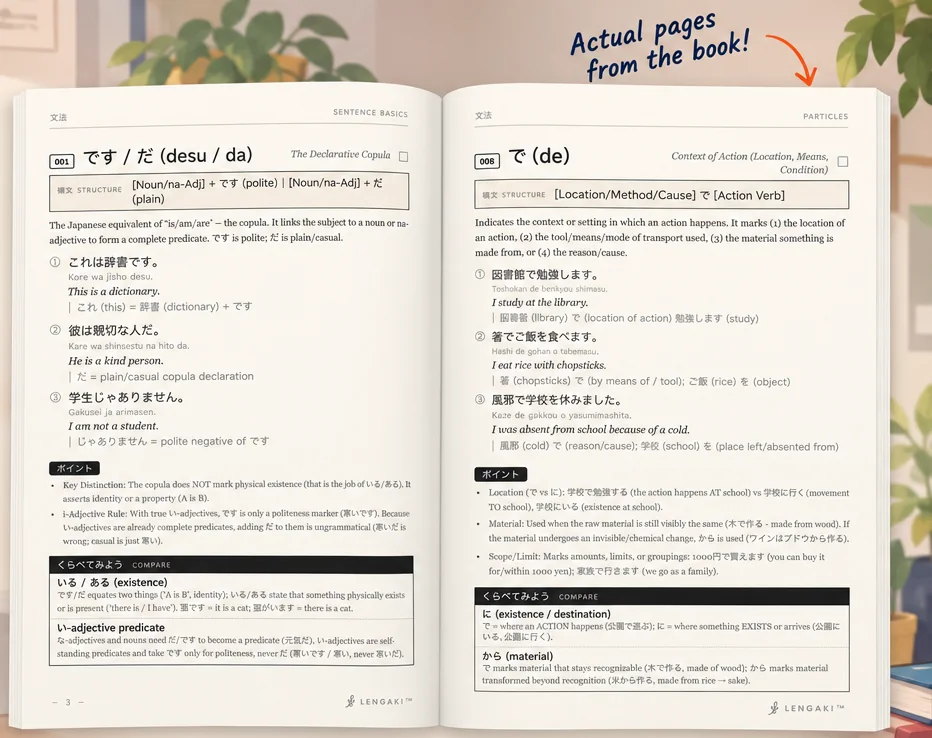
The book follows the same N5 syllabus as the LenGaki website and app, so any chapter can be practised online: the grammar path for the points you just read, and timed mock exams when you finish. In India the books are delivered by LenGaki’s partner Vyaktigat Vikas (here is the complete N5 set); for international delivery, email lengaki2426@gmail.com before ordering. The books page has the details of all four books.
Do you need a grammar book at all? Not if you are working through a full textbook course: it already teaches N5 grammar, and our guide to grammar books argues you can skip a separate one at this level. A standalone book suits you if you want the grammar on its own, as a reference you can keep beside this list.
Frequently asked questions
How many grammar points are in JLPT N5?
There is no official number: the JLPT stopped publishing lists of vocabulary, kanji and grammar with its 2010 revision, so every N5 list is a compilation. LenGaki’s N5 list has 82 grammar points, and other lists differ mainly in how finely they split patterns.
What N5 grammar should I learn first?
Start with です (desu), the particles は (wa), が (ga), を (o), に (ni) and で (de), and the polite verb forms ます (masu), ました (mashita) and ません (masen). Almost every N5 sentence uses several of these, and the rest of the list builds on them.
What is the difference between は and が?
は (wa) marks the topic, what the sentence is about, while が (ga) marks the subject, often as new or specific information. Question words take が, and so does the answer: だれが来ましたか (Dare ga kimashita ka, Who came?) is answered with 田中さんが来ました (Tanaka-san ga kimashita, Tanaka came).
Can you learn all N5 grammar in a month?
Yes, as a first pass, if you already read hiragana and katakana: about three points a day covers all 82 in four weeks. Plan a second pass and some timed practice afterwards, because recognising a pattern is not the same as using it.
Are LenGaki’s grammar pages free?
Yes. Every grammar point has its own page on LenGaki, free to read without an account. The interactive grammar path is free for N5 units 1–4 with a free account, and the full path from N5 to N2 comes with Pro, a small monthly subscription.
Does the LenGaki N5 Grammar book cover the same points as the website?
Yes. LenGaki N5 Grammar is a printed book with 82 N5 grammar points on the same syllabus as the website and app, with simple explanations, examples with English and くらべてみよう comparison boxes. In India it is delivered by LenGaki’s partner Vyaktigat Vikas; for international delivery, email lengaki2426@gmail.com before ordering.