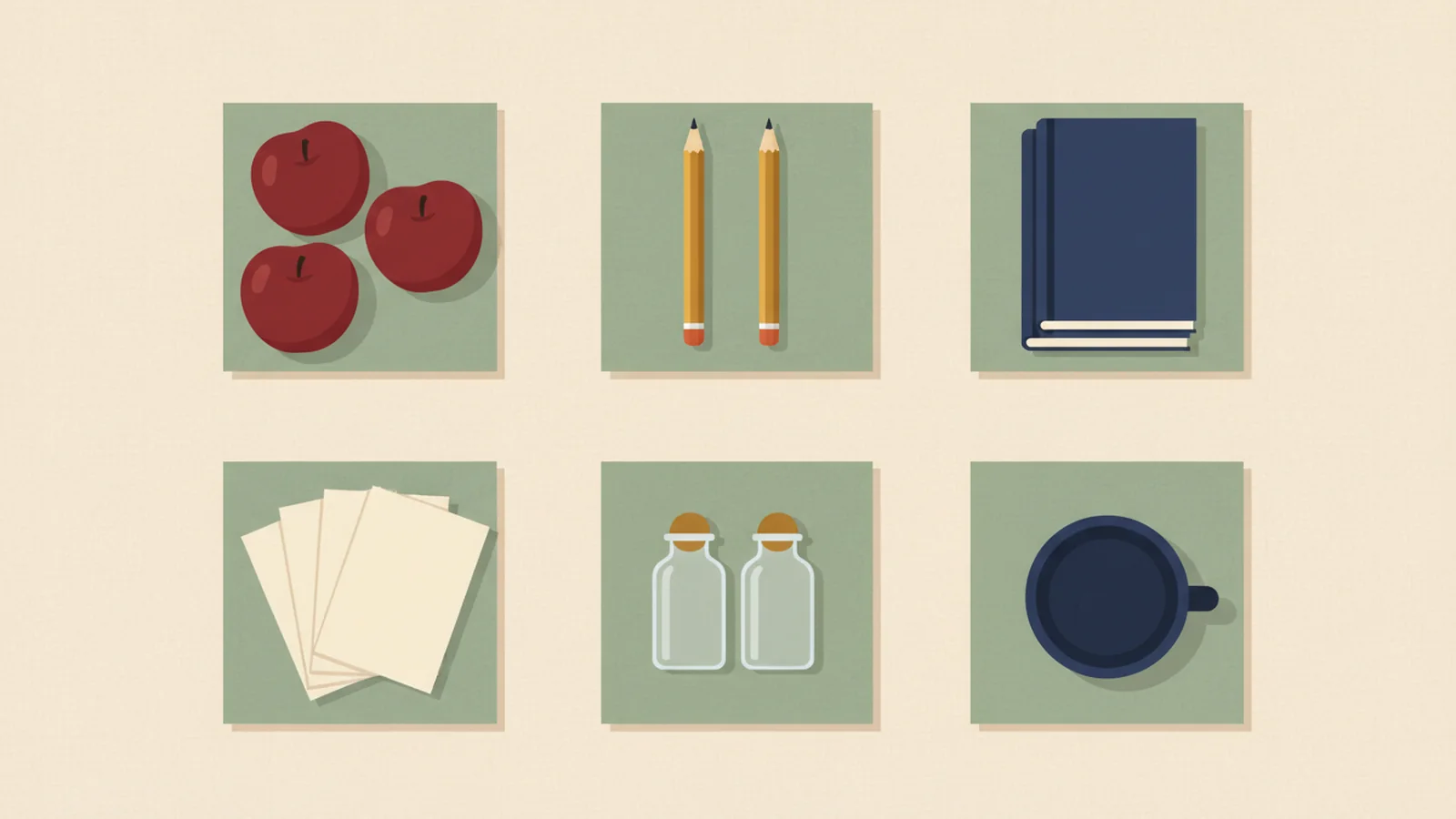
In English, we say "two apples", "three papers", or "four pens". In Japanese, however, you cannot simply attach a number directly to a noun. You must use a specific counter word based on the shape, size, or nature of the item you are counting.
If you are studying for the JLPT N5, there are 7 fundamental counters that you are very likely to be tested on. In this guide, we'll explain each counter, show how it behaves, and provide two practical sentence examples for each.
Decision Flow: Which Counter to Use?
When you want to count an item, follow this decision tree to find the correct Japanese counter suffix:
Exceptions: 1=hitori, 2=futari.
Used for paper, shirts, plates, stamps.
Used for pens, bottles, umbrellas.
Used for round things, ideas, orders.
Quick Reference Table of N5 Counters
| Counter Suffix | Objects Counted | Numbers 1, 2, 3 | Pronunciation Alert |
|---|---|---|---|
| 〜つ (tsu) | General inanimate objects | ひとつ, ふたつ, みっつ | Changes completely from regular numbers |
| 〜人 (nin) | People | ひとり, ふたり, さんにん | 1 & 2 are irregular (hitori, futari) |
| 〜本 (hon) | Long, cylindrical shapes | いっぽん, にほん, さんぼん | Mutates: ippon, sanbon, roppon |
| 〜枚 (mai) | Flat, thin things | いちまい, にまい, さんまい | Very regular and simple |
| 〜冊 (satsu) | Books, magazines, bound items | いっさつ, にさつ, さんさつ | 1 = issatsu, 8 = hassatsu |
| 〜匹 (hiki) | Small animals, insects, fish | いっぴき, にひき, さんびき | Mutates: ippiki, sanbiki, roppiki |
| 〜台 (dai) | Vehicles, appliances, computers | いちだい, にだい, さんだい | Very regular and simple |
The 7 Essential N5 Counters Explained with Examples
1. 〜つ (tsu) — General Inanimate Objects
Use this for anything that doesn't have a specialized counter (like round objects, ideas, box orders, etc.) up to 10. For numbers above 10, use standard numbers (e.g. じゅういち).
Example 1:
りんごを二つ(ふたつ)買いました。
Ringo o futatsu kaimashita. — I bought two apples.
Example 2:
この部屋にはテーブルが一つ(ひとつ)あります。
Kono heya ni wa teeburu ga hitotsu arimasu. — There is one table in this room.
2. 〜人 (nin) — Counting People
Used specifically for counting humans. The numbers 1 and 2 are irregular: ひとり (hitori) and ふたり (futari). From 3 (さんにん) onward, you add "-nin" to the standard number; just remember that 4 is よにん (yonin), not よんにん.
Example 1:
私の部屋に友達が三人(さんにん)来ます。
Watashi no heya ni tomodachi ga sannin kimasu. — Three friends are coming to my room.
Example 2:
公園に子供が一人(ひとり)います。
Kouen ni kodomo ga hitori imasu. — There is one child in the park.
3. 〜本 (hon / pon / bon) — Long, Cylindrical Objects
Used for pens, pencils, bottles, trees, roads, umbrellas, and flowers. Note the pronunciation sound changes: 1 (いっぽん), 3 (さんぼん), 6 (ろっぽん), 8 (はっぽん), 10 (じゅっぽん).
Example 1:
ペンを二本(にほん)貸してください。
Pen o nihon kashite kudasai. — Please lend me two pens.
Example 2:
傘を一本(いっぽん)買いました。
Kasa o ippon kaimashita. — I bought one umbrella.
4. 〜枚 (mai) — Flat, Thin Objects
Used for sheets of paper, tickets, stamps, plates, clothing (shirts, coats), and slices of bread or pizza. This counter is completely regular.
Example 1:
電車の切符を三枚(さんまい)買いました。
Densha no kippu o sanmai kaimashita. — I bought three train tickets.
Example 2:
Tシャツを二枚(にまい)洗いました。
T-shatsu o nimai araimashita. — I washed two T-shirts.
5. 〜冊 (satsu) — Bound Volumes
Used for books, magazines, dictionaries, notebooks, and booklets. Pronunciation details: 1 (いっさつ), 8 (はっさつ), 10 (じゅっさつ).
Example 1:
図書館で本を四冊(よんさつ)借りました。
Toshokan de hon o yonsatsu karimashita. — I borrowed four books from the library.
Example 2:
新しい日本語の辞書を一冊(いっさつ)買いました。
Atarashii nihongo no jisho o issatsu kaimashita. — I bought one new Japanese dictionary.
6. 〜匹 (hiki / piki / biki) — Small Animals
Used for dogs, cats, rabbits, insects, fish, and frogs. Large animals (like horses or elephants) use 〜頭 (tou). Watch the pronunciation mutations: 1 (いっぴき), 3 (さんびき), 6 (ろっぴき), 8 (はっぴき), 10 (じゅっぴき).
Example 1:
私の家には犬が一匹(いっぴき)います。
Watashi no ie ni wa inu ga ippiki imasu. — There is one dog in my house.
Example 2:
池に小さな魚が五匹(ごひき)泳いでいます。
Ike ni chiisana sakana ga gohiki oyoide imasu. — Five small fish are swimming in the pond.
7. 〜台 (dai) — Machines & Vehicles
Used for cars, bicycles, airplanes, computers, TVs, ovens, and large mechanical units. This counter is regular and simple.
Example 1:
駐車場に車が二台(にだい)停まっています。
Chuushajou ni kuruma ga nidai tomatte imasu. — Two cars are parked in the parking lot.
Example 2:
私たちのオフィスにはパソコンが十台(じゅうだい)あります。
Watashitachi no ofisu ni wa pasokon ga juudai arimasu. — There are ten computers in our office.
How to Practice Counters
Memorizing these tables is only half the battle. To speak Japanese fluently without hesitation, you need to practice them in sentences. When you see an object around you (a cup, a laptop, a dog), try to count it instantly in your head.