
Seven weeks is enough to get ready for JLPT N5 on Sunday, 6 December 2026, if you already read kana and have studied part of the syllabus. Study 45–75 minutes a day, finish a first pass of the N5 vocabulary, kanji and grammar by 15 November, listen every day, and sit full timed mocks on 25 October, 8 November and 22 November. Keep the last two weeks for fixing mistakes, aiming well past the pass bar: 80 of 180 overall, plus at least 38 of 120 in language knowledge and reading and 19 of 60 in listening.
The plan at a glance
Exam
Sun 6 Dec 2026
N5 papers
20 · 40 · 30 min
Study
45–75 min a day
First pass done
by Sun 15 Nov
Full mocks
25 Oct · 8 Nov · 22 Nov
To pass
80/180, 38/120, 19/60
Who is this 7-week N5 plan for?
This plan is for you if you sit N5 on 6 December (registration has closed or filled at every centre we checked, in India, the USA, the UK and Japan) and you:
- read kana without sounding it out. Try わたしは まいにち がっこうへ いきます。 (Watashi wa mainichi gakkō e ikimasu, “I go to school every day”). If that was slow, add ten minutes of kana reading a day in week 1;
- know part of N5: a few hundred words, some kanji, and basics such as は (wa), を (o) and ます (masu) forms;
- can study about an hour a day.
With three months or more, use our 3-month N5 study plan. For every date up to your certificate, see JLPT December 2026: exam date, admit card, timings and results.
Starting from zero?
Seven weeks at an hour a day is 40–60 hours: enough for kana and a good slice of N5, rarely all of it. If you have paid, sit anyway: every examinee gets a score report, and you will learn the format. Start with LenGaki’s free kana course (no account needed), keep the daily listening, and aim at the next test: no 2027 date is announced yet, but the JLPT is normally held on the first Sunday of July and of December.
What does the 7-week N5 plan look like, week by week?
Targets are cumulative, on LenGaki’s N5 lists of 726 words, 124 kanji and 82 grammar points. The JLPT has published no official lists since its 2010 revision (official FAQ), so every N5 list is a compilation.
| Week | Minutes a day | By Sunday: words · kanji · grammar | Listening (15–20 min of it) | Mocks and review |
|---|---|---|---|---|
| 1 now – Sun 25 Oct | 60 | 330 · 50 · 34 | Official sample questions: one of each type. Then 問題1–2 of the 2012 official workbook, a few items a day | Sun 25 Oct: mock 1, N5 set 1 on /jlpt (free) |
| 2 26 Oct – 1 Nov | 60–75 | 460 · 75 · 50 | 問題3–4 of the 2012 workbook; read the script of every set 1 miss | Error log from mock 1; drill its two weakest 問題 |
| 3 2 – 8 Nov | 75 | 600 · 100 · 66 | Earlier recordings again at full speed, no script; dictate one a day | Sun 8 Nov: mock 2, N5 set 2 (free) |
| 4 9 – 15 Nov | 75 | 726 · 124 · 82 (first pass done) | Set phrases and quick replies (問題3–4), daily | Error log; re-sit mock 1’s weakest paper only |
| 5 16 – 22 Nov | 60 | Second pass; nothing new | Recordings you already know | Sun 22 Nov: mock 3, the dress rehearsal, at your exam’s start time |
| 6 23 – 29 Nov | 60 | Error log only | Replay every listening miss you logged | Redo every logged question; re-sit mock 2’s weakest paper |
| 7 30 Nov – 6 Dec | 45, tapering to 15 | Nothing new | 10–15 minutes of familiar audio | No mocks. Sun 6 Dec: the exam |
Mock Sundays add 90 minutes of papers, breaks and about an hour of review.
Where to do each part of the day
LenGaki (lengaki.com) is a Japanese learning website and Android app that takes you from your first hiragana to the JLPT, with a guided roadmap, kana, kanji, vocabulary, grammar, flashcards, quizzes, speaking practice, JLPT mock exams and an AI tutor called Lena. Kanji and grammar pages are free to read; a free account opens all N5 vocabulary, kanji, flashcards and quizzes. A 60-minute day:
- 10–15 minutes: flashcard reviews, old cards first.
- 15–20 minutes: about 20 new words and 3–4 kanji a day in weeks 1–4. Learn each kanji through a word: 毎日 (mainichi, every day) for 日.
- 15 minutes: two or three grammar points, with one sentence of your own for each.
- 15–20 minutes: listening, as in the table. On Sundays without a mock, add an N5 quiz (free, no account needed).
Study order is in our N5 vocabulary, kanji and grammar lists. Stuck? Ask Lena, LenGaki’s AI tutor: three messages a day are free.
When should you sit each N5 mock, and how do you review it?
Sit three fresh, full, timed mocks two weeks apart, the last 14 days before the exam: time to act on each result, and a calm final week.
| When | What you sit | Where |
|---|---|---|
| By 25 Oct | Format check: one sample of each question type | Official sample questions, free on jlpt.jp |
| Sun 25 Oct | Mock 1, your baseline: LenGaki N5 set 1 | lengaki.com/jlpt, free, no account needed |
| Sun 8 Nov | Mock 2, the progress check: N5 set 2 | lengaki.com/jlpt, free |
| Sun 22 Nov | Mock 3, the dress rehearsal: N5 set 3, or the Official Practice Workbook Vol. 2 | Set 3 comes with Pro (a small monthly price, cancel anytime); the workbook is free on jlpt.jp |
Prefer paper? The LenGaki N5 Mock Tests book prints three full tests in the JLPT format, with answer keys, a scoring guide and every listening script. They share their questions with online sets 1–3 (hence the book’s audio on lengaki.com/jlpt: Tests 1 and 2 free, Test 3 with Pro), so sit each test once, in either format.
jlpt.jp’s two Official Practice Workbooks (2012, and Vol. 2 from 2018) are free to download: test booklets, audio, a sample answer sheet, answers and scripts. They predate the December 2020 cut in N5 vocabulary and grammar-reading questions and times, so their first two papers are longer than today’s. Keep today’s 20 and 40 minutes anyway: when time runs out, draw a line, finish in another colour and score both ways. Their 30-minute listening papers match today’s.
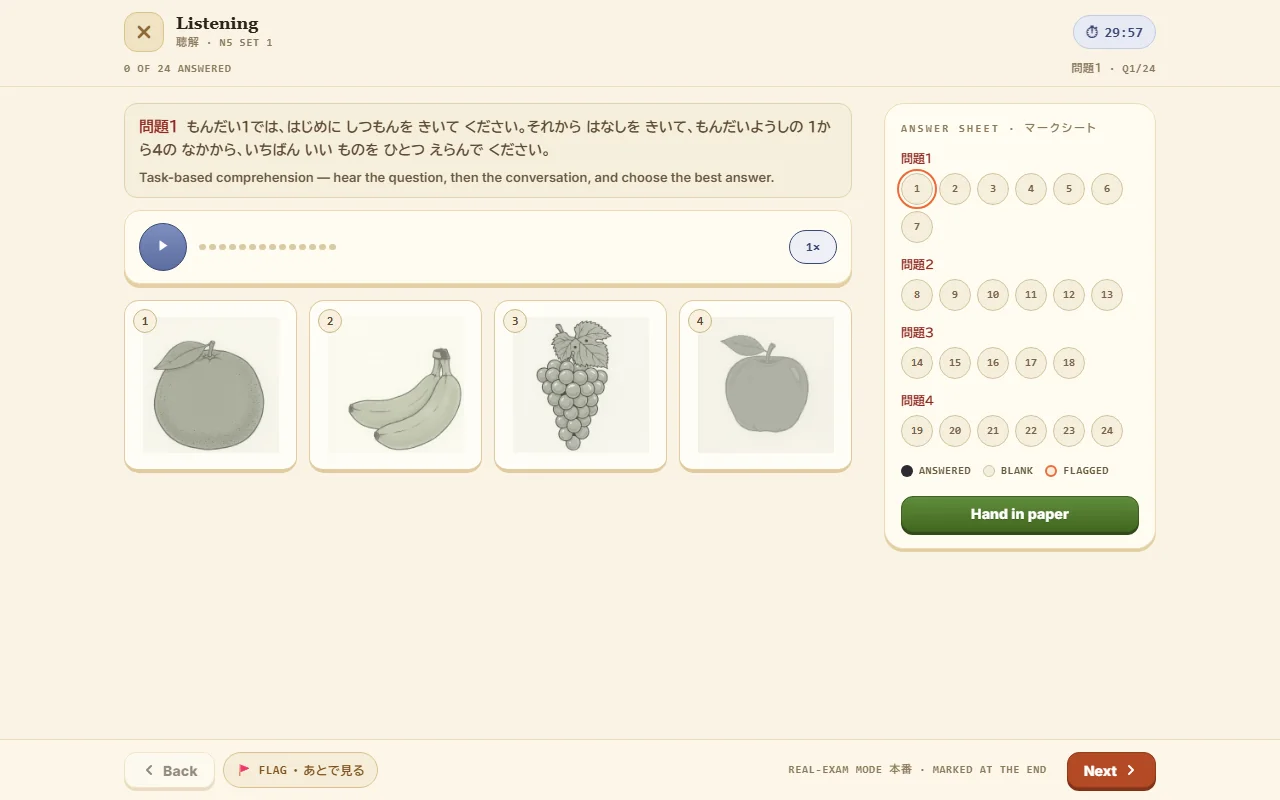
LenGaki’s N5 mock sets 1 and 2 are free on the website with no account: three papers each, timed to the official limits, with the official 問題 structure, an answer sheet and a full answer review.
Sit N5 set 1 freeOn mock day
- Your exam’s time of day; all three papers in order, at 20, 40 and 30 minutes, short breaks only.
- Phone in another room; no dictionary, no notes.
- On paper, use the workbook’s sample answer sheet and fill each circle fully in pencil.
- Play each recording once, without pausing; keep scripts closed until you hand in.
- Stuck? Guess, dot it, move on. Never leave a blank.
Review the same day or the next morning:
- Score each section as a percentage: vocabulary plus grammar-reading, then listening.
- Log every miss and dotted guess by paper and 問題.
- Name the cause and fix it: didn’t know (a flashcard today), misread (a one-line rule), out of time (a timed drill of that 問題) or a trap (note it).
- Read the script of every listening miss; with the workbook MP3s, replay and shadow it too.
- Give the next two weeks to the two 問題 with the highest error rate.
The full method is in our guide to JLPT mock tests.
What score do you need, and why does listening catch N5 candidates?
N5 is scored in two sections, and you need the overall pass mark and both sectional minimums: miss one minimum and you fail, whatever the total (official pass marks).
| Scoring section | Score range | You need at least |
|---|---|---|
| Language Knowledge (Vocabulary/Grammar)・Reading the vocabulary and grammar-reading papers together | 0–120 | 38 |
| Listening | 0–60 | 19 |
| Total | 0–180 | 80 |
Scores are scaled, not counts of right answers (FAQ), so read mocks as a percentage per section and aim for 60% or more in each; our N5 and N4 pass marks guide explains more. Listening is where N5 candidates get caught:
- It has its own floor. 90 of 120 plus 18 of 60 makes 108, far above 80, and still fails.
- Reading practice doesn’t carry over. The official N5 summary describes short, slowly spoken conversations, but you can’t reread them or lean on kanji.
- Almost half the paper prints no options. In 問題3 (hatsuwa hyōgen, verbal expressions) and 問題4 (sokuji ōtō, quick response) you hear three replies; for 問題4 the official workbook says えなどが ありません (e nado ga arimasen, “there are no pictures”).
- It comes last, after an hour of written papers. In 問題1 and 2 the question comes before the conversation: listen for it.
For dictation, shadowing and tactics, see our JLPT listening practice guide.
Which N5 mistakes cost the most points?
Five classic N5 traps, all in N5 words and grammar:
| Japanese | English | The trap |
|---|---|---|
| 休みは 四日から 八日までです。 やすみは よっかから ようかまでです。 | The holiday is from the 4th to the 8th. | よっか (4th) and ようか (8th) sound alike. Drill the special readings aloud: dates 1–10, 14, 20 and 24, and times such as 四時 (よじ, yoji) and 九時 (くじ, kuji). |
| えんぴつを 三本 買いました。 えんぴつを さんぼん かいました。 | I bought three pencils. | The counter 本 changes its sound: いっぽん, にほん, さんぼん. |
| 「もう ご飯を 食べましたか。」「いいえ、まだ 食べて いません。」 もう ごはんを たべましたか。いいえ、まだ たべて いません。 | “Have you eaten yet?” “No, not yet.” | “Not yet” is まだ〜ていません; 食べませんでした means “I didn’t eat” on some past occasion. |
| 「バスで 行きましょうか。」「雨ですから、タクシーで 行きましょう。」 バスで いきましょうか。あめですから、タクシーで いきましょう。 | “Shall we go by bus?” “It’s raining, so let’s take a taxi.” | In 問題1 the first idea is often dropped: answer with the plan still standing at the end. |
| 「いってきます。」「いってらっしゃい。」 | “I’m off.” “See you later.” | In 問題3 you choose what the person marked by the arrow says: the one leaving says いってきます. |
What should you cut if you fall behind?
Protect the daily listening, the three mocks with their reviews, and sleep. Cut the rest in this order:
- Writing kanji by hand. The JLPT is all multiple choice: read the N5 kanji in words; skip writing them.
- The long tail of the word list. N5 listening covers everyday and classroom topics, so finish those first: numbers, dates, times, counters, family, food, places, transport, common verbs and adjectives.
- New words after 15 November. More than a week behind? Stop adding words and meet all 82 grammar points on the list: grammar is tested directly and runs through every reading and listening question.
- Extra resources. One source per skill: no new textbook or app now, and no N4.
Starting late? Sit mock 1 in your first week, then keep the 8 and 22 November dates.
What should the last week before N5 look like?
Week 7: Monday 30 November to Sunday 6 December
- Mon–Tue, 45 minutes: error-log flashcards, one 20-minute vocabulary paper you have already sat, 15 minutes of listening.
- Wed–Thu, 30–45 minutes: dates, times, counters and the 問題3 set phrases, plus 15 minutes of listening.
- Fri, 30 minutes: light review. Check your test voucher for the venue and check-in time, and plan the route.
- Sat: 15 minutes with your error log, then stop and pack.
- Sun: the exam. Arrive early and fill every circle.
No new material and no new mocks: a bad score now leaves no time to act on it.
In India
N5 is in the afternoon session at the centres we checked (New Delhi, Chennai, Kolkata and Bengaluru), so sit the 22 November rehearsal in the afternoon. Your test voucher, which Indian hosts call the admit card or hall ticket, gives the reporting time for your centre; carry a printed copy. More in our JLPT India guide.
Outside India
Times are set locally and printed on your test voucher. AATJ says most US sites start around 1 pm, with check-in around 11 am on the West Coast; UK centres start in the late morning, and N3–N5 in Japan at 3:10 pm. Time your rehearsal to match.
The night before
- Pack your printed test voucher, photo ID (without it you cannot sit the test), wooden HB or No.2 pencils and a plastic eraser. Answer sheets marked in pen are invalid, and smartwatches cannot be used as a watch.
- Know your check-in time: arrive after it, or after a section starts, and you cannot sit that section, which means failing.
- Your phone stays off from check-in to the end, breaks included.
- Sleep at your usual time. For the day itself, see our JLPT exam day checklist.
Sources: jlpt.jp (date), test sections (times; listening can vary slightly), the Japan Foundation’s 2026 Test Guide (rules) and host institutions (local times).
Frequently asked questions
Can you pass JLPT N5 in 7 weeks?
Yes, if you already read kana and have studied part of the N5 syllabus. About an hour a day is enough for a first pass of the vocabulary, kanji and grammar plus three timed mocks; from zero, seven weeks rarely covers all of N5.
How many minutes a day should I study for JLPT N5?
With seven weeks left, 45–75 minutes a day suits most learners: reviews, new words and kanji, two or three grammar points and 15–20 minutes of listening. In the final week, taper from about 45 minutes a day to 15.
When should I take JLPT N5 mock tests before the December exam?
For the test on 6 December 2026, sit full timed mocks on 25 October, 8 November and 22 November, each with all three papers at 20, 40 and 30 minutes. Sit no new full mock in the final week.
What is the pass mark for JLPT N5?
You need 80 of 180 points overall, plus at least 38 of 120 in Language Knowledge (Vocabulary/Grammar)・Reading and 19 of 60 in Listening. Falling below either sectional minimum is a fail, whatever your total.
Are there free JLPT N5 mock tests?
Yes. LenGaki’s N5 mock sets 1 and 2 at lengaki.com/jlpt are free with no account, and the official JLPT website, jlpt.jp, has free sample questions and two Official Practice Workbooks with audio, answers and scripts.