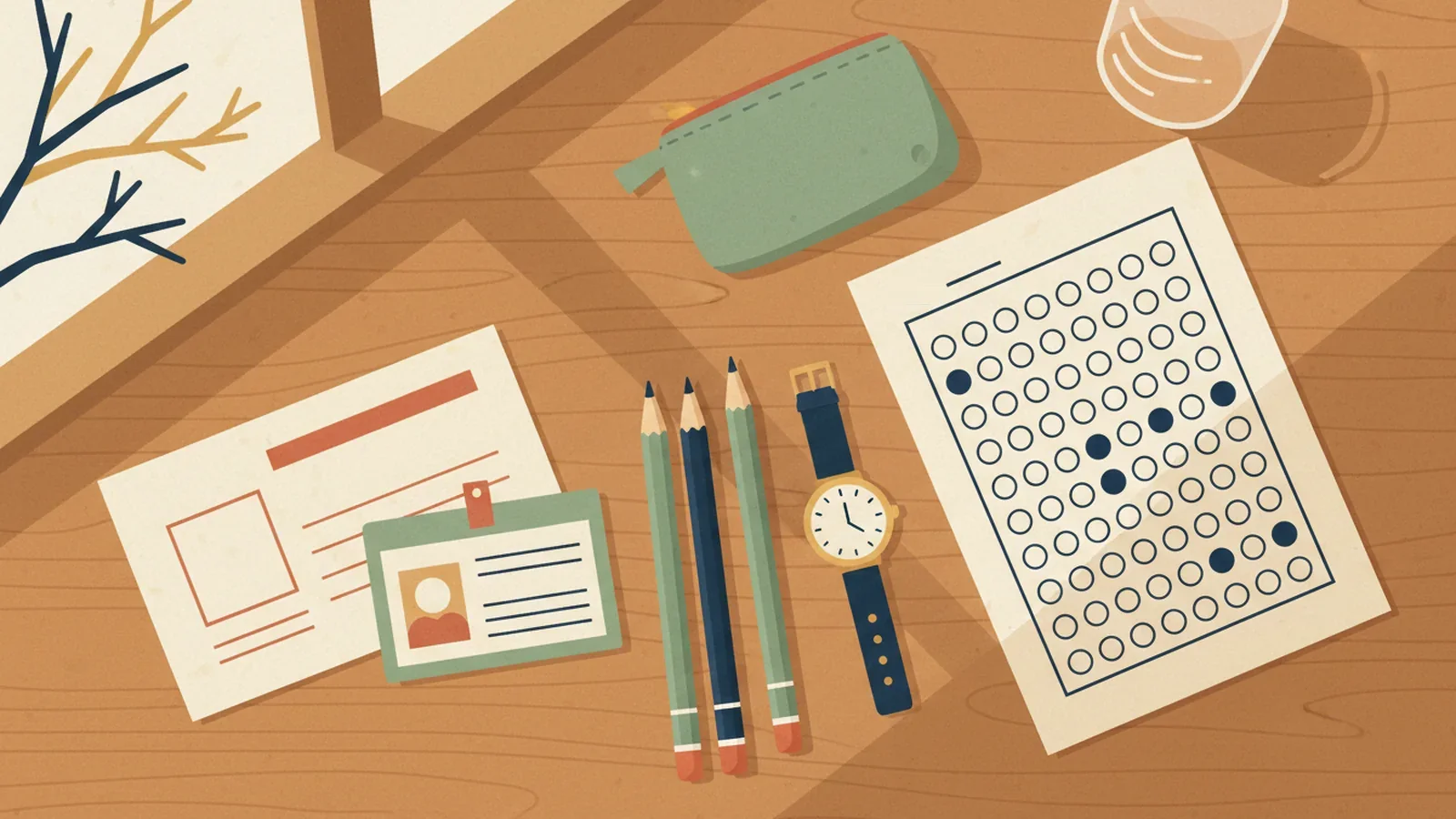
For the JLPT on Sunday, 6 December 2026, bring only your printed test voucher (in India usually called the admit card), an official photo ID, a few sharpened wooden HB or No.2 pencils, a plastic eraser and a plain watch that isn’t a smartwatch. Arrive before the check-in time on your voucher: since July 2026 you can’t sit a section if you arrive after check-in or after it starts, and missing any section means failing. Your phone stays off from the time you enter the test room until the listening section ends and everyone has left, breaks included.
What should you bring to the JLPT?
The Japan Foundation’s Test Guide for December 2026 is short and strict: “You may only bring the Test Voucher, writing utensils (medium-soft <No.2, HB, B or 2B> blacklead pencils and a plastic eraser) and photo identification”.
| Bring | The rule | Tip |
|---|---|---|
| Test voucher 受験票 (じゅけんひょう, jukenhyō) (India: admit card) | Shows your registration number, check-in time and test centre. | Bring it printed: Kolkata bans a soft copy on a phone. |
| Photo ID | A passport, driving licence or other official ID your host accepts. No ID, no test. | Bring the original of the ID you applied with; Chennai accepts nothing else. |
| Pencils | Medium-soft black-lead: No.2, HB, B or 2B. | Three wooden HB or No.2 pencils, sharpened at home: a sharpener isn’t on the list. |
| Plastic eraser | Plastic or gum only; no ink erasers. | Check that it erases cleanly without smudging. |
| A plain watch | Not on the list, but “Smartwatches can not be used as a watch.” | Indian hosts ask for a “normal” or “simple” watch; Chennai bans alarm and vibration watches too. |
Leave everything else at home, or switched off and out of reach:
- Your phone. The guide asks you not to bring devices. If you must, switch it fully off before you go in: silent or flight mode isn’t off. Some centres collect phones; Chennai bans them on site.
- Smartwatches, fitness bands, earphones, tablets and recorders. All count as devices.
- Pens and ink erasers. A pen-marked answer sheet is invalid.
Which JLPT rules can cost you the test?
None of these is about Japanese, and each can end your attempt.
- Arriving late. From July 2026, “if you arrive after the Check-in time or the designated start time of each subject, you will not be permitted to take the subject.” There’s no grace period, and missing any section means failing, so being late for the first section costs you the result. The same applies after each break.
- A device that isn’t off. Devices are banned from the official entry time “until the listening section has ended and all examinees have exited the room”. Touching one in a break is misconduct, and so is a phone that rings or vibrates in your bag (official notice).
- Writing in pen. “Answer sheets written with any kind of pen will be invalid.”
- Taking or sharing the questions. Taking the booklet home means failing; photographing it, or sharing questions or audio online, even afterwards, is misconduct.
How does the JLPT answer sheet work?
The answer sheet, 解答用紙 (かいとうようし, kaitō yōshi), is read by machine, so how you mark it matters.
- Before the test starts, you write your registration number and date of birth on it, fill in the matching circles and check the number against your voucher.
- Fill each circle completely, so the number inside can’t be seen; light or partial marks may not be read. The marking guide’s よいれい (yoi rei, correct example) is a solid circle; its わるいれい (warui rei, incorrect examples) include crosses, ticks, outlines and light grey fills.
- To change an answer, erase it cleanly with your plastic eraser.
- Mark each answer in the row numbered like the question. Rows are grouped by 問題 (もんだい, mondai, question part), and at N5 and N4 each listening 問題 begins with an example, れい, before question 1.
You may write notes in the question booklet, 問題用紙 (もんだいようし, mondai yōshi), but only the answer sheet is marked, so fill in each answer as you go.
What happens on JLPT day, and how long does it take?
Every level starts with language knowledge and ends with listening, each section timed separately. These are the official answering times:
| Level | Sections, in order | Answering time |
|---|---|---|
| N5 | Vocabulary 20 min · Grammar and reading 40 min · Listening 30 min | 90 min |
| N4 | Vocabulary 25 min · Grammar and reading 55 min · Listening 35 min | 115 min |
| N3 | Vocabulary 30 min · Grammar and reading 70 min · Listening 40 min | 140 min |
| N2 | Vocabulary, grammar and reading 105 min · Listening 50 min | 155 min |
| N1 | Vocabulary, grammar and reading 110 min · Listening 55 min | 165 min |
Listening can vary slightly with the recordings. The day itself runs longer, because instructions, collecting papers and breaks sit between the sections. In Kolkata, N3 to N5 check in from 12:00 to 12:20 pm, start at 1 pm and finish at 4 pm.
Expect this order:
- Check in with your voucher and photo ID, switch off your devices and find your seat.
- Sit the sections in order, with a break between each: three at N3 to N5, two at N1 and N2. Be back before each start time.
- After listening, papers are collected. Devices stay off until everyone has left the room.
How should you handle the listening section?
Listening comes last, when you’re tired, and has its own minimum score. The official sample questions and scripts show how its question types work at N5 and N4:
- 問題1 and 問題2: you hear the situation and the question, then the conversation, then the question again, and choose from four options printed in your booklet. Look over them while the question is read and notice how they differ, such as a time, a place or an object: that’s what to listen for.
- 問題3 and 問題4: the three answer choices are spoken. Hear all three before you decide, jotting ○ or × beside each number in your booklet, never on the answer sheet.
If you lose a question, mark your best guess at once and move on: an empty circle can’t score. Practise in full, timed sittings without pausing, with the free official sample questions and our JLPT listening guide.
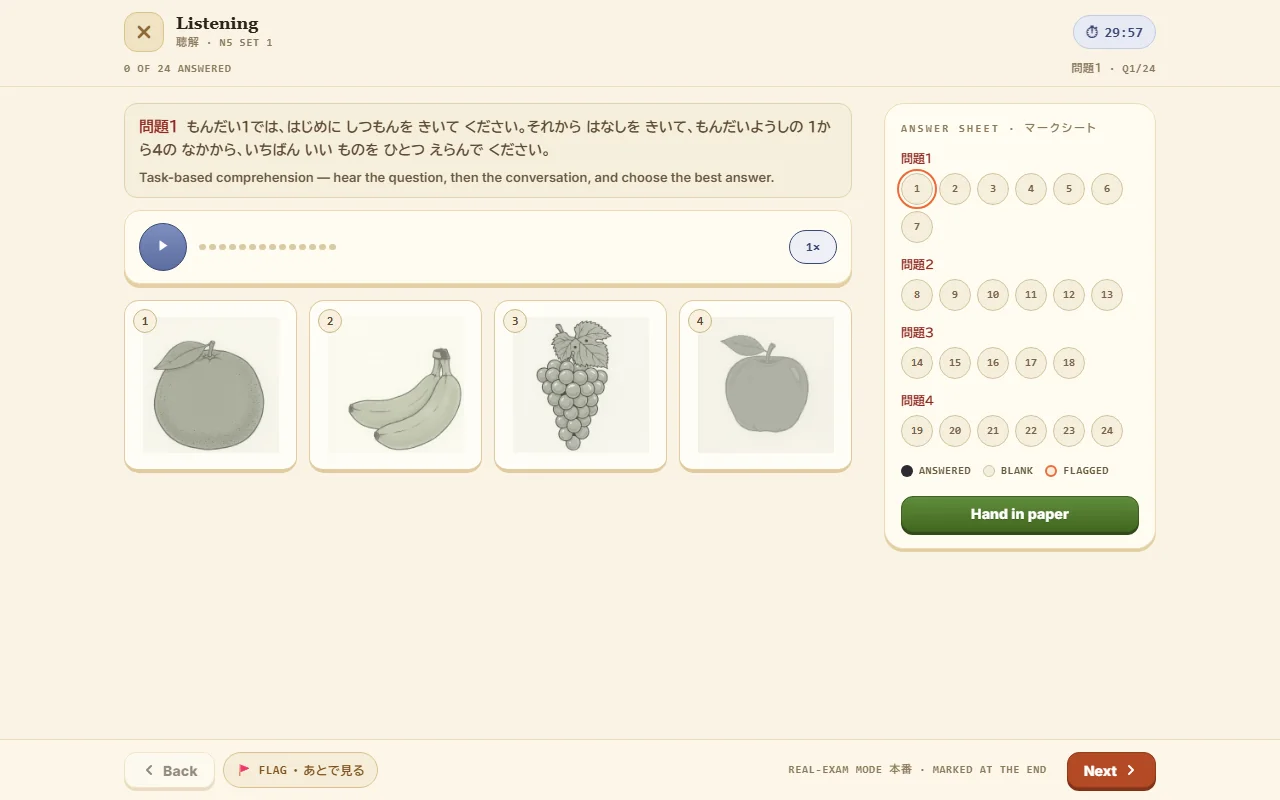
LenGaki (lengaki.com) is a Japanese-learning website and Android app that takes learners from their first hiragana to the JLPT, and its mock exams let you rehearse the papers’ timing and layout at home.
LenGaki’s N5 and N4 mock exams are timed to the official limits, follow the official 問題 structure and include an answer sheet, a score and a full answer review. N5 sets 1 and 2 are free on the website; N5 set 3 and the N4 sets come with Pro.
Sit a free N5 mockWhat Japanese will you see on JLPT day?
Written instructions are in Japanese, mostly with English alongside. The voucher and the N5 answer sheet print these words in hiragana; the N5 and N4 question booklets use kanji with small readings above them.
| Japanese | Reading | Meaning | Where you’ll see it |
|---|---|---|---|
| 受験票 | じゅけんひょう jukenhyō | test voucher (admit card) | Your voucher |
| 受験番号 | じゅけんばんごう juken bangō | examinee registration number | Voucher, booklet, answer sheet |
| 受付時間 | うけつけじかん uketsuke jikan | check-in time | Voucher |
| 試験会場 | しけんかいじょう shiken kaijō | test venue | Voucher |
| 問題用紙 | もんだいようし mondai yōshi | question booklet | Booklet cover |
| 解答用紙 | かいとうようし kaitō yōshi | answer sheet | Answer sheet |
| 注意 | ちゅうい chūi | notes, instructions | Booklet cover |
| 聴解 | ちょうかい chōkai | listening | Listening booklet and answer sheet |
Two lines from the covers of the official sample booklets:
- この問題用紙を持って帰ることはできません。 (この もんだいようしを もって かえる ことは できません。) You can’t take this question booklet home.
- この問題用紙にメモをとってもいいです。 (この もんだいようしに メモを とっても いいです。) You may make notes in this question booklet.
And the voucher’s own checklist: しけんの ひの もちもの:じゅけんひょう、くろい えんぴつ、けしごむ、しゃしんつきの みぶんしょうめいしょ (things to bring on test day: test voucher, black pencil, eraser, photo ID).
Taking the JLPT in India: what should you check?
In India the voucher is usually called the admit card or hall ticket, and each host sends its own:
- New Delhi (MOSAI): dispatched in November 2026, with your centre details.
- Chennai (ABK-AOTS DOSOKAI): sent to your registered email.
- Kolkata (IJWCA): by post, or collected at the office if you chose that.
- Bengaluru (BNK): venue and seat printed on the hall ticket closer to the exam date.
- Pune, Mumbai (JALTAP) and Karur: we couldn’t find December details on their official websites, so ask your host.
Print it, however it arrives. Kolkata wants “only original hard copy of Admit Card, Photo ID, Pencils and erasers normal watch”, and no soft copies on phones in the test room. The official voucher asks you to report mistakes in your name, gender or date of birth to your host by 6 November 2026; if yours arrives later and something is wrong, contact your host at once.
At every centre that has published details, N1 and N2 sit in the morning and N3 to N5 in the afternoon, but the times differ:
| Centre (host) | N1 and N2 (morning) | N3, N4 and N5 (afternoon) |
|---|---|---|
| New Delhi (MOSAI) | Morning session | Afternoon session; detailed schedule “coming soon” |
| Chennai (ABK-AOTS DOSOKAI) | Gate check-in 8:05–8:30 am, seated by 8:40, exam 9:00 am | Gate check-in 12:05–12:30 pm, seated by 12:40, exam 1:00 pm |
| Kolkata (IJWCA) | Check-in 8:00–8:20 am, start 9:00 am, finish 12 noon | Check-in 12:00–12:20 pm, start 1:00 pm, finish 4:00 pm |
| Bengaluru (BNK) | Reporting 7:45 am, exam 8:30 am | Reporting 12:15 pm, exam 1:00 pm |
As published by each host by 14 October 2026. Your admit card has the final time.
Chennai’s instructions also ban phones anywhere on the premises, allow no bags except a small pouch, and keep parents outside the gates. Chennai and Kolkata split levels across two venues, so check yours. For centres, fees and registration, see our guide to the JLPT in India.
Taking the JLPT outside India: what should you check?
Your host sets the check-in time and venue. Find it on the official list of overseas test cities and read its exam-day page, since hosts can add rules.
- USA (AATJ): vouchers download from your account in early November. At most sites check-in starts around noon and the test around 1 pm (West Coast check-in around 11 am). AATJ says mechanical pencils aren’t prohibited but may damage the answer sheet, and recommends regular #2 pencils.
- UK: SOAS wants you in the exam room by 11:00 am, Edinburgh’s check-in closes at 11:30 am, and Leicester starts at 11:30 am with no late arrivals.
- Japan (JEES): vouchers are mailed by 20 November and on MyJLPT from 17 November; N3 to N5 start at 3:10 pm.
What happens after the JLPT?
- Results: online by around the end of January 2027, says the Test Guide. You need your registration number (on your voucher) and the 8-digit passcode from your application, so keep both. No exact date has been announced.
- Certificates: outside Japan, everyone gets a Certificate of Result and Scores through their host by mid-March 2027, says the Test Guide, and passers also get a Certificate of Japanese-Language Proficiency. If nothing arrives by the end of March, contact your host. In the USA, AATJ says passers’ certificates come around the end of March or by the end of April.
To pass you need the overall mark and every sectional minimum; see JLPT N5 and N4 pass marks. For the whole calendar, see JLPT December 2026: exam date, admit card, timings and results. The JLPT runs in July and December, though some cities hold only one (US sites are December only), and no July 2027 date has been announced yet.
What should you do the night before?
Night-before checklist
Then sleep. With weeks still to go, follow our N5 7-week study plan or N4 7-week study plan, and sit one full mock at the same time of day as your test.
Frequently asked questions
Can I bring my phone to the JLPT?
The Japan Foundation asks you not to bring one, and some centres ban phones on site or collect them. If you do bring it, it must stay switched off from the time you enter the test room until the listening section has ended and everyone has left, breaks included; a phone that rings or vibrates counts as misconduct even if you never touch it.
What happens if I am late for the JLPT?
Since the July 2026 test, you can’t sit a section if you arrive after the check-in time or after that section has started. Missing any section means failing, so being late for the first section costs you the result.
Can I use a pen or a mechanical pencil in the JLPT?
Not a pen: answer sheets written with any kind of pen are invalid. The official Test Guide lists medium-soft black-lead pencils (No.2, HB, B or 2B) and doesn’t mention mechanical pencils, so bring ordinary wooden HB or No.2 pencils.
Is a soft copy of the JLPT admit card accepted?
Don’t rely on one. The Kolkata host doesn’t allow a soft copy of the admit card or photo ID on a phone in the test room, so bring the printed test voucher and your original ID.
Can I write notes in the JLPT question booklet?
Yes. The official sample question booklets say you may make notes in them, but only your answer sheet is marked, and the booklet must stay in the test room.
When will the December 2026 JLPT results be released?
Outside Japan, the Japan Foundation says results will be on the JLPT website by around the end of January 2027, and you need your registration number and 8-digit passcode to see them. Certificates come through your local host institution by mid-March 2027.