
Seven weeks can be enough to pass JLPT N4 on Sunday, 6 December 2026, if your N5 is solid. Study 60–90 minutes a day, finish N4 grammar by the end of week 4 and the vocabulary and kanji by week 5, read and listen daily from week 1, and sit full mocks at the official 25, 55 and 35 minutes until two weeks before the test. You pass with 90 of 180 overall, plus at least 38 of 120 in language knowledge and reading and 19 of 60 in listening.
Who this plan is for
You passed N5, or know its material well, and you are registered for N4 on 6 December 2026. Registration has closed in most places; if you missed it, the next test is expected in July 2027 (no date announced yet). Our JLPT December 2026 guide has the full timeline. Sitting N5? Use the N5 seven-week plan. Months to go? See the longer N5, N4 and N3 plan.
What does N4 add to N5?
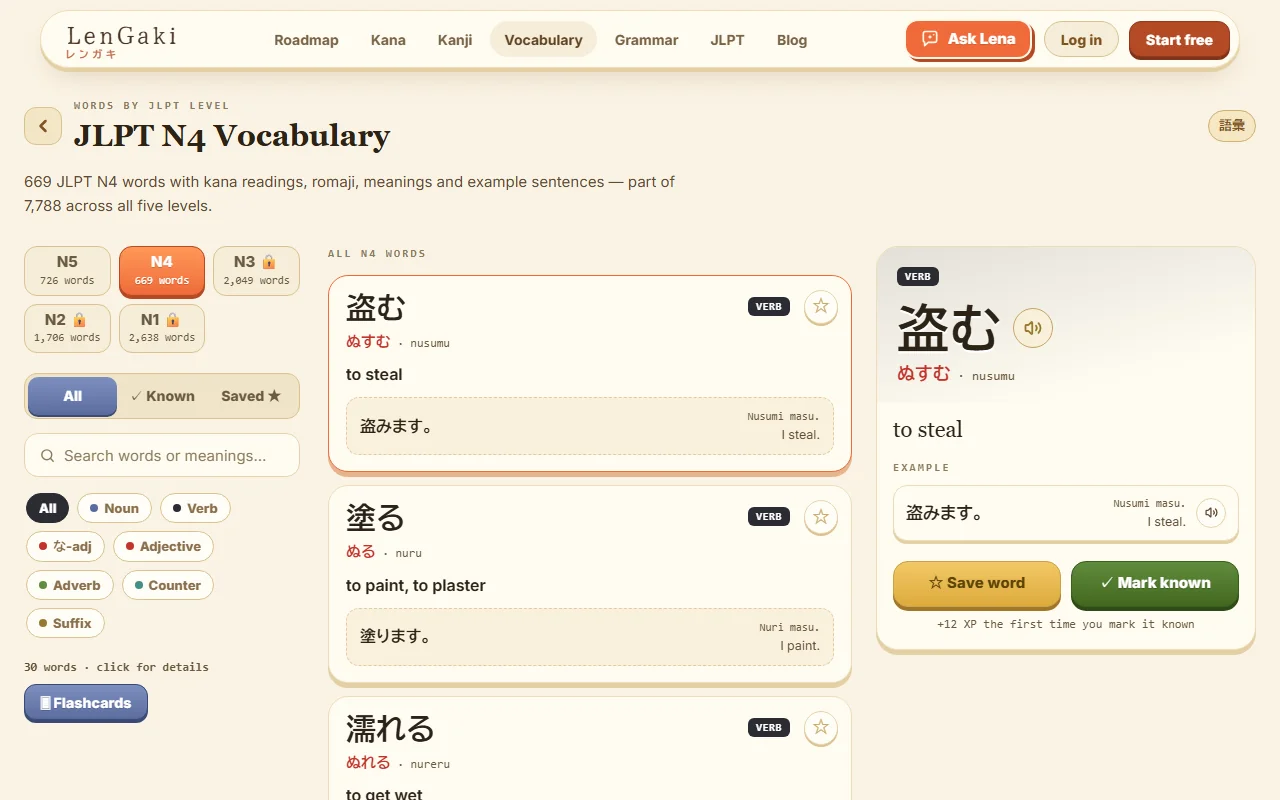
About as many words again as N5, and more kanji and grammar. The JLPT has published no official word, kanji or grammar lists since 2010 (official FAQ), so these are LenGaki’s own counts:
| LenGaki list | N5 | N4 adds | N5 + N4 |
|---|---|---|---|
| Vocabulary | 726 words | 669 words | 1,395 words |
| Kanji | 124 | 156 | 280 |
| Grammar points | 82 | 139 | 221 |
The exam changes too:
| Feature | N5 | N4 |
|---|---|---|
| Section times | 20 / 40 / 30 min | 25 / 55 / 35 min |
| Overall pass mark | 80 / 180 | 90 / 180 |
| Section minimums | 38 / 120 and 19 / 60 | The same |
| Vocabulary question types | Four | Five: adds 用法 (yōhō, usage), picking the sentence that uses a word correctly |
| Reading texts (approx.) | 80, 250 and 250 characters | 100–200, 450 and 400 characters |
Sources: test sections, pass marks, official N5 and N4 test-item guides.
The bigger jump is grammar. N4 builds on the plain form and changes the verb itself: potential 読める (yomeru, can read), volitional 読もう (yomō, let’s read), passive 読まれる (yomareru, is read) and causative 読ませる (yomaseru, makes someone read). Add four ways to say “if” and giving and receiving, and that is most of the hard part; our N4 grammar list sorts it all.
How many minutes a day do you need for N4?
Plan on 60 minutes on weekdays and 90 when you can, longer on mock Sundays. A 75-minute day:
- 20 minutes, words and kanji: reviews first, then new cards; read kanji inside words rather than writing them.
- 20 minutes, grammar: new points until week 4, then contrast pairs and timed drills.
- 15 minutes, reading, always against a timer.
- 15–20 minutes, listening, at full speed, no replay the first time.
From zero N4, that means about 19 words, 4 or 5 kanji and 5 grammar points a day. You need half the points, not all: if you fall behind, protect grammar and listening.
What is the week-by-week N4 study plan?
Weeks run Monday to Sunday, ending on exam day. Before 19 October, download the two official workbooks and try the free sample questions. Starting later? Join at the current week and cut what you missed; don’t cram it. Where a cell names no resource, use the one above it.
Each paper is split into numbered question sections, 問題 (mondai). The four in listening are 課題理解 (kadai rikai, task-based), ポイント理解 (pointo rikai, key points), 発話表現 (hatsuwa hyōgen, verbal expressions) and 即時応答 (sokuji ōtō, quick response).
| Week | Min / day | Vocabulary and kanji | Grammar | Reading speed | Listening |
|---|---|---|---|---|---|
| Week 119–25 OctMock 1 on Sunday | 60–90 | 135 words (19 a day) and 30 kanji, learned through the words that use them→ LenGaki N4 words, N4 kanji and flashcards (Pro), or your textbook | Plain forms, then potential, volitional, てしまう (te shimau, end up doing), ておく (te oku, do in advance) and てみる (te miru, try doing)→ Free pages in the N4 grammar list | The first paragraph of one article a day (about 100–200 characters), timed→ NHK News Web Easy (free) | 15 minutes of easy audio a day; each N4 question type once→ jlpt.jp sample questions (free) |
| Week 226 Oct–1 NovReview mock 1 | 60–90 | Next 135 and 30 (270 and 60 so far) | Passive, causative, causative-passive; と・たら・ば・なら (to, tara, ba, nara: “if”) and ても (te mo, even if) | Re-read mock 1’s texts aloud against the clock | Mock 1’s 問題3–4: listen, write it down, check the script, shadow→ The workbook’s audio and script (free) |
| Week 32–8 NovMock 2 on Sunday | 60–90 | Next 135 and 30 (405 and 90) | Giving and receiving, あげる・くれる・もらう (ageru, kureru, morau), with their て-forms; hearsay and guesses, そうだ・らしい・みたい・はず・かもしれない (sō da, rashii, mitai, hazu, kamo shirenai) | One 400–500-character article a day, down to 5 minutes→ NHK News Web Easy | Mock 1’s 問題2: read the question in the pause, then listen for the reason |
| Week 49–15 NovMock 3 on Sunday | 60–90 | Next 135 and 30 (540 and 120) | Honorific and humble, いらっしゃる・お〜になる・いたす (irassharu, o-… ni naru, itasu); time and purpose, 間に・うちに・ために・ように (aida ni, uchi ni, tame ni, yō ni). All 139 met once | Question first: redo the reading (問題4–6) of mocks 1 and 2 in 30 minutes | Mock 1’s 問題1: who does what, and what changes after でも (demo, but) |
| Week 516–22 NovMock 4 on Sunday | 60–90 | Last 129 and 36: all 669 and 156 done | No new points. Contrast pairs: ので / から (node / kara, because), のに / けど (noni / kedo, although / but), そうだ / 〜そう (sō da / -sō, I hear / it looks like) | An article a day in 5 minutes; mock 3’s reading redone in 25 | Mock 1’s or 2’s full listening paper again, midweek; 15 minutes on other days |
| Week 623–29 NovSingle papers only | 60 | Reviews, plus error-log words as cards | Error-log points; timed 問題1–3 sets | A timed reading section every other day | 20 minutes a day, all four 問題 |
| Week 730 Nov–6 DecExam on Sunday | 30–45 | Reviews only | Re-read your error log | One short text a day | 15 minutes a day, nothing new |
The listen-and-shadow loop and more audio are in our JLPT listening guide. Not using LenGaki? Any N4 textbook’s lists do the same job; see our N4 and N3 book guide.
When should you sit each N4 mock, and how do you review it?
Sit every full mock in one go: papers in order, phone in another room, answers on an answer sheet, at the official 25, 55 and 35 minutes (official test times). LenGaki’s N4 sets are timed to those limits; for paper, keep a clock in view.
| Date | Sitting | Paper |
|---|---|---|
| Sun 25 Oct | Mock 1: baseline | Official Practice Workbook (2012), free |
| Sun 8 Nov | Mock 2: did your fixes work? | LenGaki N4 set 1 (Pro). Free: re-sit mock 1’s weakest paper |
| Sun 15 Nov | Mock 3: trend | LenGaki N4 set 2 (Pro). Free: timed drills of your weakest 問題 |
| Sun 22 Nov | Mock 4: dress rehearsal, at your exam’s start time | Official Practice Workbook Vol. 2 (2018), free |
| 23–29 Nov | Single papers, for pace | LenGaki N4 set 3, one paper on each of three days (Pro) |
Mock 1 comes early on purpose: once reviewed, its audio and texts become your drills.
Both workbooks are free on jlpt.jp with audio, answers and scripts (workbook page), but they predate the shorter papers of December 2020 (official FAQ): their first two papers have 34 or 35 questions each. Keep the official clock anyway: when time runs out, draw a line, finish in another colour and score both ways, for pace and for knowledge.
The review routine
- Mark it the same day, score each section as a percentage, and log every wrong answer and lucky guess by paper and 問題.
- Name the cause: didn’t know, misread, ran out of time, or changed a right answer.
- Fix by cause: a flashcard, a rule at the top of your log, or a timed drill of that 問題.
- A week later, redo every logged question with the answers covered.
The full method is in how to use JLPT mock tests.
LenGaki’s three N4 mock sets (Pro) have all three papers, listening audio included, timed to the official limits, with the official 問題 structure, an answer sheet, a score and a full answer review.
See the N4 mock setsWhat scores do you need to pass N4?
Two bars at once: the overall pass mark and a minimum in each scoring section (official pass marks).
| N4 scoring section | Range | Minimum |
|---|---|---|
| Language Knowledge (Vocabulary/Grammar)・Reading | 0–120 | 38 |
| Listening | 0–60 | 19 |
| Total | 0–180 | 90 |
The first section combines the vocabulary paper with the grammar and reading paper. Score 85 of 120 there and 18 of 60 in listening: 103 is well above 90, and still a fail.
Scores are scaled, so no mock converts exactly; work in percentages. The bars are 50% overall and about 32% per section, and our rule of thumb for mocks is 60% in every section. More in JLPT N5 and N4 pass marks.
What does N4 grammar look like in real sentences?
Six typical N4 patterns in short, everyday sentences. Each links to its free LenGaki page.
| Pattern | Example |
|---|---|
| Potential + 〜ようになるyō ni naru: come to be able to | 漢字が少し読めるようになりました。かんじが すこし よめるように なりました。I can now read a little kanji. |
| 〜てしまうte shimau: end up doing, often with regret | 電車に傘を忘れてしまいました。でんしゃに かさを わすれて しまいました。I went and left my umbrella on the train. |
| Passive 〜られるrareru: done to you; 食べられる (taberareru) can also mean “can eat” | 弟にケーキを食べられました。おとうとに ケーキを たべられました。My little brother ate my cake (and I was not pleased). |
| Causative 〜させるsaseru: make or let someone do | 母は私に野菜を食べさせました。はは は わたしに やさいを たべさせました。My mother made me eat vegetables. |
| そうだ / 〜そうsō da / -sō: I hear / it looks like | 明日は雨が降るそうです。あしたは あめが ふる そうです。I hear it will rain tomorrow.雨が降りそうです。あめが ふりそうです。It looks like it is going to rain. |
| 〜ておくte oku: do in advance | 試験の前の日に、かばんに鉛筆と消しゴムを入れておきます。しけんの まえの ひに、かばんに えんぴつと けしゴムを いれて おきます。The day before the exam, I will put pencils and an eraser in my bag. |
Three mistakes that cost N4 points
- Writing kanji by hand. The JLPT is all multiple choice (official FAQ): learn readings and meanings.
- Leaving listening for the end. It has its own minimum and takes the longest to improve.
- Dropping N5 review. N4 texts are built on N5 words and grammar.
What should you do in the last week and the night before?
30 November to 6 December
- Monday to Wednesday: 30–45 minutes of error log, flashcards and listening; at most one timed paper.
- Thursday and Friday: check your route and the check-in time on your test voucher (受験票, jukenhyō; in India, the admit card). Arrive late and you cannot sit that section (Japan Foundation test guide, p.10); miss any section and you fail (results page).
- Saturday, the night before: pack the voucher, photo ID, HB or No.2 pencils and a plastic eraser (guide, p.20), plus a plain watch if you like: smartwatches can’t be used as one. Light review, usual bedtime.
- Sunday 6 December: eat, leave early, and keep your phone off from the moment you go in, breaks included.
In India
At the centres we checked (New Delhi, Chennai, Kolkata and Bengaluru), N3, N4 and N5 sit in the afternoon, from 1 pm in the last three, so rehearse in the afternoon. Take a printed admit card: Kolkata, for one, refuses a copy on your phone.
Outside India
Start times are set locally and printed on your voucher: Leicester begins at 11:30 am, most US sites around 1 pm, and N4 in Japan at 3:10 pm. Rehearse at your own start time, bring the voucher printed, and read our JLPT exam day checklist.
Where does LenGaki fit, and what is free?
LenGaki (lengaki.com) is a Japanese learning website and Android app that takes learners from their first hiragana to the JLPT, with a roadmap, kanji, vocabulary, grammar, flashcards, quizzes, mock exams and an AI tutor, Lena. For N4:
- Free, no account: every grammar and kanji page, the first 30 entries of each N4 list, and N5 mock sets 1 and 2 at lengaki.com/jlpt.
- Free account: all N5 lists, flashcards and quizzes, and Lena, 3 messages a day.
- Pro (a small monthly price, cancel anytime): full N4 lists, flashcards and quizzes, the full grammar path, the three N4 mock sets and unlimited Lena (pricing).
LenGaki’s printed books cover N5 only.
Frequently asked questions
Can you pass JLPT N4 in 7 weeks?
Yes, if your N5 is solid and you study 60–90 minutes a day, with daily reading and listening and timed mocks. You need 90 of 180 overall, plus at least 38 of 120 in Language Knowledge (Vocabulary/Grammar)・Reading and 19 of 60 in Listening.
How many words, kanji and grammar points are in JLPT N4?
The JLPT has published no official lists since 2010. LenGaki’s lists add 669 words, 156 kanji and 139 grammar points at N4, on top of its N5 lists of 726 words, 124 kanji and 82 grammar points.
How long is the JLPT N4 exam?
Vocabulary takes 25 minutes, Grammar・Reading 55 and Listening 35, so 115 minutes of test time plus instructions and breaks. Listening can vary slightly with the length of the recordings.
Where can I find free JLPT N4 practice tests?
jlpt.jp has free sample questions for each N4 question type, and two Official Practice Workbooks as free PDFs with audio, answers and scripts. Both predate the shorter papers of December 2020, so their first two papers are longer than today’s.
Are LenGaki’s N4 mock exams free?
No. LenGaki’s three N4 mock sets and the full N4 vocabulary and kanji lists come with Pro; signed out, you see the first 30 entries of each list. Every grammar and kanji page is free to read, and N5 mock sets 1 and 2 are free at lengaki.com/jlpt.
What should I do the night before the JLPT?
Pack your test voucher, photo ID, HB or No.2 pencils and a plastic eraser, check your route and check-in time, then do light review and sleep at your usual time. Late arrivals cannot sit a section, and missing any section means failing.