
Treat a JLPT mock test as a measurement, not a lesson. Sit your first full mock about eight weeks before the exam, take all three papers in one timed sitting (at N5: 20, 40 and 30 minutes), score each section against its minimum, and spend the next two weeks fixing what your error log shows before you sit another. To pass N5 you need 80 of 180 points overall, plus at least 38 of 120 in language knowledge and reading and 19 of 60 in listening; N4 asks for 90 overall with the same two minimums.
Where mock tests usually go wrong
Too few, too late, untimed, and judged by the total alone. Each hides what a mock (模試, moshi) is for: showing which 問題 (mondai, question section) costs you points, and whether your last fixes worked.
When should you start taking JLPT mock tests?
After your first full pass through the level’s material, not before: a full mock in month one mostly measures what you have not studied yet, and uses up a paper you will want later. Plan for that first pass to end eight to ten weeks before the exam. If you are sitting the JLPT in early December, mid-October is about eight weeks out.
You are ready for mock one when:
- you read hiragana and katakana without slowing down;
- you have met most of the N5 grammar at least once (LenGaki’s N5 grammar list has 82 points);
- you have done some listening at natural speed, not only read transcripts.
Want to see the format sooner? The official sample questions on jlpt.jp show every question type without spending a full mock. For where to find full-length mocks, free and paid, see our guide to free JLPT mock tests online.
How do you simulate JLPT exam day at home?
Copy the real conditions: pace and pressure are part of what the JLPT tests. These are the official N5 times, in use since the December 2020 test:
| N5 paper | Time | Questions (LenGaki N5 set) | Pace to aim for |
|---|---|---|---|
| 言語知識(文字・語彙) gengo chishiki (moji・goi), vocabulary | 20 min | 21 | About 40 seconds an item, leaving 5 minutes to check |
| 言語知識(文法)・読解 gengo chishiki (bunpō)・dokkai, grammar and reading | 40 min | 22 (17 grammar, 5 reading) | 15 minutes for grammar, 20 for reading, 5 spare |
| 聴解 chōkai, listening | 30 min | 24 | Set by the audio: answer in the pause, then move on |
| Total | 90 min | 67 |
The official guide fixes the times and question types; the counts are those of a LenGaki N5 set. Listening can run slightly over or under 30 minutes, depending on the recordings.
N4 is longer: 25 minutes for vocabulary, 55 for grammar and reading and 35 for listening, according to the official test sections page. Not every practice paper has caught up with the shorter limits introduced in December 2020, so whatever you practise with, stop yourself at the official time.
Exam conditions, at home
- Same time of day as your real exam; all three papers in one sitting, in order, with only short breaks.
- A wall clock or plain timer in view; your phone in another room.
- Answers on the answer sheet, in pencil, as you go. The real マークシート (māku shīto, mark sheet) is grouped by 問題, so practise finding your row.
- No dictionary, no notes, no pausing, and each listening track heard once, with no replays.
- Stuck? Guess, put a dot in the margin, move on.
- Every bubble filled before time is called: a blank can never score.
N5 time management, paper by paper
- Vocabulary. Anything past a minute gets a guess and a dot; spend the spare minutes at the end on the dots and on checking every answer sits in the right row.
- Grammar and reading. Do the grammar (問題1–3) briskly to bank time for the reading (問題4–6). The texts are short (about 80 characters for short passages and 250 for the others, per the official guide), so the time goes on understanding, not reading speed. Read the question before the text, especially in 問題6 情報検索 (jōhō kensaku, information retrieval).
- Listening. The audio sets the pace. Use the pause before each item to look at the pictures or options, answer as soon as you know, and let a missed item go: the next one is already starting.
What are the JLPT pass marks for N5 and N4?
You pass only by clearing two bars at once: the overall pass mark and a sectional pass mark in each scoring section. At N5 and N4 those sections are Language Knowledge (Vocabulary/Grammar)・Reading, which combines the first two papers, and Listening.
| Level | Overall pass mark | Language Knowledge (Vocabulary/Grammar)・Reading | Listening |
|---|---|---|---|
| N5 | 80 / 180 | 38 / 120 | 19 / 60 |
| N4 | 90 / 180 | 38 / 120 | 19 / 60 |
The section minimums catch people who never expected to fail. At N5, 95 of 120 in language knowledge and reading plus 17 of 60 in listening makes 112: far above 80, and still a fail, because 17 is below 19.
Two cautions when you read your own score. The JLPT reports scaled scores, not a count of correct answers, so no mock converts exactly. And a quiet room at home is kinder than a test hall. So work in percentages per section, and leave a margin:
- The real bars are about 44% overall at N5 (80 of 180) and 50% at N4 (90 of 180), and about 32% in each section (38 of 120, 19 of 60).
- Our rule of thumb for mocks: 60% or more in every section is comfortable, anything between the minimum and 60% is borderline, and below the minimum in any section is a fail, whatever the total says.
LenGaki’s N5 mock sets 1 and 2 are free and need no account: three papers each, timed to the official N5 limits, with the official 問題 structure and an answer sheet. Set 1 makes a good baseline.
Sit N5 set 1 freeHow should you review a JLPT mock test?
Mark it the same day and review it within 24 hours, while you still remember why you chose each answer. Keep an error log organised by 問題: each question type goes wrong for its own reasons and needs its own fix.
- Log every wrong answer and every lucky guess. The dots in the margin count: a right guess is an error you got away with.
- Write down the trap. Paper, 問題, question number, what you chose and what was right.
- Name the cause. You didn’t know it, misread it, ran out of time, or talked yourself out of a right answer. Those need different fixes: study, slower reading, pacing drills, trusting your first answer.
- Rank by error rate, not by count. Divide the errors in each 問題 by its number of questions. Two wrong out of three in 問題4 言い換え類義 (iikae ruigi, paraphrases) is 67%; three wrong out of seven in 問題1 漢字読み (kanji yomi, kanji reading) is 43%. The paraphrases get your next two weeks.
Here is what a page of an N5 error log looks like:
| Paper · 問題 | What happened | Cause | Fix |
|---|---|---|---|
| Vocabulary · 問題1 漢字読み kanji yomi, kanji reading | Read 六百 as ろくひゃく; it is ろっぴゃく (roppyaku, 600) | Misread: sound change | Drill numbers with their sound changes: 三百 さんびゃく (sanbyaku), 六百 ろっぴゃく, 八百 はっぴゃく (happyaku) |
| Vocabulary · 問題2 表記 hyōki, orthography | Chose 体み for やすみ; the answer is 休み (yasumi, a day off) | Look-alike kanji | Write 休 and 体 side by side; 体 (karada, body) has one more stroke |
| Vocabulary · 問題3 文脈規定 bunmyaku kitei, contextually-defined expressions | ぼうしを( ) (bōshi o, “a hat …”): chose きます; the answer is かぶります (kaburimasu, to put on a hat) | Didn’t know | Learn wearing verbs as a set: きます (kimasu) for shirts, はきます (hakimasu) for shoes and trousers, かぶります for hats, かけます (kakemasu) for glasses |
| Grammar · 問題2 文の組み立て bun no kumitate, sentence composition | Built the sentence correctly, then marked the wrong slot | Process | Write the full word order in the margin first, then mark only the word in the ★ slot |
| Reading · 問題6 情報検索 jōhō kensaku, information retrieval | Ran out of time on the notice question | Pace | Read the question first, then scan the notice for that one detail |
| Listening · 問題1 課題理解 kadai rikai, task-based comprehension | Chose the first plan mentioned; the speaker changed it after でも | Trap | Listen for change words such as でも (demo, but) and やっぱり (yappari, on second thought) |
Every “didn’t know” becomes a flashcard the same day; every “misread” becomes a rule at the top of the page, such as “check the small っ (tsu) and long vowels”; every “pace” becomes a timed drill of that one 問題.
How often should you retake JLPT mock tests?
Two different things get called a retake. A fresh mock, a paper you have never seen, is a measurement. A re-sit is practice: you remember answers, so its score is inflated.
- Fresh full mocks: about one every two weeks, never more than one a week, so there is time to fix what the last one showed.
- Re-sits: at least three weeks later, only your weakest paper, judged by whether you can explain every answer and finish with time to spare.
- How many: three fresh mocks is a useful minimum for one level; four or five is plenty.
| Weeks out | What you do | What it is for |
|---|---|---|
| 8 | Fresh mock 1, all three papers | Baseline; start the error log |
| 7 | Study the two 問題 with the highest error rates | Fixing, not measuring |
| 6 | Fresh mock 2 | Did the fixes work? |
| 5 | Optional: re-sit mock 1’s weakest paper | Pace and process, not score |
| 4 | Fresh mock 3 | Trend for each section |
| 3 | Error-log drills | Close the remaining gaps |
| 2 | Fresh mock 4, at your exam’s start time | Dress rehearsal |
| 1 | No new full mocks | Light review and logistics |
With only three fresh mocks, drop the one in week 4 and keep weeks 8, 6 and 2.
What should you do in the last two weeks before the JLPT?
Stop measuring and start sharpening. The last fresh mock, about 14 days out, is your dress rehearsal; everything after it comes from the error log.
The final fortnight
- Day 14: the dress rehearsal. Same start time as your exam, same order, pencil and answer sheet, desk cleared of everything else.
- Days 13–8: error log only. Redo every question you got wrong, answers covered; drill your two weakest 問題; and listen for 15–20 minutes a day, including short exchanges for 問題3 発話表現 (hatsuwa hyōgen, verbal expressions) and 問題4 即時応答 (sokuji ōtō, quick response).
- Days 7–3: keep the pace, drop the load. At most one timed paper (the 20-minute vocabulary paper is ideal) plus flashcards of the words in your log. No new full mocks: a bad score now costs confidence and leaves no time to act on it.
- Days 2–1: logistics. Check the route and travel time to your test site, and pack your test voucher (受験票, jukenhyō), pencils, an eraser and anything else the voucher lists. Go to bed at your usual time.
- On the day: fill every bubble, and change an answer only for a clear reason.
Where do LenGaki’s free N5 mocks and the N5 Mock Tests book fit?
LenGaki (lengaki.com) is a Japanese learning website and Android app that takes learners from their first hiragana to the JLPT. Its mock tests come in two formats: timed papers on screen and printed tests on paper.
| What you get | Online mock exams | LenGaki N5 Mock Tests (book) |
|---|---|---|
| Full N5 tests | 3 sets: sets 1 and 2 free, set 3 with Pro | 3 full-length tests |
| Inside | 3 papers per set: vocabulary, grammar and reading, listening | Vocabulary, grammar, reading and listening sections |
| Format | Official 問題 structure and an answer sheet | Real JLPT format, with the same question types |
| Timing | Timed to the official N5 limits | You keep time: 20, 40 and 30 minutes |
| For review | With an account, results sync with the Android app | Answer keys and listening scripts |
| Access | Sets 1 and 2 need no account; Pro is a small monthly price | Print book, part of the four-book LenGaki N5 set |
A sensible split for the schedule above: free sets 1 and 2 on the JLPT mock exam page as fresh mocks 1 and 2, then tests from the book (or N5 set 3, with Pro) for mocks 3 and 4, with the book’s answer keys and scripts beside you when you fill in the “cause” column. For N4, all three online sets come with Pro.
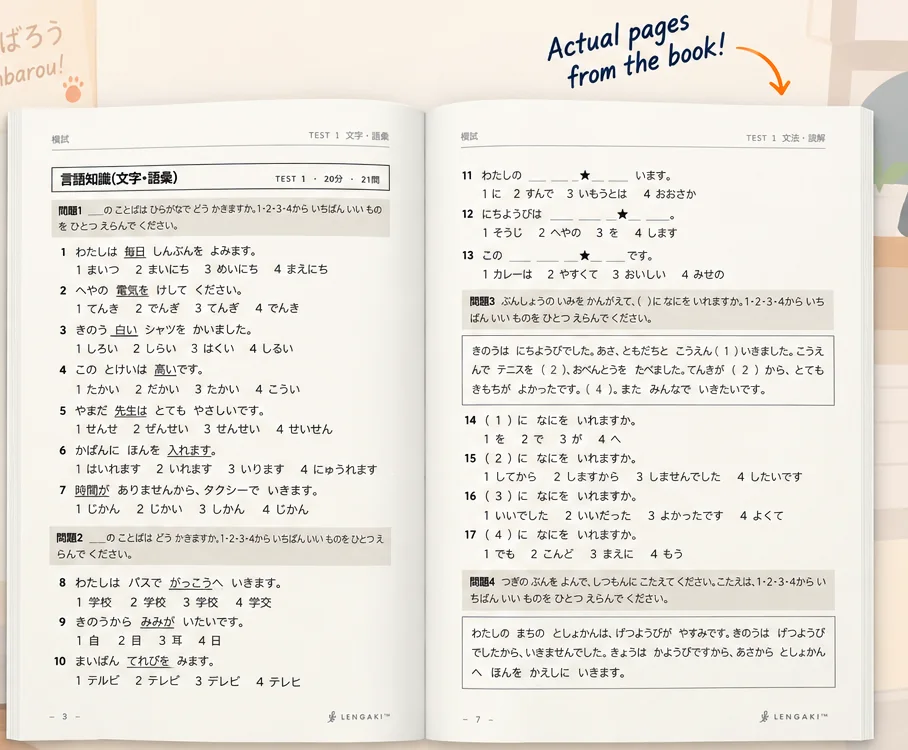
The book follows the same N5 syllabus as the website and app. In India it is delivered by LenGaki’s partner Vyaktigat Vikas; for international delivery, email lengaki2426@gmail.com before ordering. The LenGaki books page has the details. Between mocks, a free account’s analytics also show your study time and a predicted JLPT score: a useful trend line, though a timed mock is still the real measurement.
Frequently asked questions
What is the pass mark for JLPT N5?
You need at least 80 of 180 points overall, plus at least 38 of 120 in Language Knowledge (Vocabulary/Grammar)・Reading and 19 of 60 in Listening. Falling below either section minimum is a fail, whatever your total.
What is the pass mark for JLPT N4?
N4 requires 90 of 180 points overall, with the same section minimums as N5: 38 of 120 in Language Knowledge (Vocabulary/Grammar)・Reading and 19 of 60 in Listening.
How long is the JLPT N5 test?
The three N5 papers take 90 minutes in total: 20 minutes for vocabulary, 40 for grammar and reading, and 30 for listening. These are the official times since the December 2020 test; listening can vary slightly with the length of the recordings.
When should I start taking JLPT mock tests?
Take your first full, timed mock about eight weeks before the exam, once you have been through the level’s grammar and vocabulary at least once. After that, take a fresh mock about every two weeks, with the last one around 14 days before the test.
Is it worth retaking the same JLPT mock test?
Only as practice: you remember the answers, so the score comes out inflated. Wait at least three weeks, re-sit only your weakest paper, and judge it by whether you can explain every answer and finish on time.
Are LenGaki’s JLPT mock tests free?
LenGaki’s N5 mock sets 1 and 2 are free and need no account; each has three timed papers with the official 問題 structure and an answer sheet. N5 set 3 and all three N4 sets come with Pro, a small monthly subscription you can cancel anytime.