Most “JLPT practice tests” online are quizzes wearing a costume. Twenty multiple-choice questions, no timer, no section structure, no listening. Then you sit the real thing and discover the paper is three separate timed papers with a specific 問題 structure and an answer sheet you have never seen. This is what a real mock exam should look like, and how to use one properly.
The mistake almost everyone makes
Practising questions is not practising the exam. The JLPT fails people on pacing, section order and listening pressure at least as often as on vocabulary. If your practice has no clock and no 聴解, you are training for a different test.
What the real paper actually looks like
The JLPT is not one exam. It is three papers sat back to back with short breaks, each timed separately, and at N5 and N4 they are scored as two sections, each with its own pass minimum. At N5:
| Paper | Time | Questions | Structure |
|---|---|---|---|
| 言語知識 (文字・語彙) | 20 min | 21 | 問題1 漢字読み ×7 · 問題2 表記 ×5 · 問題3 文脈規定 ×6 · 問題4 言い換え ×3 |
| 言語知識 (文法)・読解 | 40 min | 22 | 問題1 文法形式 ×9 · 問題2 組み立て ×4 · 問題3 文章の文法 ×4 · 問題4–6 読解 ×5 |
| 聴解 | 30 min | 24 | 問題1 課題理解 ×7 · 問題2 ポイント理解 ×6 · 問題3 発話表現 ×5 · 問題4 即時応答 ×6 |
N4 is the same shape, larger and longer: 25 minutes for 28 vocabulary questions, 55 minutes for 29 grammar and reading, 35 minutes for 28 listening. The 問題 numbering shifts because N4 adds 問題5 用法 to the vocabulary paper.
The scoring rule that surprises people
You do not need a good total. You need a good total and a minimum in each section. Miss either and you fail regardless of the other.
Overall
80 / 180 at N5. 90 / 180 at N4. Scaled, not raw.
Language + reading
38 / 120 minimum. Vocabulary and grammar-reading are combined into one section score.
Listening
19 / 60 minimum. This is the one that catches self-taught learners.
The listening minimum is where people who learned from textbooks and apps come unstuck. You can read comfortably at N5 and still score 15/60 in 聴解 if you have never practised listening at native speed with no replay.
LenGaki has three complete mock sets for N5 and three for N4 — 456 questions in total, built to the official 問題 structure, timed to the real limits, with a 本番-style answer sheet and genuine audio for every listening question. N5 sets 1 and 2 are free for everyone; N5 set 3 and the N4 sets come with Pro.
Open the exam hallThree things a real mock has that a quiz does not
1. A clock you cannot pause
The N5 vocabulary paper gives you 20 minutes for 21 questions — under a minute each. Most learners can answer every question correctly given unlimited time, which is exactly why untimed practice feels reassuring and teaches nothing. The skill being tested is deciding fast and moving on.
2. The answer sheet, blocked by 問題
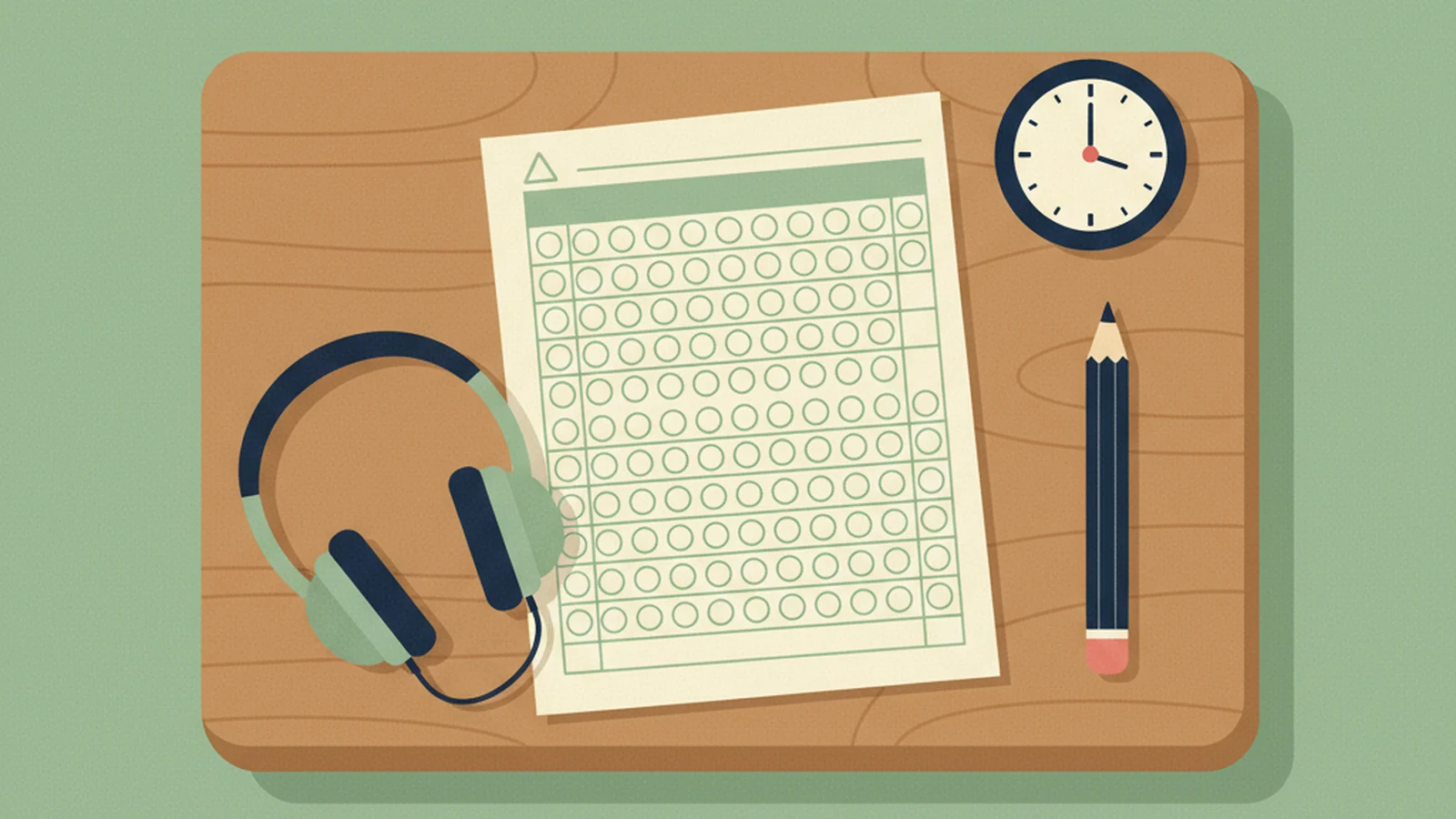
The real marksheet is grouped by 問題 section, not in rows of five. This matters more than it sounds: mis-aligning your answers by one row is a genuine, common, catastrophic exam-day failure. Practising on a marksheet laid out the same way removes the risk entirely.
3. One hearing per recording
Sit each recording as a single hearing, with no pausing and no replays. 問題3 発話表現 and 問題4 即時応答 give you no printed options at all — you hear a situation and choose from three spoken responses. If your practice lets you scrub back, you are not practising the thing that is hard.
How to use a mock properly
- Sit the whole paper in one go. Phone away. If you stop halfway, you have measured nothing.
- Do not look up words during the paper. Guess and flag it. Reviewing after is where the learning happens.
- Score by section, not overall. A 75% total that hides 30% listening is a fail.
- Review only your wrong answers, and write down why each was wrong — misread, didn’t know, ran out of time. Those three need different fixes.
- Then leave it a week before the next full paper. Mocks are measurement; study is what changes the number.
How many mocks, and when
Three full papers per level is enough, spaced across your final six weeks. More than that and you start memorising the papers instead of the language — and you burn your calibration tools before exam day.
- Six weeks out — paper 1. Diagnostic. Expect it to be uncomfortable. The number is not the point; the section breakdown is.
- Three weeks out — paper 2. After you have worked on whichever section paper 1 exposed. This tells you whether your fix worked.
- One week out — paper 3. Full dress rehearsal, same time of day as your real exam. Then stop. The last week is light review only.
What your score actually predicts
Mock scores run slightly optimistic — you are at home, unpressured, and reading questions in a familiar interface. A reasonable rule is to treat a mock result as about 5–10 points generous on the 180 scale. If you are scraping 82/180 on a mock at N5, you are genuinely borderline, not safe.
Where mocks are highly reliable is the shape of your performance. If listening is your weakest section on all three papers, that will be true on the day too.
Once a mock shows you which section is weak, the fix is targeted study — 7,788 vocabulary words, 2,057 kanji and 445 grammar points, all filterable by level. The N5 lists are free with an account, the higher-level lists come with Pro, and every kanji and grammar page is free to read.
Fix the gapsFree versus paid mock tests
You do not need to pay for JLPT practice. The official Japan Foundation workbooks are worth buying if you want the exact paper feel on paper, but for measurement and pacing, free online mocks built to the real structure do the same job. What you should refuse to pay for is an untimed 20-question quiz described as a “practice test” — that is a vocabulary check, and there are better free ones.
Study for the JLPT on LenGaki
Everything on this page, ready to study
- 7,788 JLPT vocabulary words, N5 through N1, with readings and audio (N5 free)
- 2,057 kanji with on'yomi, kun'yomi and stroke-order practice
- 445 grammar points with examples and commonly-confused comparisons
- Full-length N5 and N4 mock exams, timed, with real listening audio (N5 sets 1 and 2 free)

Get the Android app
Your XP, streak and roadmap sync between this website and the app, which adds offline study and home-screen widgets on your phone.
See the app ›The summary
A mock exam is a measuring instrument, not a study method. Use three per level, sit them whole and timed, score them by section, and act on the section that is weakest — which for most self-taught learners will be listening. Everything else is study, and study is what you do between the mocks.