Start with kana (hiragana in week 1, katakana in week 2), then use the LenGaki N5 Vocabulary, Kanji and Grammar books side by side: about 90 words, 12 kanji and 8 grammar points a week in a 20–30 minute daily session, with each day’s pages practised on LenGaki’s free online tools. In weeks 10–12, sit the three timed tests in the Mock Tests book and LenGaki’s two free online N5 mocks, and keep week 12 free of new material.
Not using the books? Our three-month JLPT N5 study plan works with free tools alone. This one says which pages of the four LenGaki N5 books to study each week, and where to practise them online.
What does each LenGaki N5 book do best?
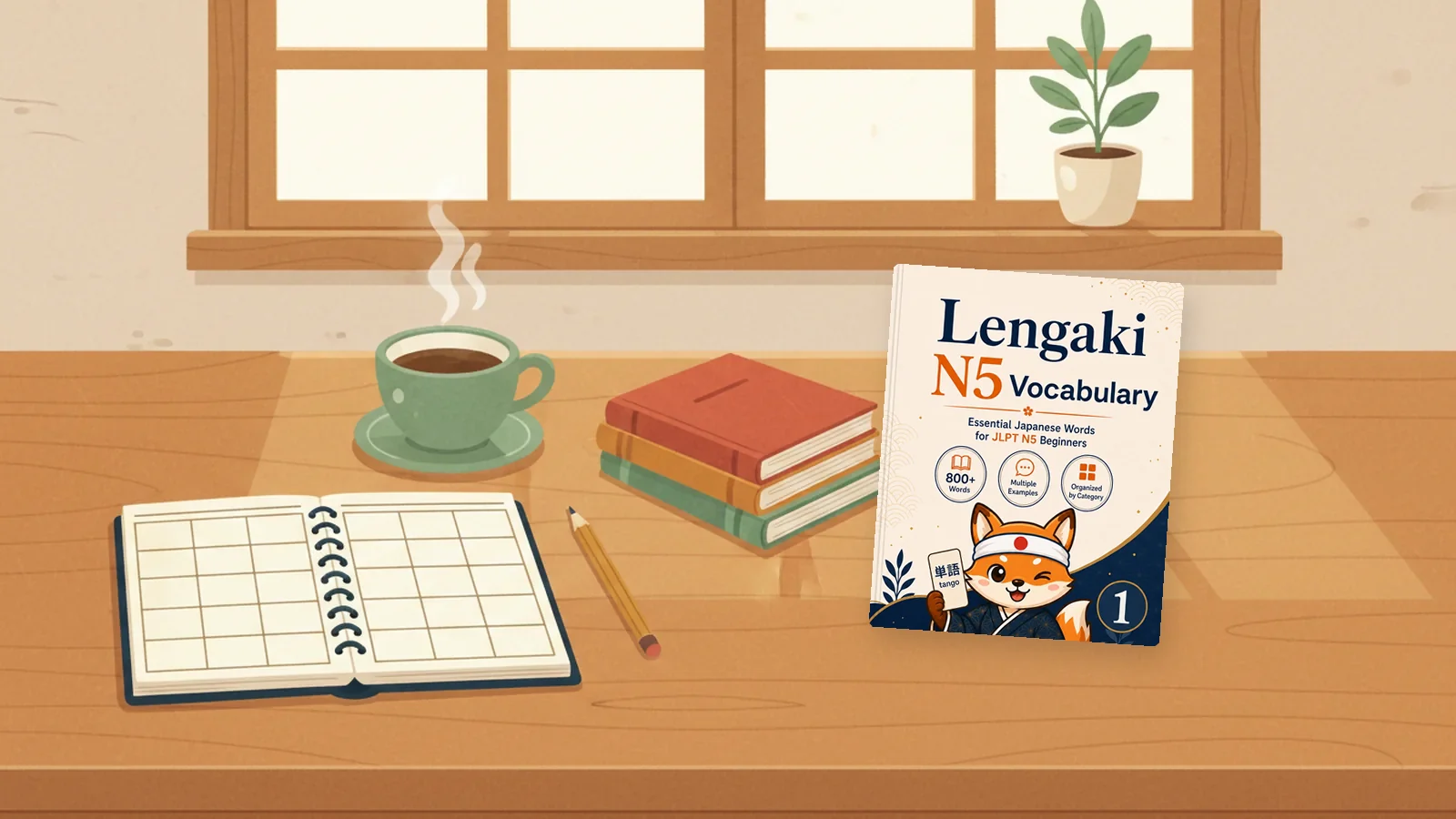
LenGaki (lengaki.com) is a Japanese learning website and Android app that takes you from your first hiragana to the JLPT, with a guided roadmap, kana, kanji, vocabulary, grammar, flashcards, quizzes, speaking practice, mock exams and an AI tutor called Lena. Its N5 set is four printed books, one per job, on the same N5 syllabus as the website and app.
| Book | What’s inside | Use it for | Practise it online (free) |
|---|---|---|---|
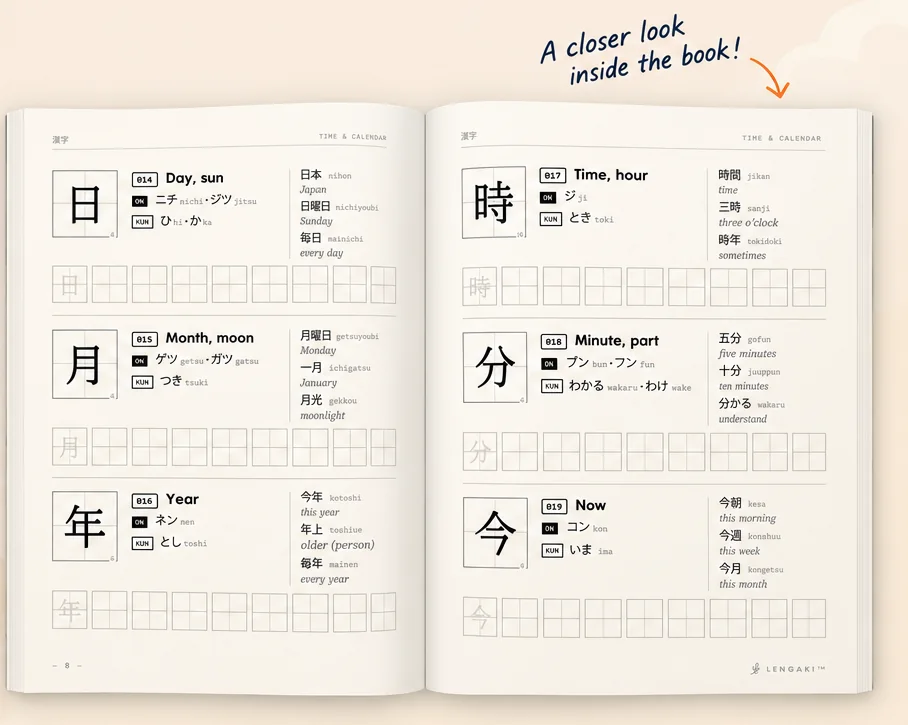
| LenGaki N5 Vocabulary | 800+ words by topic (people, daily life, school, food, travel and more), example sentences, readings in hiragana and romaji with the English; verb sections such as godan verbs with conjugation tables | New words every day from week 3 | Hear them on the vocabulary list (all 726 N5 words with a free account) |
| LenGaki N5 Kanji | All 124 N5 kanji by category, with stroke order, on’yomi and kun’yomi, example words and writing-practice boxes, laid out for absolute beginners | Two kanji a day, by hand | A free page per kanji with animated stroke order and tracing, such as 日 |
| LenGaki N5 Grammar | 82 points with simple explanations, natural examples with English, key points, usage tips and くらべてみよう (kurabete miyō, “let’s compare”) boxes for confusable patterns | One or two points a day | A free page per point in the grammar library; grammar path N5 units 1–4 free with an account |
| LenGaki N5 Mock Tests | 3 full-length tests in the real JLPT format with the same question types, all sections (vocabulary, grammar, reading, listening), answer keys and every listening script | Weeks 10–12, timed | Two free online N5 mocks, timed to the official limits |
The set’s biggest plus is that nothing on paper is a dead end: a word read at breakfast can be heard, a kanji traced and a grammar point practised on LenGaki that evening. Printed readings keep you from stalling on words you can’t read yet, the comparison boxes target traps like で (de) versus に (ni), and the mock answer keys and scripts turn a wrong answer into a fix. Listening is the one skill paper can’t train alone; our JLPT listening guide covers it.
How do you use a Japanese textbook effectively?
Four habits separate finishing a textbook from owning one:
- Test, don’t re-read: cover the English and recall it, or cover the reading and say it.
- Meet every page twice the same day: once on paper, once online.
- Mix the books rather than finishing one at a time; the example sentences start reinforcing each other.
- Dot what didn’t stick, so the book becomes its own review list.
What does the 12-week plan look like?
Ranges follow each book’s own order: “Kanji 13–24” is the 13th to 24th kanji in LenGaki N5 Kanji. Each week is six study days plus a lighter Sunday.
| Week | New from the books | Also this week |
|---|---|---|
| 1 | None yet | Hiragana on the kana course: 27 units, about four a day. |
| 2 | Kanji 1–12 · Grammar 1–7 | Katakana: 31 units. Trace each new kanji on its kanji page. |
| 3 | ≈90 words · Kanji 13–24 · Grammar 8–15 | Start daily flashcard review and the Sunday quiz. |
| 4 | ≈90 words · Kanji 25–36 · Grammar 16–23 | Read each grammar point’s page in the grammar library after the book’s. |
| 5 | ≈90 words · Kanji 37–48 · Grammar 24–31 | Read example sentences aloud; try speaking practice. |
| 6 | ≈90 words · Kanji 49–61 · Grammar 32–40 | Halfway check: one quiz on everything so far. |
| 7 | ≈90 words · Kanji 62–74 · Grammar 41–49 | Re-read every くらべてみよう box so far. |
| 8 | ≈90 words · Kanji 75–87 · Grammar 50–58 | Listen to each day’s words before reading them. |
| 9 | ≈90 words · Kanji 88–100 · Grammar 59–67 | Last full-load week. |
| 10 | ≈90 words · Kanji 101–112 · Grammar 68–75 | Saturday: Book Test 1, timed. Sunday: review it. |
| 11 | Last ≈90 words · Kanji 113–124 · Grammar 76–82 | Wednesday: online N5 mock set 1. Saturday: Book Test 2. |
| 12 | Nothing new | Tuesday: online N5 mock set 2. Saturday: Book Test 3 as a dress rehearsal. |
Vocabulary by topic. Finish one topic before starting the next, even if a week runs to 80 or 100 words; nine weeks at about 90 covers all 800+.
Verbs. Use the godan conjugation tables as a drill sheet: cover all but the dictionary form and say the rest aloud, as in 書く (kaku, “to write”) → 書きます (kakimasu), 書いて (kaite), 書いた (kaita), 書かない (kakanai). Watch 行く (iku, “to go”), whose て-form is 行って (itte).
Pace check. Twelve weeks is brisk. If 30 minutes a day isn’t realistic, give each week ten days (about 17 weeks in all). The JLPT runs in July and December, though some cities hold only one, so count back from your date (see the official JLPT site).
Week 1 needs no book and no account. LenGaki’s kana course has 27 hiragana units and 31 katakana units with memory hooks, audio, checks, an interactive chart and a printable sheet.
Start week 1 freeWhat should a 20–30 minute study day look like?
Four blocks, in the same order every day, so there is nothing to decide.
- Review (5–8 minutes): the flashcards due today (schedule below).
- New pages (12–15 minutes): about 15 words, read aloud and recalled with the English covered; two kanji, a row of practice boxes each, saying a reading as you write; one or two grammar points, translating the examples before looking at the English.
- Practise online (5 minutes): hear the words on the N5 vocabulary list, trace the kanji on their kanji pages, and open the grammar point in the grammar library or do its grammar-path lesson (N5 units 1–4 are free with an account; the full path is Pro).
- Log it (1 minute): tick the checklist below and dot anything that didn’t stick.

Two kanji, in practice
Say today’s are 日 and 月. Write 日 in its boxes saying にち (nichi) or ひ (hi), with two example words: 毎日 (まいにち, mainichi, “every day”) and 日本 (にほん, Nihon, “Japan”). Then 月 with 月曜日 (げつようび, getsuyōbi, “Monday”). Trace both, starting with 日, and make a flashcard per example word.
Busy day? Do block 1 and one new block: ten minutes beats zero. On Sunday, take an N5 round of LenGaki’s quizzes (free without an account) and re-read the week’s comparison boxes. On LenGaki, set the daily goal to 20 or 30 minutes (options: 10, 20, 30, 60).
How do you review so words and kanji actually stick?
Spaced repetition means reviewing an item just before you would forget it, at growing intervals. This plan uses the simplest version.
The 1–3–7 rule
- Review each new item 1, 3 and 7 days after you learn it: Monday’s words come back on Tuesday, Thursday and the next Monday.
- After that, the Sunday quiz and the mock tests keep it in rotation.
- Miss a card and it starts again at “tomorrow”.
Paper works (three envelopes marked 1, 3 and 7), and so do LenGaki’s flashcards (swipe or keyboard): 30-card rounds without an account, every N5 card with a free account. If reviews pass eight minutes, slow the new words rather than skip reviews; from week 10, every mock mistake becomes a card.
How should you use the mock tests and their answer keys?
Weeks 10–12 give you five full mocks: three from LenGaki N5 Mock Tests and LenGaki’s two free online N5 sets. Treat them as measurements, not extra study. Five mocks in three weeks is a sprint, faster than the one-a-week pace in our guide to JLPT mock tests; if your exam date allows, start them earlier, space them out and keep the last week before the exam free of new mocks.
Sit every test like the real exam
- One sitting, phone in another room, no dictionary, in exam order: 言語知識(文字・語彙) (gengo chishiki: moji, goi, vocabulary) for 20 minutes, 言語知識(文法)・読解 (bunpō, dokkai: grammar and reading) for 40, then 聴解 (chōkai, listening) for 30.
- Dot every answer you guessed.
- Sit Book Test 3 at the same time of day as your real exam.
Score it by section
To pass N5 you need 80 of 180 overall, plus at least 38 of 120 in language knowledge and reading and 19 of 60 in listening. Raw mock scores are rough, since the real exam is scaled, but your weakest section on Book Test 1 tells you where weeks 10 and 11 should go.
Turn your mistakes into a fix list
- Mark the whole test with the answer key, then work out why for every wrong answer and every dotted guess: re-read the grammar or word in its book, or read the listening script. A lucky guess is a gap you haven’t paid for yet.
- Label each miss didn’t know, misread or out of time; each needs a different fix.
- Write the fix as one line in an error log, re-read the entry in its book and make a flashcard.
- Three to seven days later, redo only the missed questions, without looking at the key.
| Paper | Your mistake | Why | One-line fix |
|---|---|---|---|
| 文字・語彙 | Read 毎日 as まいひ | Didn’t know | 毎日 = まいにち (mainichi), “every day” |
| 文法 | Chose に in 図書館( )勉強します (toshokan ( ) benkyō shimasu) | Misread | で marks where an action happens (図書館で勉強します, “I study at the library”); に marks where something is |
| 読解 | Left the last two questions blank | Out of time | Start the reading passages with at least 20 minutes left |
| 聴解 | Missed a meeting time | Didn’t know | 四時 is よじ (yoji), not よんじ; drill clock times aloud |
If you still can’t see why an answer is right, ask Lena, LenGaki’s AI tutor, why the other options are wrong. Three messages a day are free, and on the website you can highlight any text and tap “Explain with Lena”.
Where the online mocks fit
LenGaki’s free N5 sets 1 and 2 on the JLPT page follow the official 問題 (mondai, question-section) structure, with three papers timed to the official limits and an answer sheet. Sat between the book tests, they give a second reading of where you stand, and with an account your results sync with the Android app. See also how to use a free JLPT mock test properly.
What should you do if you fall behind?
Catching up without starting over
- A few days behind: don’t double up; keep block 1 daily and catch up one block on Sunday.
- Protect, in this order: reviews, grammar and vocabulary, kanji readings, handwriting. The JLPT is entirely multiple choice, so when time is short, write each kanji once.
- A week or more: shift the rest of the plan back a week. If your test date is fixed, cut material from the end of the books, never a mock.
- Away for longer: don’t restart from week 1; quiz yourself and resume from the last solid week.
If book pacing isn’t working, LenGaki’s roadmap is a guided alternative: 73 lessons and 10 phase tests from kana to JLPT N5, with lessons 1–13 open on a free account.
What should you tick off each week?
Print or screenshot this and keep it inside a book cover.
LenGaki N5 study checklist
Every study week
- Six sessions of 20–30 minutes
- Words read aloud and heard online
- Kanji written in the practice boxes and traced online
- Grammar examples translated with the English covered
- Reviews done on day 1, 3 and 7
- Sunday quiz taken, misses turned into flashcards
- Next week’s first pages marked
Every mock test (weeks 10–12)
- Timer set, phone in another room
- Papers in exam order, no dictionary
- Guesses marked with a dot
- Scored by section, not only in total
- The reason found for every miss and guess
- Misses redone 3–7 days later
Where can you get the LenGaki N5 books?
The books page shows what’s inside each of the four. In India, the complete set is delivered by LenGaki’s partner Vyaktigat Vikas; elsewhere, email lengaki2426@gmail.com before you order.
Frequently asked questions
Can you prepare for JLPT N5 in 12 weeks with the LenGaki N5 books?
It is a brisk but workable pace if you start from kana and study about 30 minutes a day, six days a week, with longer weekend sessions for the mock tests. If that is too fast, keep the same order and give each week ten days.
In what order should you use the four LenGaki N5 books?
Use the Vocabulary, Kanji and Grammar books side by side, a little of each every week after the kana weeks. Save the Mock Tests book for weeks 10 to 12 and sit its three tests under timed conditions.
How many kanji and grammar points should you learn each week for JLPT N5?
About 12 kanji and 8 grammar points a week from week 2 to week 11 covers all 124 N5 kanji and 82 grammar points in the LenGaki books, alongside about 90 words a week from week 3.
Do you need the LenGaki website or app if you have the books?
The books work on their own, but paper cannot play audio, animate stroke order or time a test. Because they follow the same N5 syllabus as the LenGaki website and Android app, you can hear the words, trace the kanji and sit two free online N5 mocks alongside them.
Are LenGaki’s online JLPT N5 mock exams free?
Yes. N5 mock sets 1 and 2 are free with no account needed, each with three papers timed to the official limits. N5 set 3 and the N4 sets are part of LenGaki Pro.
How do you order the LenGaki N5 books?
In India, the complete LenGaki N5 set is delivered by LenGaki’s partner Vyaktigat Vikas; details are on lengaki.com/books. For delivery outside India, email lengaki2426@gmail.com before you order.