So, you’ve decided to learn Japanese. Congratulations! You are about to embark on an incredible journey. But right now, you might be staring at a wall of symbols that look like intricate squiggles and wondering,"Where do I even begin?"
The answer is Hiragana (ひらがな). It is the foundation of the entire Japanese writing system. Without it, you can't read grammar explanations, you can't look up words in a dictionary properly, and you definitely can't read native material.
Why Romaji is a Trap
Many beginners try to delay learning Japanese scripts by relying on Romaji (English letters). This is a massive mistake. Romaji ruins your pronunciation and stops you from recognizing Japanese words as native speakers do. Drop Romaji immediately. Dedicate this week to Hiragana instead.
The 7-Day Roadmap
There are 46 basic characters in Hiragana. If you try to memorize them all at once, your brain will melt. The secret is breaking them down into small, digestible rows (called gyō) and practicing them daily.
The Vowels & The 'K' Row
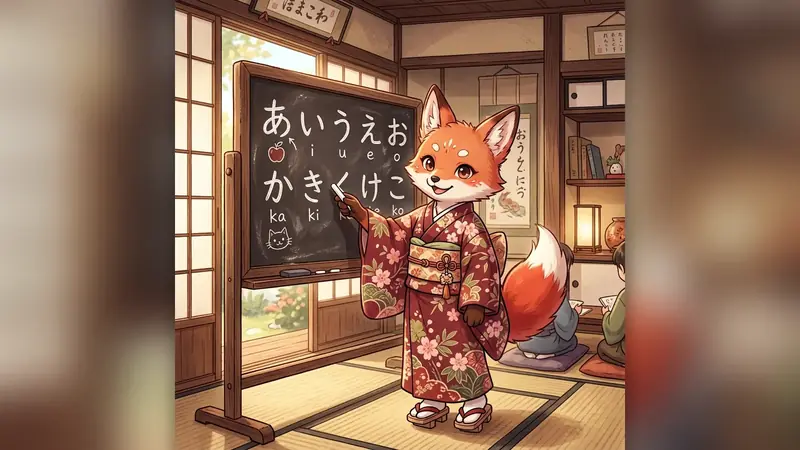
Start with the foundation vowels, then add the 'K' row consonants.
Action item: Write each character 10 times. Create mental mnemonics. (e.g., 'ki' き looks like a key).
The 'S' and 'T' Rows
Notice the pronunciation shifts here: it's 'shi' (not 'si'), 'chi' (not 'ti'), and 'tsu' (not 'tu').
The 'N' and 'H' Rows
The 'H' row introduces another exception: 'fu' (not 'hu').
The 'M', 'Y', and 'R' Rows
The 'Y' row is small, and the 'R' row is pronounced like a soft 'd/l' mix.
The 'W' Row and the Loner 'N'
Finish up the main characters, including the only consonant that can stand alone: 'n' (ん).
Dakuten & Handakuten (The Quotes and Circles)
You don't need to learn new shapes! Adding two small lines ( ゛ ) changes unvoiced sounds to voiced sounds (K → G, S → Z, T → D, H → B).
Example: か (ka) → が (ga).
Adding a small circle ( ゜) to the H row makes it a P sound (ha は → pa ぱ).
Combinations & Mastery
Learn how to combine characters with small ya, yu, yo (e.g., kyu きゅ, sha しゃ). Spend the rest of the day drilling flashcards until you can instantly recognize every character.
The Secret to Never Forgetting
The biggest mistake learners make is reading a chart and assuming they "know" it. Passive recognition is not enough.You need active recall. You need to be tested. You need spaced repetition.