Yes. Fifteen minutes a day is enough to learn Japanese steadily, as long as it really is every day and the minutes go to review first, then one small piece of new material, then saying it out loud. It is not a fast route to fluency or to a JLPT certificate in a few months, but it is a reliable one, because short daily sessions suit the way memory works.
The 15-minute routine at a glance
Minutes 0–5
Review
Recall words, kana or kanji from the last few days. Say the answer before you check.
Minutes 5–12
One new thing
About five kana, five to eight words, two or three kanji, or one grammar point.
Minutes 12–15
Speak and listen
Say today’s words in a sentence, then repeat a short line of audio after the speaker.
Same time every day. Saturday is a mixed quiz and Sunday a 10-minute minimum day.
Is 15 minutes a day enough to learn Japanese?
For steady progress, yes. For speed, no. Fifteen minutes every day adds up to 1 hour 45 minutes a week and about 91 hours a year: real study time, but modest next to what each JLPT level asks for. Our guide to how long it takes to learn Japanese sets out the hours per level. Divide the figure for your target by your yearly hours and you have an honest timeline.
| Daily study | Per week | Per year (365 days) | A LenGaki daily goal option? |
|---|---|---|---|
| 10 minutes | 1 h 10 min | about 61 hours | Yes |
| 15 minutes | 1 h 45 min | about 91 hours | No: set 10 as your floor |
| 20 minutes | 2 h 20 min | about 122 hours | Yes |
| 30 minutes | 3 h 30 min | about 183 hours | Yes |
| 60 minutes | 7 h | 365 hours | Yes |
In practice, 15 minutes a day is plenty for the foundations: kana, a growing core vocabulary, the first grammar patterns and simple sentences. It is too little for an exam a few months away; with a date, expect to move up to 30 or 60 minutes as it gets close. Treat 15 minutes as the floor, not the ceiling. Slow progress rarely ends anyone’s Japanese; stopping does.
Why do short daily sessions work so well?
Three well-studied findings from memory research favour little-and-often study, and none of them needs an app.
Spacing: why every day beats once a week
In 1885 the German psychologist Hermann Ebbinghaus published Über das Gedächtnis (“On memory”), the first careful experiments on forgetting. Testing himself on lists of nonsense syllables, he found that forgetting is steep at first and then levels off, the shape now called the forgetting curve. He also concluded that “with any considerable number of repetitions a suitable distribution of them over a space of time is decidedly more advantageous than the massing of them at a single time” (chapter 8 of the English translation). The spacing effect has been replicated many times since, including with foreign-language vocabulary.
For your 15 minutes: seven short sessions put seven reviews into a week. One 105-minute Sunday session puts in one, after six days of forgetting.
Retrieval practice: recall it, don’t reread it
In a 2006 study, Henry Roediger and Jeffrey Karpicke had students read short prose passages, then either study them again or write down everything they could remember. Five minutes later, the re-readers did better. Two days or a week later, the students who had practised recalling remembered substantially more, even though rereading had made students more confident (Psychological Science, 2006). This is the testing effect: pulling something out of memory strengthens it more than looking at it again.
For your 15 minutes: cover the answer, say it, then check. A flashcard you answer before flipping is a tiny test; a list you scroll through is rereading.
Interleaving: mix the things you confuse
Interleaving means mixing related items instead of practising them in blocks. In a 2008 study by Nate Kornell and Robert Bjork, people studied paintings by several artists, some artists one at a time and others mixed in with the rest. Later they were better at naming the artist of paintings they had never seen when that artist’s work had been mixed. Yet participants rated the one-at-a-time approach as more effective, even after their own results showed the opposite (Psychological Science, 2008). Similar results have been found with maths problems.
For your 15 minutes: most of this research is not about language, so treat it as a nudge rather than a law. Practise confusable pairs side by side: シ (shi) and ツ (tsu), 待つ (まつ, matsu, to wait) and 持つ (もつ, motsu, to hold), or the particles は (wa) and が (ga), which our は vs が explainer compares.
What is a good daily Japanese study routine?
Here is the 15-minute version, minute by minute. Use a timer, so the new block cannot swallow the review.
| Minutes | Block | What you do | Example |
|---|---|---|---|
| 0–5 | Review | Recall material from the last few days before you check it. Anything you miss goes into tomorrow’s review too. | See 水, say みず (mizu), “water”, then flip. |
| 5–12 | New | One small chunk, learned with an example: about five kana, five to eight words, two or three kanji, or one grammar point. | 毎日 (まいにち, mainichi, every day), learned as 毎日勉強する (mainichi benkyō suru, to study every day). |
| 12–15 | Speak and listen | Say the new words aloud in a sentence, then shadow: play a short line of audio and repeat it straight after the speaker. | 毎日、日本語を十五分勉強します。 (Mainichi, nihongo o jūgo-fun benkyō shimasu.) “I study Japanese for fifteen minutes every day.” |
Review, 復習 (ふくしゅう, fukushū), goes first because it is the block that gets skipped when time runs short, and the one that stops you forgetting. Learn new words inside a phrase rather than alone: 毎日 sticks better as 毎日勉強する (まいにち べんきょうする).
Rather not pick the new chunk yourself every day? LenGaki’s roadmap puts it in order: 73 short lessons and 10 phase tests from your first kana to JLPT N5, so the new block is always the next lesson. Lessons 1–13 and the first two phase tests are free with an account.
Open the roadmapWhat does a week of 15-minute days look like?
Keep the same three blocks every day, rotate what goes into the new block, and give the weekend a different job.
| Day | Review | New | Speak and listen |
|---|---|---|---|
| Monday | Last week’s misses | 5–8 new words | Each word in a phrase |
| Tuesday | Monday’s words | One grammar point | Its examples, aloud |
| Wednesday | Words and grammar so far | 2–3 kanji (kana, in your first weeks) | Shadow one audio line |
| Thursday | Monday to Wednesday, mixed | 5–8 new words | The week’s sentences |
| Friday | The whole week, mixed | One grammar point | Shadow, then repeat without audio |
| Saturday | 12-minute mixed quiz on the whole week | Nothing new | Your best sentence, aloud |
| Sunday | The 10-minute floor: one review round | Choose next week’s material | Optional |
Saturday’s mixed quiz is retrieval practice and interleaving at once. Sunday’s 10-minute floor keeps the chain unbroken and leaves time to plan the week ahead.
What should a complete beginner learn first?
Kana. For your first few weeks, every new block is hiragana and then katakana, about five characters a session, with the review block quizzing the earlier ones. LenGaki’s kana course is free with no account: 27 hiragana units and 31 katakana units with memory hooks, audio, checks, an interactive chart and a printable sheet. To go faster, see how to learn hiragana in one week.
After kana, most learners aim at JLPT N5. For scale, LenGaki’s N5 lists hold 726 words, 124 kanji and 82 grammar points, so at five to eight words a session, N5 vocabulary alone takes many months. That is fine without a deadline. With one, add daily time rather than cramming more into the same 15 minutes.
How do you make a 15-minute habit stick?
- Same time, same cue. Attach the session to something you already do every day: the first cup of tea, the train, the minutes before email. In a University College London study, volunteers did one new behaviour daily in the same context (such as “after breakfast”), and it took between 18 and 254 days to become close to automatic (Lally and colleagues, 2010). Expect weeks, not days.
- Set a daily goal you cannot fail. LenGaki’s daily goal options are 10, 20, 30 or 60 minutes, so set 10 as the floor and aim for 15.
- Keep a streak, but don’t let it boss you. The same study found that missing one opportunity did not materially affect habit formation. The rule that matters is never to miss two days in a row.
Japanese has a saying for this: 継続は力なり (けいぞくはちからなり, keizoku wa chikara nari), “continuing is strength.”
What mistakes waste a short daily session?
Five ways to spend 15 minutes and keep nothing
- All new, no review. The forgetting curve wins. Review is the first five minutes for a reason.
- Rereading instead of recalling. Scrolling a list feels productive and teaches little. Cover the answer and say it first.
- Studying in silence. Japanese you have never said aloud is hard to produce when you need it.
- Streak theatre. Thirty seconds of tapping to keep a number alive is not a session. Your floor is ten real minutes.
- Changing resources every week. Each switch sends you back to chapter one. Pick one path and finish it.
How does LenGaki support a 15-minute routine?
LenGaki (lengaki.com) is a Japanese learning website and Android app that takes you from your first hiragana to the JLPT, with a guided roadmap, kana, kanji, vocabulary, grammar, flashcards, quizzes, speaking practice, JLPT mock exams and an AI tutor called Lena. Here is how it maps onto the routine.
| The routine needs | On LenGaki | Free or Pro |
|---|---|---|
| A daily floor and a streak | Daily goal of 10, 20, 30 or 60 minutes, a day streak and XP | Free account |
| Review (5 min) | Flashcards (swipe or keyboard); kanji, vocabulary and mixed quizzes | No account: 30-card rounds and N5 quizzes. Free account: all N5 |
| New material (7 min) | Roadmap: 73 short lessons and 10 phase tests, kana to JLPT N5 | Free account: lessons 1–13 and the first two phase tests. Pro: the rest |
| Speak and listen (3 min) | Speaking practice with pronunciation scoring (Chrome on desktop and Android) | Free, no account |
| A question you are stuck on | Lena, the AI tutor, or highlight text on the website and tap “Explain with Lena” | 3 messages a day with a free account; unlimited with Pro |
The sync is what makes a short daily habit practical. One account covers the website and the Android app, and progress syncs both ways: XP, level, rank, streak, daily goal, roadmap position, JLPT mock results and Lena chats. XP comes from every lesson and answer: 150 XP per level, 50 levels, and seven samurai ranks from 足軽 (あしがる, ashigaru, foot soldier) to 将軍 (しょうぐん, shōgun). There is no iPhone app; on an iPhone, use the website in the browser.
Use flashcards for review, the roadmap for new material, speaking practice for the last three minutes, a mixed quiz on Saturdays, and Lena when something confuses you. Analytics show your real study time, which keeps “15 minutes” honest.
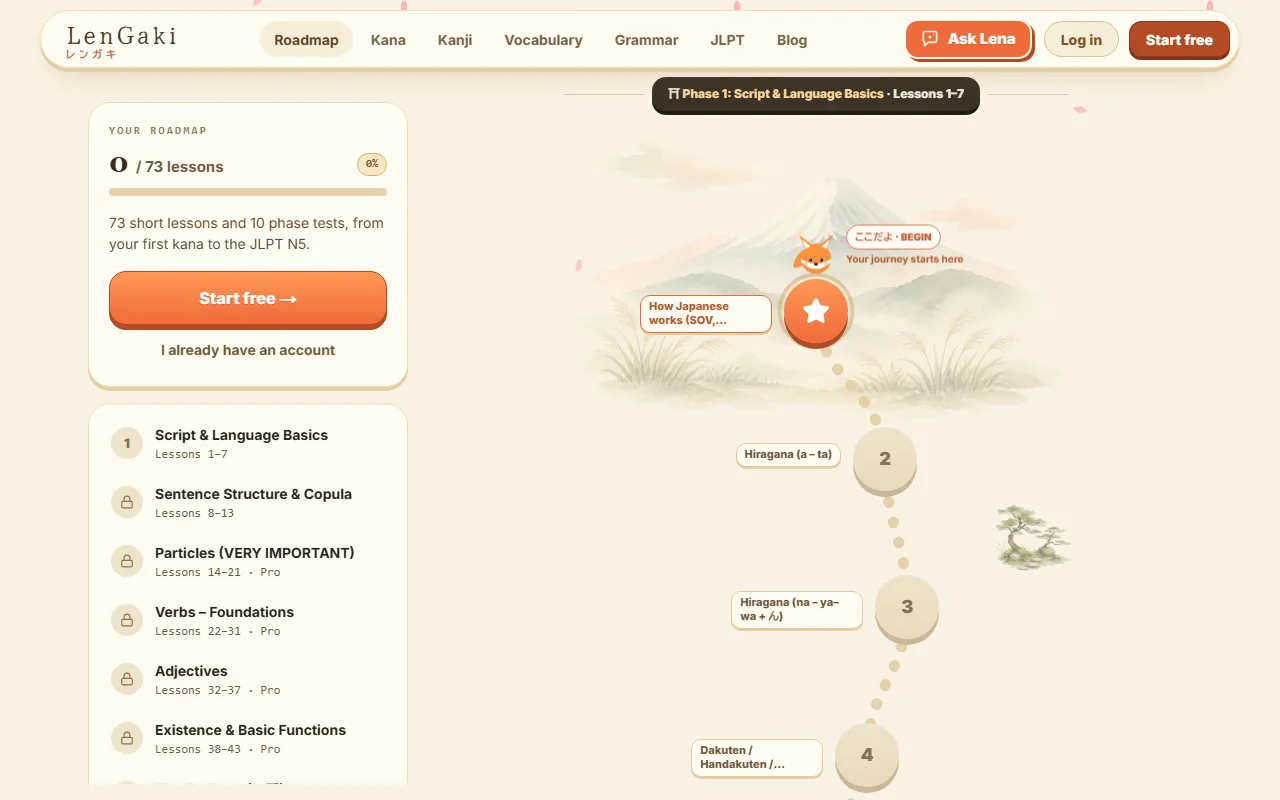
A beginner can run this routine free: the kana course, N5 flashcards and quizzes, speaking practice and roadmap lessons 1–13 cost nothing. Pro adds lessons 14–73, N4–N1 material and unlimited Lena for a small monthly price, cancel anytime.
You don’t need LenGaki for this plan, though. If you like building your own decks, Anki’s spaced-repetition scheduling is excellent for the review block, and a paper notebook with a timer covers the rest. The routine matters more than the tool.
Frequently asked questions
Is 15 minutes a day enough to learn Japanese?
Yes, for steady progress: 15 minutes every day adds up to about 91 hours a year, enough to learn kana, build vocabulary and work through beginner grammar if each session starts with review. It is not a fast route to fluency or to a JLPT exam a few months away.
What should I do in a 15-minute Japanese study session?
Spend about 5 minutes reviewing earlier material by recalling it before you check, 7 minutes on one small piece of new material, and 3 minutes saying things aloud or listening and repeating. Review comes first because it is the part that stops you forgetting.
Is it better to study 15 minutes every day or longer once a week?
Every day, for the same total time. Spreading practice out (the spacing effect, first documented by Hermann Ebbinghaus in 1885) holds memories better than cramming the same minutes into one session, and daily sessions give you seven chances a week to recall what you learned.
Can I learn hiragana in 15 minutes a day?
Yes. At about five new characters a session, reviewing the earlier ones each time, the 46 basic hiragana take a few weeks, and LenGaki’s hiragana (27 units) and katakana (31 units) courses are free with no account needed.
Does LenGaki have a 15-minute daily goal?
No. LenGaki’s daily goal options are 10, 20, 30 or 60 minutes, so for a 15-minute plan set 10 as your floor and aim for 15. Your goal, streak and XP sync between the website and the Android app; on an iPhone, use the website in the browser.
Does missing one day ruin a study habit?
No. In a 2010 University College London study by Phillippa Lally and colleagues, missing a single day did not materially affect how a new daily habit formed. The useful rule is never to miss two days in a row.