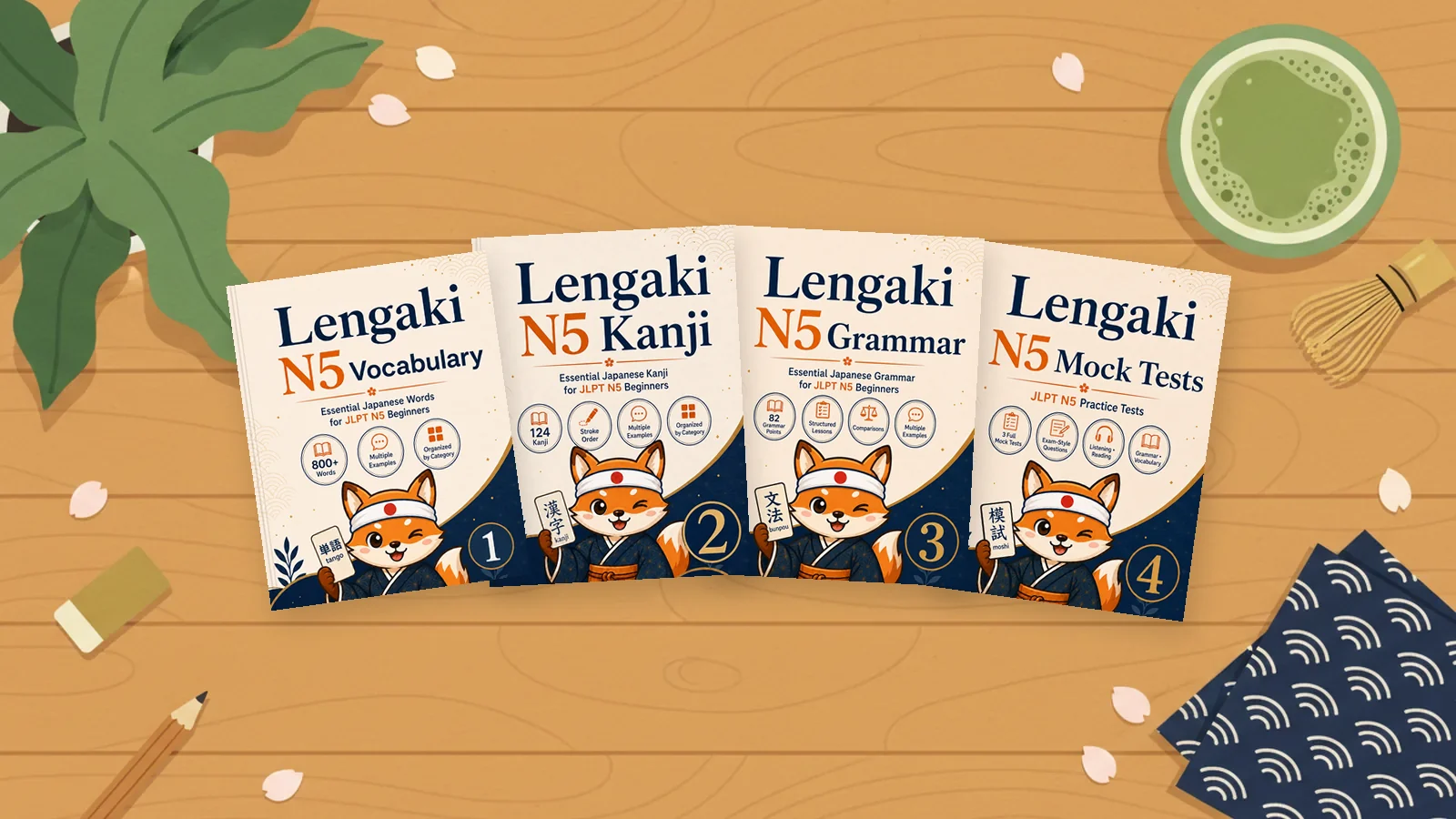
The best Japanese books to order as a beginner follow the JLPT N5 syllabus and give you readings next to new words, example sentences, room to write and mock tests with explanations. For a complete N5 set that pairs with free online practice, order the four-book LenGaki N5 set; for a classic lesson-by-lesson course in English, order Genki I with its workbook. Choose one route and finish it before you buy anything else.
Quick picks
- Studying alone for JLPT N5: the LenGaki N5 set, four books for vocabulary, kanji, grammar and mock tests, with matching online practice.
- Want one course book in English: Genki I plus the Genki I workbook.
- Learning in a class or language school: Minna no Nihongo Shokyu I with its English translation volume.
- Nervous about starting from zero: Japanese From Zero! 1, a gentle self-study book with its workbook built in.
- Planning to write 2,000+ kanji one day: Remembering the Kanji Vol. 1, but not as your N5 kanji book.
What makes a beginner Japanese book worth ordering?
You will open it most days for months, so check five things before you pay.
1. It follows the JLPT N5 syllabus
N5 is the easiest of the five JLPT levels, N5 to N1. The official description is “the ability to understand some basic Japanese”: reading “typical expressions and sentences written in hiragana, katakana, and basic kanji”, and following short, slow conversations about daily life and the classroom (see the official JLPT level summary). A book built on that syllabus gives you a finish line you can test yourself against.
2. It prints the reading next to new words
Until kanji feel familiar, a word without its reading is a word you cannot say. Look for hiragana, and romaji in the first weeks, beside each new item: 学生 (がくせい, gakusei, student), not just 学生 and an English gloss.
3. It uses each word in an example sentence
A list teaches recognition; a sentence teaches use. 毎日 (まいにち, mainichi, every day) sticks better inside 毎日日本語を勉強します。 (Mainichi nihongo o benkyou shimasu: I study Japanese every day). Good books flag the exceptions too, such as 行く (いく, iku, to go), whose te-form is 行って (itte), not 行いて (iite).
4. It leaves room to write
Kanji stick when you write them by hand, in the right stroke order, inside a square. Practice boxes printed in the book save you a separate notebook. Even a simple character like 日 (ひ, hi, sun, day) has a fixed order for its four strokes.
5. Its mock tests explain the answers
The N5 exam has three papers: vocabulary (文字・語彙, moji/goi), grammar and reading (文法・読解, bunpou/dokkai) and listening (聴解, choukai). A good mock test copies that format and its question types, and lets you check every answer. A score tells you where you are; working out why you lost each point tells you what to fix.
Why order the LenGaki N5 set?
LenGaki (lengaki.com) is a Japanese learning website and Android app that takes learners from their first hiragana to the JLPT. The LenGaki N5 set is its printed companion, made by the same team: four books, one for each part of N5, written to the same syllabus as the website and app. These are its plus points:
- Complete N5 in four focused books, written for beginners. Vocabulary, kanji, grammar and mock tests each get their own book, so you always know what you are working on and what is left.
- Online practice for what you read. Read a chapter, then practise it online: hear the words, trace the kanji, walk the grammar path and sit timed mocks. A free account opens all N5 vocabulary, kanji, flashcards and quizzes, plus grammar-path units 1–4; the two free N5 mock exams need no account. Stuck? Ask Lena, LenGaki’s AI Japanese tutor (3 messages a day free).
- 800+ words with readings and examples. Words come with their reading in hiragana and romaji, their English meaning and example sentences, organised by topic: people, daily life, school, food, travel and more. Verb sections, such as godan verbs, include conjugation tables.
- All 124 N5 kanji. Stroke order, on’yomi and kun’yomi readings, useful example words and writing-practice boxes, organised by category in a clear layout for absolute beginners.
- 82 grammar points, explained simply. Natural examples with English, key points and usage tips, plus side-by-side comparisons of the patterns learners mix up, in くらべてみよう (kurabete miyou, “let’s compare”) boxes.
- 3 full mock tests in the real exam format. The same question types as the JLPT and every section (vocabulary, grammar, reading and listening), with answer keys and every listening script.
What is inside each LenGaki N5 book?
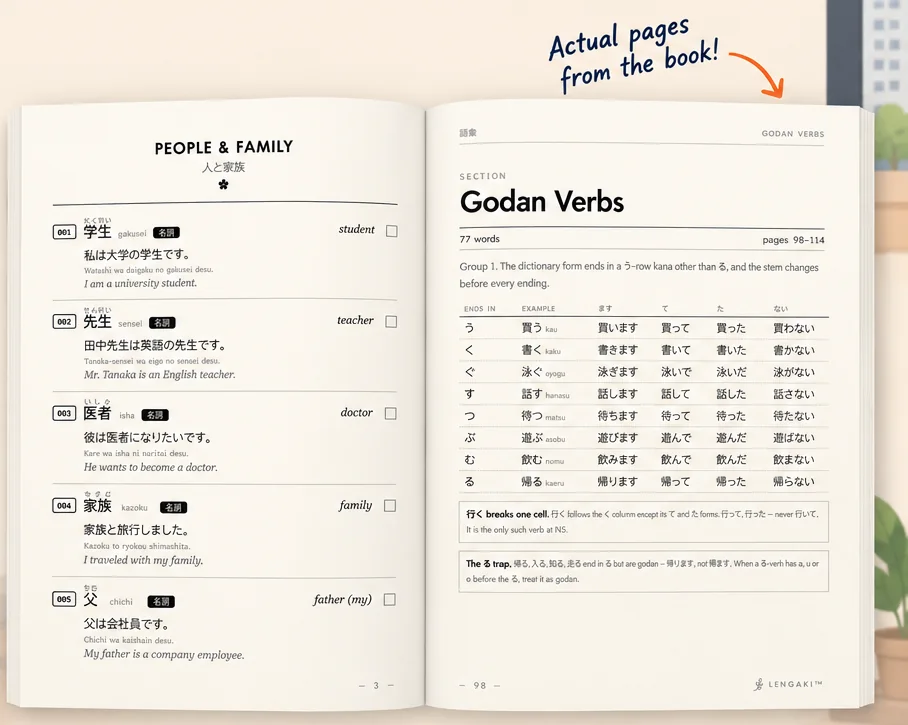
Real pages from the four books, so you can judge the layout before you order.
Book 1: N5 Vocabulary (単語, tango)
Words are grouped by topic, so 先生 (せんせい, sensei, teacher) and 家族 (かぞく, kazoku, family) sit on the same pages, each with its reading and an example sentence. The godan-verb table lines up four forms of each verb, such as 買う (かう, kau, to buy): 買います (kaimasu), 買って (katte), 買った (katta) and 買わない (kawanai).
Book 2: N5 Kanji (漢字, kanji)
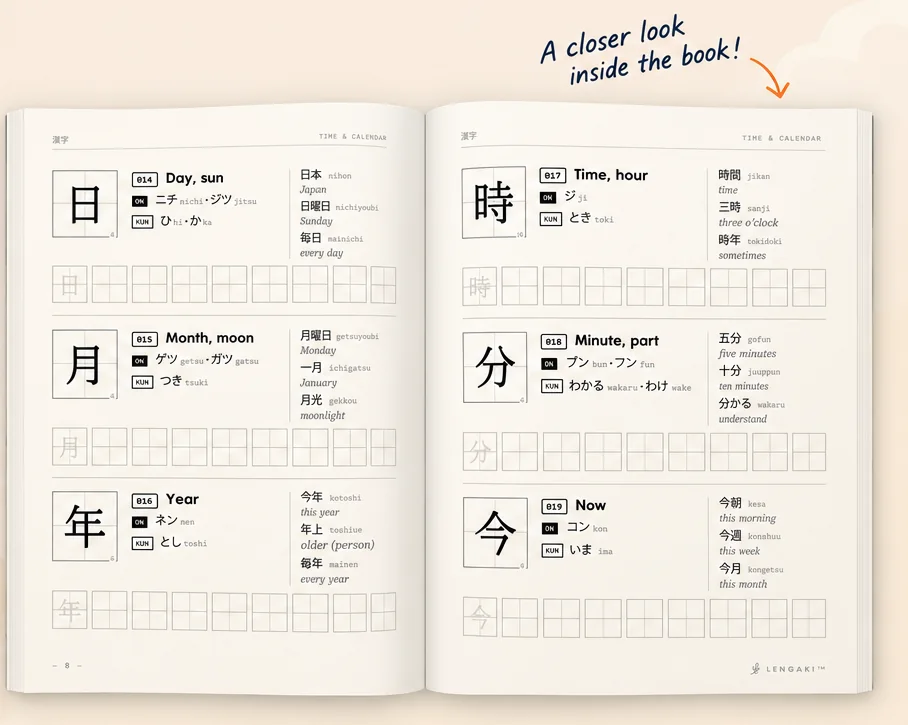
In the spread below, 日 (day, sun) has the on’yomi ニチ (nichi), as in 毎日 (mainichi, every day), and the kun’yomi ひ (hi), used when it stands alone. 日曜日 (にちようび, nichiyoubi, Sunday) has both: nichi at the start and hi, softened to bi, at the end. Writing-practice boxes sit right underneath each kanji. New to the two kinds of reading? Start with our on’yomi vs kun’yomi guide.
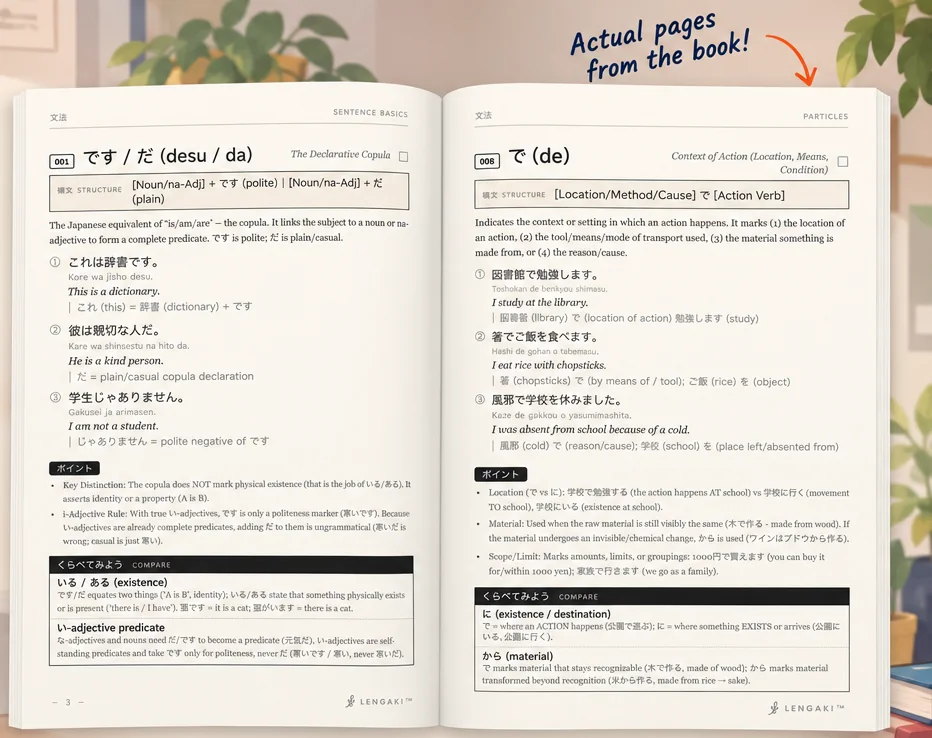
Book 3: N5 Grammar (文法, bunpou)
The くらべてみよう boxes compare look-alike patterns, such as で (de) for where an action happens and に (ni) for where something is or where you are going: 図書館で勉強します (toshokan de benkyou shimasu, I study at the library) but 図書館に行きます (toshokan ni ikimasu, I go to the library).
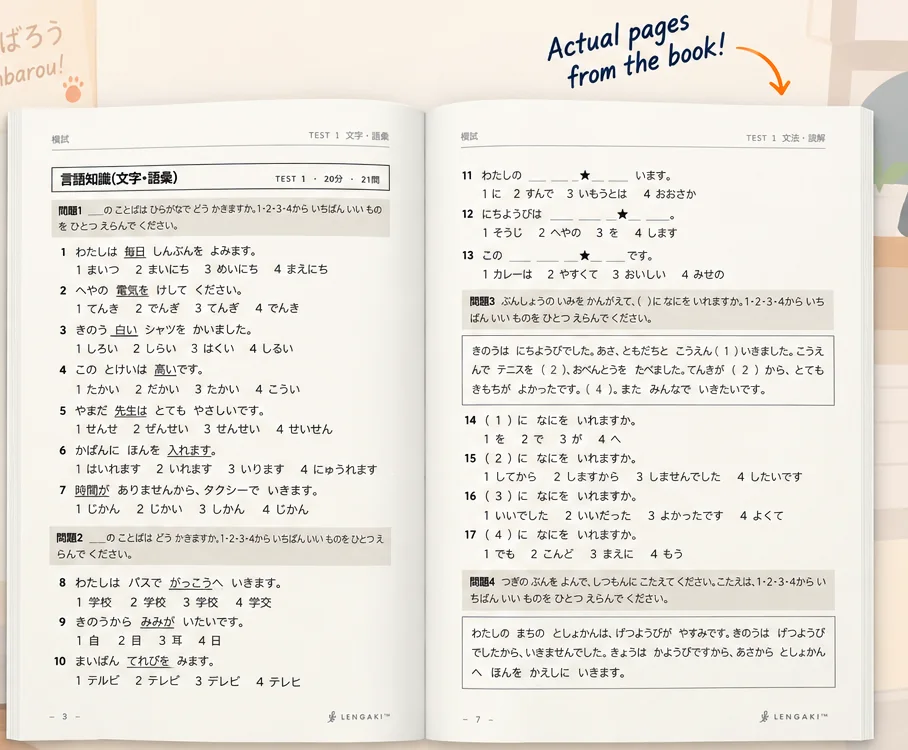
Book 4: N5 Mock Tests (模試, moshi)
The real exam’s sections and question types, three times over. In the spread below, Test 1 opens with 問題1 (mondai ichi, part 1): how is an underlined word such as 毎日 written in hiragana? Sit each test under exam conditions, then mark it with the answer key and find the pattern behind your mistakes.
Every kanji in the book also has a free page on LenGaki with its meaning, on’yomi and kun’yomi, example words, animated stroke order and tracing practice. Try 日 before your books arrive.
Trace 日 freeHow does the LenGaki set compare with Genki, Minna no Nihongo and other well-known books?
All of these are good books, built for different learners.
Genki I
Genki: An Integrated Course in Elementary Japanese I is a dialogue-led course in 12 lessons, with grammar explained in English on the page, a gentle pace and a separate workbook that you should order with it. It is the safest default for self-study in English, but as a general course it has no JLPT-format mock tests. Our N5 textbook guide reviews it in full.
Minna no Nihongo Shokyu I
Twenty-five lessons, each with sentence patterns, example sentences, a conversation, drills and exercises, in a main text that is entirely in Japanese. The explanations live in a separate translation and grammar notes volume, available in English and many other languages. It is excellent with a teacher and harder going alone; Genki vs Minna no Nihongo explains how to choose.
Japanese From Zero! 1
A friendly self-study book that teaches you to read and write hiragana, with easy example dialogues, glossaries in kana and romaji, and a workbook with an answer key built in. Its five-book series is not organised by JLPT level, so it suits a gentle start better than an exam deadline.
Remembering the Kanji, Vol. 1
James Heisig’s method teaches the meaning and handwriting of 2,200 kanji through English keywords and memory stories built from their parts. It works if you want to write a lot of kanji eventually, but it leaves readings out on purpose, and N5 tests readings from the very first question type on the vocabulary paper. Our kanji book guide compares it with the alternatives.
Later, our grammar book guide covers when a reference earns its place, and our book budget guide shows what a full shelf costs at each level.
Which beginner Japanese book is right for you?
The five options side by side: what each covers, how it explains, and who it suits.
| Book | What it covers | Readings and explanations | Practice and tests | Best for |
|---|---|---|---|---|
| LenGaki N5 set (4 books) | JLPT N5: 800+ words, all 124 N5 kanji, 82 grammar points, 3 mock tests | Hiragana and romaji readings and English meanings for words; grammar examples with English | Kanji writing boxes; 3 full mock tests with answer keys and listening scripts; free online practice on LenGaki | Self-learners aiming at JLPT N5 |
| Genki I + workbook | General beginner course in 12 lessons, built around dialogues | English explanations on the page | Practice in each lesson plus a separate workbook; no JLPT-format mock tests | Self-study or university courses in English |
| Minna no Nihongo Shokyu I + translation volume | Beginner course in 25 lessons: patterns, examples, a conversation and drills | Main text in Japanese; English in a separate volume | Drills and exercises in each lesson; no JLPT-format mock tests | Classrooms and language schools |
| Japanese From Zero! 1 | First steps: reading and writing hiragana, everyday words and dialogues | English explanations; glossaries in kana and romaji | Built-in workbook with answer key; a five-book series, not organised by JLPT level | Nervous total beginners |
| Remembering the Kanji Vol. 1 | Meanings and handwriting of 2,200 kanji | English keywords and memory stories; no readings | No JLPT-style questions | Long-term learners who want to write kanji |
Prices vary by edition, seller and country, so we have left them out.
Should you order the LenGaki set or a course textbook like Genki?
Genki and Minna no Nihongo are courses: each chapter mixes a dialogue, new words, grammar and exercises, and the book sets the order. The LenGaki N5 set is organised by skill instead, and the website and app add the audio, stroke-order animation and timed exams.
- Order a course textbook if your class uses one, or if you want the book to set your pace lesson by lesson.
- Order the LenGaki N5 set if your goal is the JLPT N5 and you will also practise on your phone or laptop.
- Do not stack two beginner courses. Genki and Minna no Nihongo cover almost the same ground. If you already own Genki I, keep it as your course and add exam-format practice before the test: LenGaki’s two free online N5 mocks are timed to the official limits.
How do you order the LenGaki N5 set in India or abroad?
- Look inside first. The LenGaki books page shows every cover and real page spreads from all four books.
- In India: order the complete N5 set from LenGaki’s partner Vyaktigat Vikas, who deliver it, at shop.vyaktigatvikas.com.
- Outside India: email lengaki2426@gmail.com before you order, with your name, your country and city and the number of sets, so international delivery can be arranged.
- While you wait: learn hiragana and katakana in LenGaki’s free kana course, which needs no account, so you can read page one the day the books arrive. Then plan on about three months of daily study; our three-month N5 study plan lays it out month by month.
Sitting the exam in India? Our JLPT India guide covers registration and test centres.
Three beginner mistakes to avoid
- A kanji book before kana. Learn hiragana and katakana first: kanji books write their readings in kana.
- A textbook without its workbook. Reading an explanation is not practice.
- All three mocks in one week. Space them out. A mock measures progress; the study between mocks is what changes the score.
Frequently asked questions
What is the best Japanese book for beginners to order?
For JLPT N5, pick one route and finish it: the four-book LenGaki N5 set if you want vocabulary, kanji, grammar and mock tests in separate books that pair with free online practice, or Genki I with its workbook if you want a lesson-by-lesson course in English. Learn hiragana and katakana first, from free material, while your books are on the way.
Which books do I need to pass JLPT N5?
You need vocabulary, kanji, grammar and exam practice that includes listening. A course textbook such as Genki I covers the first three; the LenGaki N5 set covers all four, one book each. For extra timed practice, LenGaki's N5 mock sets 1 and 2 are free online.
What is in the LenGaki N5 set?
Four books: N5 Vocabulary (800+ words with example sentences, readings in hiragana and romaji, and English meanings), N5 Kanji (all 124 N5 kanji with stroke order, on'yomi, kun'yomi, example words and writing practice boxes), N5 Grammar (82 grammar points with examples, comparisons and usage tips) and N5 Mock Tests (3 full mock tests in the real JLPT format, with answer keys, a scoring guide and every listening script).
Can I order the LenGaki N5 books in India and from abroad?
Yes. In India, the complete N5 set is delivered by LenGaki's partner Vyaktigat Vikas and is ordered from shop.vyaktigatvikas.com. From any other country, email lengaki2426@gmail.com before you order so international delivery can be arranged.
Do the LenGaki books work with the LenGaki app?
Yes. The books follow the same JLPT N5 syllabus as the LenGaki website and Android app, so after reading a chapter you can hear the words, trace the kanji, walk the grammar path and sit a timed mock exam online. On an iPhone, use the website in your browser.
Is Remembering the Kanji good for JLPT N5?
It is excellent for learning what kanji mean and how to write them, but it deliberately leaves out readings, and the N5 exam tests readings. For N5, use a kanji book that teaches on'yomi, kun'yomi and example words, either instead of it or alongside it.