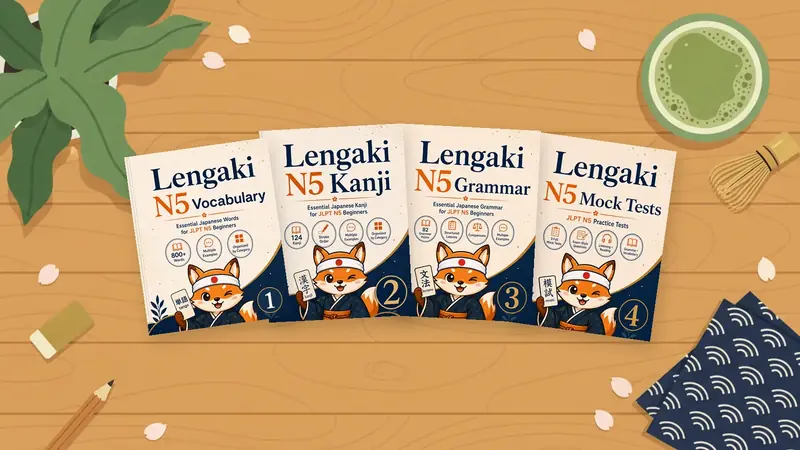
You can reach JLPT N5 having bought two books, or having bought eleven. The learners who buy eleven do not pass sooner. Here is how many books a complete Japanese library actually needs at each level, what is genuinely free, and the order to spend in so that nothing is wasted if you stop.
Affiliate disclosure. LenGaki is a participant in the Amazon Associates Program. If you buy through a link on this page we may earn a small commission, at no extra cost to you. We only recommend books we would tell a student to buy anyway, and nobody pays us for placement.
The short answer
Two books gets you through N5. Four gets you through N4. At N3 you swap one book for a harder series instead of adding, so you are still working from four (five if you add a kanji book). Anything beyond that is a shelf, not a curriculum — and roughly half of what most people buy could have been free.
Spend nothing for the first two weeks
Learn hiragana and katakana before you buy anything at all. There is no book that teaches kana better than free material does, it takes one to three weeks, and it is the point at which a large share of beginners discover they are not going to continue.
If you are in that share, you have spent nothing. If you are not, you have proved to yourself that you will show up — which is a far better reason to buy a textbook than enthusiasm on day one.
All 142 hiragana and katakana characters with audio, a memory hook for every basic one and a test for every row, free, no account needed. Two weeks here before you spend anything.
Learn kana freeThe N5 library: two books
Genki I (3rd Edition)
N5Banno et al.
The default first textbook in most university courses. Dialogue-led, English explanations, workbook sold separately.
- Best for:
- Your one and only beginner textbook.
- Our verdict:
- Buy this with its workbook and nothing else. The workbook is not optional — reading a grammar explanation is not practice, and the exercises are where the material actually lands.
Genkouyoushi practice notebook
anySquared manuscript paper. Handwriting kanji in proper boxes is what fixes the shapes.
- Best for:
- Handwriting kana and kanji properly.
- Our verdict:
- Costs about as much as a coffee and does more for legible kanji than any app. One notebook lasts most of N5.
That is the whole N5 list. Not a kanji book, not a grammar reference, not a vocabulary list — your textbook contains all three at this level, and buying separates versions duplicates material you already own.
The N4 library: add two
Nihongo So-matome N4 Grammar
N4Six weeks, two pages a day. The gentlest structured route through N4 grammar.
- Best for:
- A structured pass at N4 grammar.
- Our verdict:
- Two pages a day for six weeks. Gentle enough to finish, which matters more at N4 than depth does.
A Dictionary of Basic Japanese Grammar
referenceMakino & Tsutsui
The reference every serious learner ends up owning. Alphabetical by pattern, with contrast notes.
- Best for:
- The reference that starts paying off exactly here.
- Our verdict:
- N4 is where patterns begin to look interchangeable — ので and から, のに and けど. This is the book that separates them. Buy it once; it stays useful to N1.
A kanji book also becomes worth it around here, once you have enough vocabulary for the characters to attach to. Basic Kanji Book is the usual choice.
The N3 library: swap, do not add
At N3 the move is a replacement, not an expansion. Shin Kanzen Master takes over from So-matome, because the gentler series stops carrying enough practice. Keep the dictionary. Add nothing else.
Shin Kanzen Master N3 Grammar
N3Denser and stricter than So-matome, with far more practice. The standard step up at N3.
- Best for:
- N3 grammar, and preparation for how N2 is written.
- Our verdict:
- The step up that most stalled N3 learners delayed too long. Denser, stricter, and with the volume of practice the exam actually demands.
What is genuinely free, and just as good
- Kana. No book needed, ever.
- Vocabulary lists. Every JLPT level, with readings and audio. Paying for a word list in 2026 makes no sense.
- Kanji readings and stroke order. Animated beats printed, and costs nothing.
- Mock exams. Full timed papers with listening audio are available free — the official workbooks are nice-to-have, not need-to-have.
- Reading practice. NHK Easy News, graded readers online, manga with furigana.
Where paying is actually worth it
Three things are hard to get free and worth money: structured sequencing (a textbook that orders the material for you), practice volume (workbooks and drill books), and a good reference (contrast between confusable patterns).
Everything else — word lists, kana charts, kanji readings, stroke order, mock papers — is freely available at equal or better quality. If a book is mostly a list, you are paying for paper.
The spending order
- Weeks 1–2: nothing. Kana from free material.
- Then: beginner textbook + its workbook + a squared notebook.
- N4: grammar workbook + grammar dictionary. Kanji book if you want one.
- N3: replace the grammar workbook with the harder series. Buy nothing new.
- Six weeks before any exam: one mock paper book, if you want it on paper.
The rule that saves the most money
Do not buy the next book until you have finished the current one. It sounds obvious and almost nobody does it, because buying is easy and finishing is not. A half-read shelf is the single most common feature of learners who have been “studying Japanese” for three years and are still at N5.
Study from N5 on LenGaki
Everything on this page, ready to study
- 7,788 JLPT vocabulary words, N5 through N1, with readings and audio (N5 free)
- 2,057 kanji with on'yomi, kun'yomi and stroke-order practice
- 445 grammar points with examples and commonly-confused comparisons
- Full-length N5 and N4 mock exams, timed, with real listening audio (N5 sets 1 and 2 free)

Get the Android app
Your XP, streak and roadmap sync between this website and the app, which adds offline study and home-screen widgets on your phone.
See the app ›The summary
Two books for N5, four for N4, still four at N3 — swap rather than stack at each step. Get kana, word lists, kanji readings and mock exams free. Pay for sequencing, practice and a good reference. Then finish what you bought before buying anything else.