Almost none of this matters. Japanese is learned with a book, a pen and repetition, and buying equipment is one of the most reliable ways to feel productive without studying. But three or four items genuinely change how well handwriting practice works, and they cost very little. Here is the short list, and the longer list of what to skip.
Affiliate disclosure. LenGaki is a participant in the Amazon Associates Program. If you buy through a link on this page we may earn a small commission, at no extra cost to you. We only recommend books we would tell a student to buy anyway, and nobody pays us for placement.
If you buy one thing
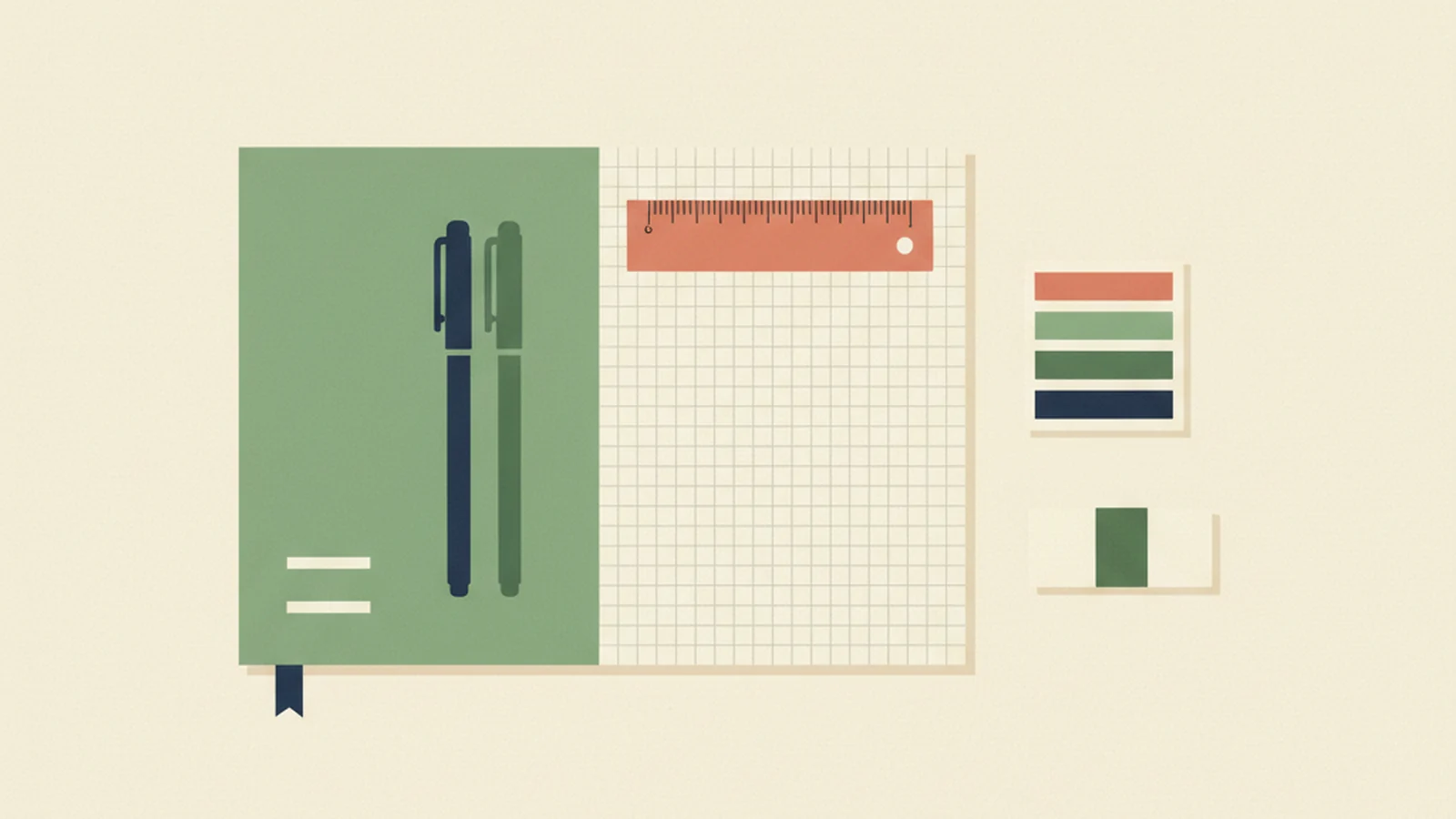
A genkouyoushi notebook. Squared manuscript paper is the difference between kanji that look right and kanji that look like they are falling over, and it costs about as much as a coffee.
The three things worth buying
Genkouyoushi practice notebook
anySquared manuscript paper. Handwriting kanji in proper boxes is what fixes the shapes.
- Best for:
- Anyone practising kana or kanji by hand.
- Our verdict:
- Kanji are built to fill a square. Writing them on lined paper teaches you the strokes but not the proportion, and proportion is most of what makes handwriting legible. One notebook covers most of N5.
A fine-tip pen, 0.5mm or under
Kanji have a lot of strokes in a small space. A broad nib turns 議 into a blot and teaches you nothing about stroke separation. Any 0.38–0.5mm gel pen works — this is not a category where the brand matters, whatever the stationery internet says.
Small sticky index tabs
Genuinely useful for a grammar reference, where you look the same twenty patterns up repeatedly. Tab the ones you keep returning to and the book stops being a search problem.
The one that is not stationery at all
Set up a Japanese IME on your computer and phone. It is free, takes five minutes, and does something no notebook can: it forces you to know a word’s reading in order to type it. Typing 電気 requires you to know it is でんき — which is exactly what 問題1 tests, and exactly the layer flashcards let you skip.
Five-minute guide for Windows, Mac, iPhone and Android — free, and the highest-value “equipment” decision on this page.
How to set it upWhat to skip
- Calligraphy brush sets. Beautiful, and a different hobby. Shodō teaches you brush control, not reading.
- Kanji flashcard boxes. Physical cards do not schedule themselves, which is the entire value of spaced repetition. A free app beats a lovely wooden box.
- Wall charts. They become invisible in about four days.
- A paper dictionary. Free apps do this faster and include audio.
- Expensive fountain pens. Ink bleed on thin genkouyoushi paper makes small kanji worse, not better.
How much writing practice is actually useful
The JLPT is entirely multiple choice — no level asks you to write a single character. So handwriting is not preparation for the exam directly. It is worth doing for one narrow, important reason: it is the only practice that reliably stops you confusing visually similar characters, which the exam does test in every 表記 question.
The proportionate amount
- Five repetitions per new character, saying the reading aloud each time. Not twenty.
- Write confusable pairs adjacently — 待/持, 語/話, 開/聞.
- Stop once you can tell them apart on sight, and put the time into reading instead.
A sensible total
A genkouyoushi notebook, a fine-tip pen, a pack of index tabs, and a free IME. That is the whole list, and it comes to less than a single textbook. Everything else on the stationery shelf is a hobby wearing a study disguise — enjoyable, but do not confuse buying it with having studied.
Study kanji writing on LenGaki
Everything on this page, ready to study
- 7,788 JLPT vocabulary words, N5 through N1, with readings and audio (N5 free)
- 2,057 kanji with on'yomi, kun'yomi and stroke-order practice
- 445 grammar points with examples and commonly-confused comparisons
- Full-length N5 and N4 mock exams, timed, with real listening audio (N5 sets 1 and 2 free)

Get the Android app
Your XP, streak and roadmap sync between this website and the app, which adds offline study and home-screen widgets on your phone.
See the app ›The summary
Buy the squared notebook and a thin pen. Set up the IME. Skip the brush set, the card box and the wall chart. Then spend the money you saved on the textbook you will actually finish.