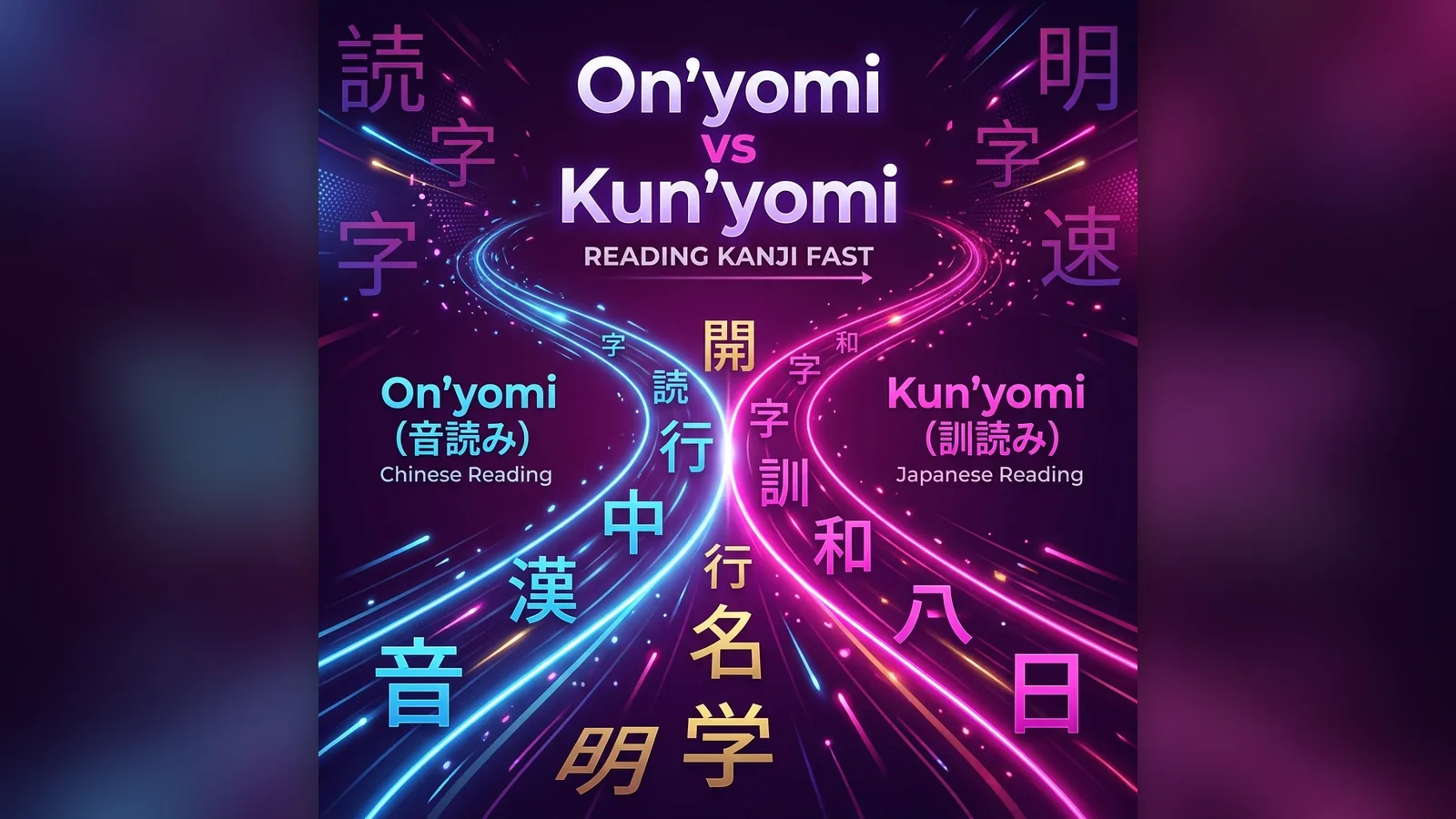
The most frustrating part of learning Japanese isn't remembering what a Kanji looks like; it's remembering how to read it. Unlike English letters, a single Kanji can have 5 or more different pronunciations depending on the word it's in. This is because of the dual reading system: On'yomi (Chinese Reading) and Kun'yomi (Japanese Reading).
The Origin Story
Japan originally had its own spoken language (Yamato Kotoba) but no writing system. They imported Chinese characters (Kanji) to write things down. When they did, they imported both the Chinese pronunciation (On'yomi) and mapped the characters to their existing Japanese words (Kun'yomi).
How to Tell Them Apart (The 80% Rule)
While there are exceptions, there is a very reliable trick to know whether you should use the Chinese reading or the Japanese reading.
Kun'yomi (Japanese Reading)
Used when a Kanji is completely alone, or when it has Hiragana attached to the end of it (Okurigana).
- 水 (Mizu) - Water (Alone)
- 食べる (Ta-beru) - To eat (With Hiragana)
- 赤い (Aka-i) - Red (With Hiragana)
On'yomi (Chinese Reading)
Used in Jukugo (compound words), where two or more Kanji are squished together with no Hiragana in between.
- 水道 (Sui-dou) - Water supply (Compound)
- 食堂 (Shoku-dou) - Cafeteria (Compound)
- 赤道 (Seki-dou) - Equator (Compound)
A Deep Dive into "Water" (水)
Let's look at the character for Water (水).
| Word | Meaning | Reading Applied |
|---|---|---|
| 水 (Mizu) | Water (The physical liquid) | Kun'yomi. The Kanji is sitting alone. |
| 水道 (Sui-dou) | Water supply / plumbing | On'yomi. Compound word (Water + Way). |
| 香水 (Kou-sui) | Perfume | On'yomi. Compound word (Fragrance + Water). |
| 水着 (Mizu-gi) | Swimsuit | EXCEPTION: Kun-Kun compound. Sometimes native Japanese words just merge together without Chinese readings. |
Stop Memorizing Readings in Isolation!
The biggest mistake beginners make is trying to memorize every reading of a Kanji using flashcards: "Okay, this character is read as sui and mizu."
Your brain cannot retain abstract sounds without context. Instead, you must learn vocabulary words. Learn the word Mizu. Learn the word Suidou. Your brain will naturally figure out the On'yomi/Kun'yomi patterns over time.
🧠 Learn Kanji in Context
Every kanji page on LenGaki shows the character's on'yomi and kun'yomi together with example words that use them, so you meet each reading inside real vocabulary. Then lock the words in with LenGaki's vocabulary flashcards, which show an example sentence on the back of each card.