
The best Duolingo alternative for Japanese is one that follows the JLPT: a roadmap from kana to N5, kanji with readings and stroke order, grammar that is actually explained, and timed mock exams. LenGaki (lengaki.com) is a Japanese learning website and Android app built that way, and it keeps the streaks, XP and daily goal that make Duolingo fun. Duolingo is still a fine place to start; many learners aiming for the JLPT simply outgrow it.
Keep Duolingo, switch, or use both?
- Just curious, or learning for a trip: Duolingo is enough to begin.
- Aiming for JLPT N5 or N4: move your main study to a JLPT-structured course; keep Duolingo as a warm-up if you like it.
- Long streak, but stuck: keep the habit and change the material (steps below).
Is Duolingo good for learning Japanese?
Yes, as a start. Duolingo is good at three things: making the first week painless, introducing hiragana and katakana gently, and turning study into a daily habit with streaks, XP and leagues. It is free to start, runs on iOS, Android and the web, and a lesson fits into a bus ride. If you have never studied a language before, that matters more than any feature list.
The trouble starts a few months in, when Japanese asks for three things Duolingo goes lighter on: kanji, grammar explanations and practice for the exam itself. For the JLPT, those three are most of the work.
Why do learners outgrow Duolingo for Japanese?
It doesn’t follow the JLPT
Duolingo’s Japanese course is organised into its own units and sections, not by JLPT level. That is fine for general practice. But the JLPT, 日本語能力試験 (にほんごのうりょくしけん, Nihongo Nōryoku Shiken), has five levels from N5 (the easiest) to N1, and each level expects a particular range of vocabulary, kanji and grammar. If your course does not map to those levels, you cannot tell whether you are ready. The official JLPT site describes each level.
Kanji get lighter treatment than the exam needs
The N5 vocabulary paper opens with two kinds of kanji question: 漢字読み (かんじよみ, kanji yomi: reading kanji) and 表記 (ひょうき, hyōki: writing words in kanji). Both test specific kanji, and kanji change their reading from word to word. 日 is ひ (hi, sun or day) on its own, にち (nichi) in 毎日 (まいにち, mainichi, every day) and か (ka) in 三日 (みっか, mikka, the third of the month). You can pick some of that up from sentences, but a JLPT course teaches each level’s kanji directly, with readings, example words and stroke order.
Grammar is shown more than explained
Duolingo teaches grammar mostly through repeated example sentences, with brief notes. That works for simple patterns. It struggles with the pairs that confuse every beginner:
- 私は学生です。 (わたしは がくせいです, watashi wa gakusei desu): I am a student. は marks the topic, what the sentence is about.
- だれが来ましたか。 (だれが きましたか, dare ga kimashita ka): Who came? A question word as the subject takes が, not は.
- 図書館で勉強します。 (としょかんで べんきょうします, toshokan de benkyō shimasu): I study at the library. で marks where an action happens.
- 図書館に行きます。 (としょかんに いきます, toshokan ni ikimasu): I go to the library. に marks the destination.
You can guess your way through these for months. A clear explanation with a side-by-side comparison fixes them in an afternoon. The は vs が guide is a good place to start.
There’s no JLPT exam practice
At N5 and N4 the JLPT is three timed papers on the same day: vocabulary, then grammar and reading, then listening. Each paper is split into numbered question blocks called 問題 (もんだい, mondai), you mark an answer sheet, and you need a minimum score in each scored section as well as overall. Duolingo has no JLPT-format mock exams, so many self-taught learners meet that structure for the first time on exam day.
What should you look for in a Duolingo alternative for Japanese?
Whatever you choose next, check it against this list. A tool that ticks most of it can carry you to N5; one that ticks two or three is a supplement, not a course.
- JLPT structure. Content sorted by level, and a path you can follow from kana to N5.
- Real kanji study. Readings, example words and stroke order for each kanji at your level.
- Grammar explanations. The rule itself, not just example sentences, with comparisons of look-alike patterns such as は and が.
- Timed mock exams. Full papers in the real format, including listening.
- The motivation you liked. Streaks, XP and a daily goal are worth keeping.
- A free way to try it on the devices you actually use.
- Somewhere to ask questions: a teacher, a community or an AI tutor.
How does LenGaki compare with Duolingo for Japanese?
LenGaki is a Japanese learning website and Android app that takes you from your first hiragana to the JLPT, with a guided roadmap, kana, kanji, vocabulary, grammar, flashcards, quizzes, speaking practice, JLPT mock exams and an AI tutor called Lena. Here is how it lines up with Duolingo on the points above. Duolingo’s column is kept general, because its course and plans change over time.
| Feature | Duolingo | LenGaki |
|---|---|---|
| Platforms | iOS, Android and the web | Website (iPhone users use it in the browser) and an Android app. No iOS app. |
| JLPT structure | Its own units and sections, not JLPT levels | A roadmap from kana to JLPT N5 (73 lessons, 10 phase tests); vocabulary and kanji sorted N5–N1 |
| Kana | Introduced gently at the start | Free hiragana (27 units) and katakana (31 units) courses with memory hooks and audio, no account needed |
| Kanji depth | Introduced inside lessons as you go | 2,057 kanji (124 at N5), each with readings, example words, animated stroke order and tracing |
| Grammar explanations | Learned mostly from example sentences, with brief notes | 445 grammar points N5–N2 (82 at N5), each with its own page, and a grammar path with explanations, examples and comparisons |
| Mock exams | No JLPT mock exams | N5 and N4, three sets each with all three papers, timed, in the official 問題 structure. N5 sets 1 and 2 are free. |
| AI tutor | Some AI features on paid plans (they vary by course) | Lena: 3 messages a day free, unlimited with Pro |
| Motivation | Streaks, XP and leagues | Day streak, XP, 50 levels, seven samurai ranks and a daily goal |
| Price model | Free with ads; optional paid subscription | Free tier; Pro at a small monthly price, cancel anytime |
The honest summary: Duolingo teaches many languages and is excellent at building a habit. LenGaki teaches only Japanese, and everything in it points at the JLPT. Both are free to start; the pricing page shows what LenGaki’s Pro plan adds. If you are on an iPhone and want a native app, Duolingo fits better: LenGaki has no iOS app, so iPhone users study on the website in the browser.
What does LenGaki keep from Duolingo, and what does it add?
What stays: the motivation
Every lesson and every answer earns XP. 150 XP makes a level, there are 50 levels, and there are seven samurai ranks to climb, from 足軽 (あしがる, ashigaru, foot soldier) up to 将軍 (しょうぐん, shōgun, military ruler). You pick a daily goal of 10, 20, 30 or 60 minutes and keep a day streak. One account works on the website and in the Android app, and progress syncs both ways, so the numbers match wherever you study.
What’s added: the JLPT structure
- A roadmap of 73 lessons and 10 phase tests, from your first kana to JLPT N5, on the study path. Lessons 1–13 and the first two phase tests are free with an account.
- Kanji pages for 2,057 kanji (124 at N5) with meanings, on’yomi and kun’yomi, example words, animated stroke order and tracing practice, free to read: try the page for 日.
- 445 grammar points from N5 to N2 (82 at N5), each with a page in the free reference library, such as the particle は, plus an interactive grammar path with explanations, examples, multiple choice, sentence building and comparisons.
- JLPT mock exams for N5 and N4 in the exam hall: three sets each, three timed papers per set (the N5 papers on the official time limits), with the official 問題 structure and an answer sheet.
- Lena, an AI Japanese tutor that answers questions, explains grammar, and gives examples and vocabulary cards you can hear and save. On the website you can highlight any text and tap “Explain with Lena”.
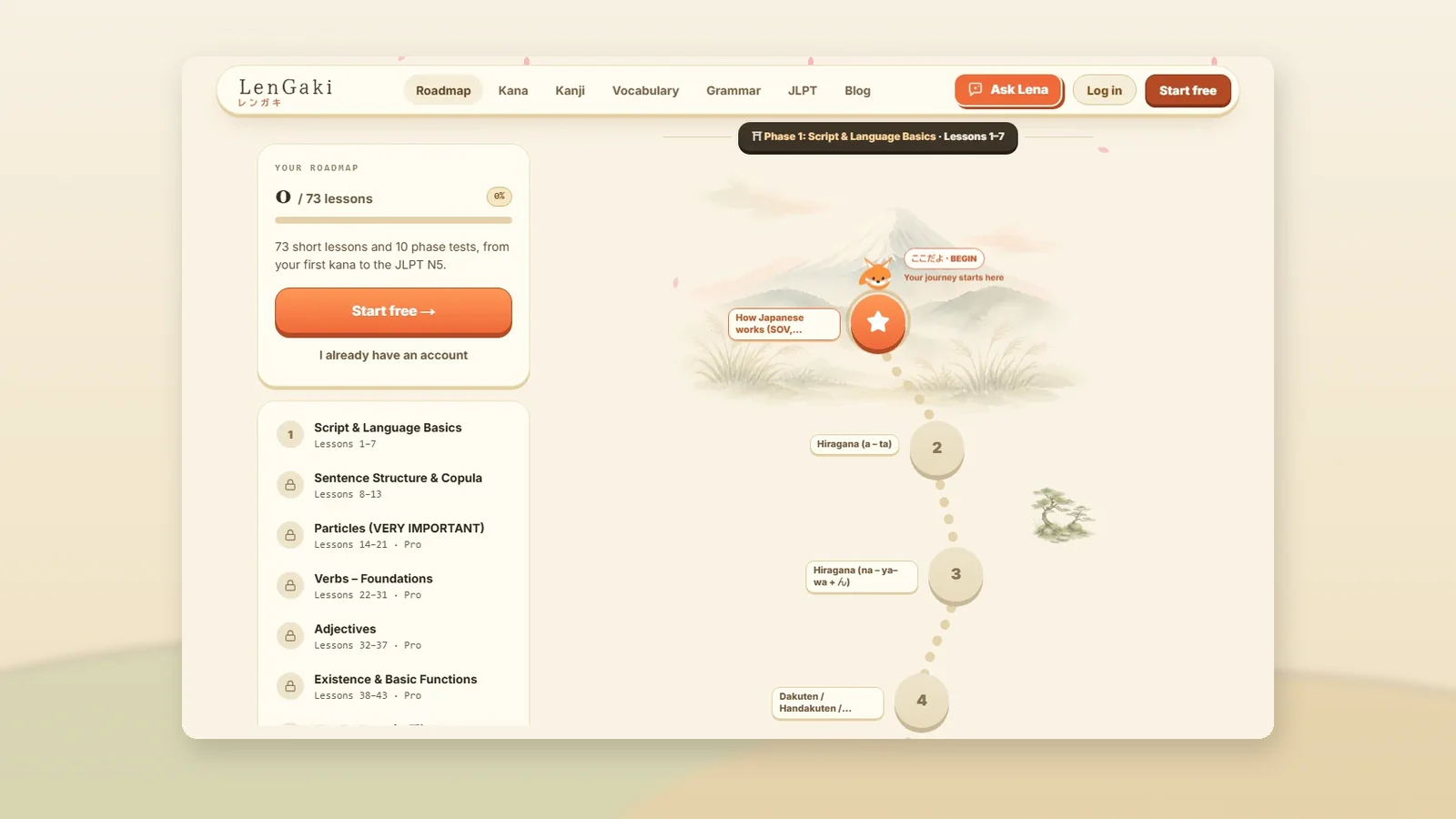
Coming from Duolingo? Open the roadmap and find the first lesson that feels new. Everything up to lesson 13 is free with an account, so reviewing what you already know costs nothing.
Open the roadmapHow do you switch from Duolingo without losing your streak habit?
A streak cannot move between apps, but the habit behind it can. Switching well means keeping the daily routine and changing what fills it.

- Keep the same slot in your day. Pick the daily goal closest to the time you spent on Duolingo, and study at the same time of day as before. The cue matters more than the app.
- Check your kana honestly. If you cannot read every hiragana and katakana at a glance, including が (ga), ぱ (pa) and combinations like きゃ (kya) and しょ (sho), take the kana course first. It is free with no account: 27 hiragana units and 31 katakana units with memory hooks, audio and checks.
- Start at the right roadmap lesson. Read the lesson titles in order and start at the first one you could not explain to a friend. Do not restart at lesson 1 out of caution, and do not skip ahead out of pride: gaps in particles and verb forms come back at N5.
- Add what Duolingo kept light. Give kanji and grammar a few minutes each day: the 124 N5 kanji with stroke order, and the 82 N5 grammar points, with comparisons where two patterns look alike. Keep vocabulary going alongside; the N5 list on LenGaki has 726 words.
- Take a mock as a diagnostic. After three or four weeks, sit one of the two free N5 mock exams in one go, timed, with no dictionary. Your weakest section tells you what to study next.
Mistakes people make when they switch
- Collecting apps. One course plus at most one flashcard tool. Any more and the reviews pile up until the habit breaks.
- Treating points as progress. XP and streaks keep you studying; they do not show what you know. Quizzes and mock exams do.
- Skipping listening. The JLPT has a whole listening paper, and reading practice does not prepare you for it.
What other apps like Duolingo are good for Japanese?
LenGaki is not the only sensible next step. None of these three is a Duolingo copy, but each is a well-established tool that does one job very well:
| Tool | Best at | Keep in mind |
|---|---|---|
| Anki | Spaced-repetition flashcards for anything. You make your own decks or download shared ones. | No curriculum: you decide what to learn and in what order. |
| Bunpro | Grammar practice with spaced repetition, organised by JLPT level. | Best known for grammar, so pair it with something for kanji, reading and listening. |
| WaniKani | Kanji and vocabulary taught through radicals and mnemonics, with spaced repetition. | Uses its own order rather than JLPT levels, and does not teach grammar. |
Each of these works best next to a structured course rather than instead of one. A good setup is one course for the path, plus one of these for the skill you find hardest.
So, what is the best Duolingo alternative for Japanese?
For the JLPT, the best alternative turns your Duolingo habit into exam study: a level-by-level path, kanji with readings and stroke order, explained grammar and timed mocks. LenGaki does that while keeping the streaks and XP, on the web and Android. Add Anki, Bunpro or WaniKani if one skill needs extra work, and keep Duolingo for five minutes a day if you still enjoy it.
Frequently asked questions
Is Duolingo good for learning Japanese?
Duolingo is a good way to start Japanese and to build a daily habit, and it introduces hiragana, katakana and simple sentences gently. It does not follow the JLPT structure and goes lighter on kanji and grammar explanations, so learners preparing for the JLPT usually add or switch to a JLPT-structured course.
Can Duolingo alone get you to JLPT N5?
It can cover part of what N5 needs, but it isn’t organised around the N5 kanji, grammar and vocabulary or the exam format. Before you book the exam, check yourself against an N5 list (LenGaki’s has 726 words, 124 kanji and 82 grammar points) and sit a timed mock exam.
What is the best app like Duolingo for Japanese?
If you want Duolingo-style streaks and XP with a JLPT structure, LenGaki is built for that: a roadmap from kana to JLPT N5, kanji with stroke order, grammar explanations, mock exams and an AI tutor, on the web and Android. For single skills, Anki (flashcards), Bunpro (grammar) and WaniKani (kanji) are popular choices.
Is LenGaki free?
Much of it is. The kana course and every kanji and grammar page are free without an account, and a free account adds all JLPT N5 vocabulary, kanji, flashcards and quizzes, roadmap lessons 1–13 and 3 Lena messages a day. Pro, a small monthly subscription, unlocks the rest.
Does LenGaki have an iPhone app?
No. LenGaki has a website and an Android app, and iPhone users study on lengaki.com in the browser. One account syncs your XP, streak, daily goal and roadmap position between the website and the Android app.
Can I use LenGaki and Duolingo together?
Yes. A simple split is a few minutes of Duolingo as a warm-up and most of your study time on the JLPT roadmap, kanji and grammar. Your streak habit stays, and the structured work gets the time it needs.