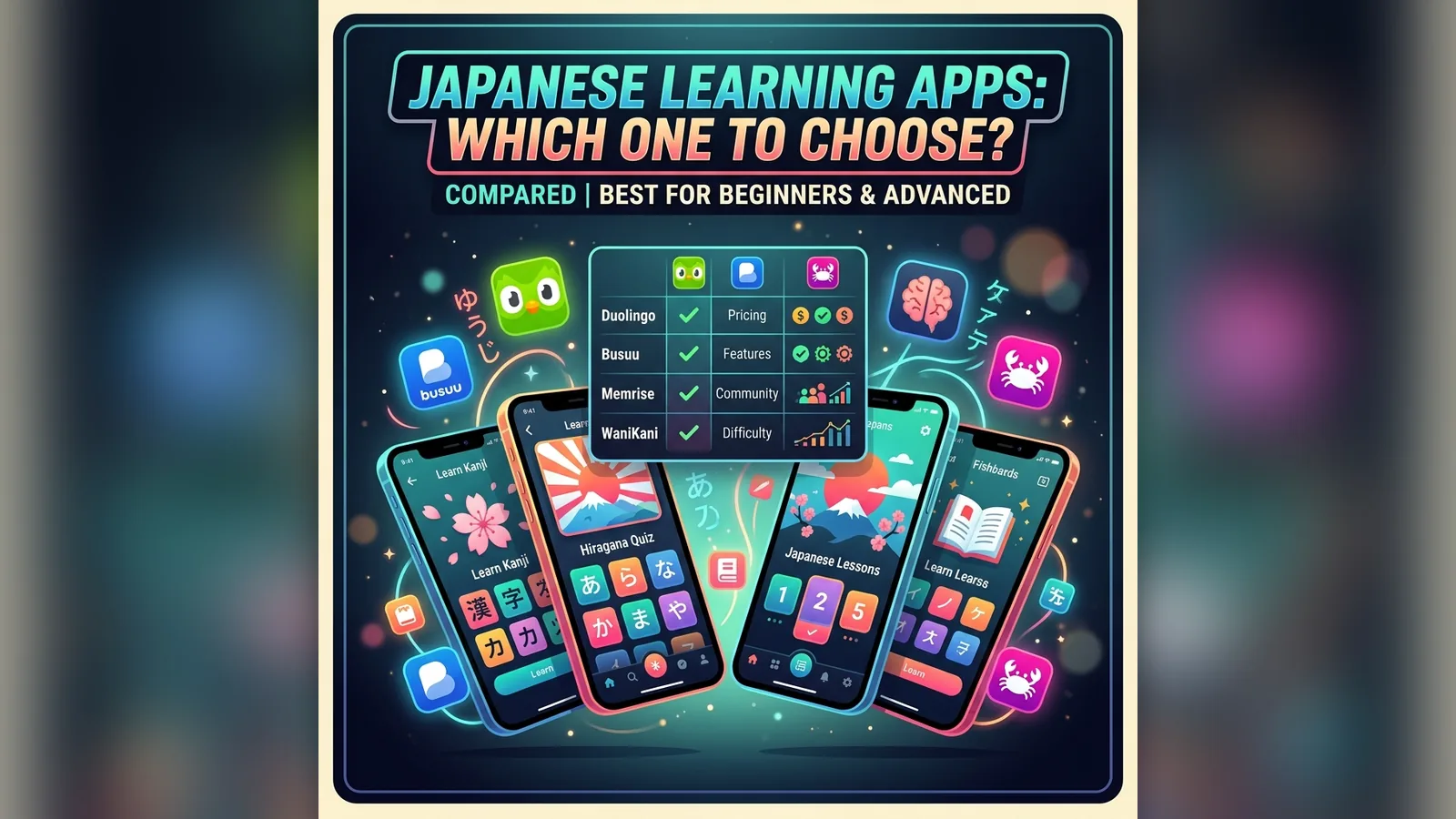
The Japanese learning app market has exploded. There are now dozens of apps claiming to make you fluent — but they are not all equal. Some are genuinely transformative; others are beautifully designed time-wasters. This comparison covers the major Japanese learning apps, what each one is really good at, and a clear recommendation for each type of learner.
A note on bias: LenGaki publishes this blog, and LenGaki is one of the apps below. We compared the apps on curriculum, review system, JLPT alignment and cost, stuck to facts you can check on each app's own site, and said where other apps do a job better. There are no sponsored placements or affiliate links in this post.
The Core Problem with Most Japanese Apps
Streaks, XP and reminders are great for building a daily habit (LenGaki uses them too), but they aren't a curriculum. A long streak doesn't mean you can read a menu. Effective apps pair the habit with regular review, grammar depth, and JLPT-aligned content.
The Master Comparison Table
| App | Best For | Review System | JLPT | Cost |
|---|---|---|---|---|
| LenGaki ✨ | JLPT prep, structured learning (our app) | ⚠️ Flashcards (know / see again); no review scheduler | ✅ Vocab + kanji N5–N1, grammar N5–N2, N5–N4 mock exams | Free / Pro |
| WaniKani | Kanji and vocabulary (meanings and readings) | ✅ Excellent | ⚠️ Partial | Free to try, then $9/mo |
| Anki (custom) | Any topic via user decks | ✅ Best-in-class (SM-2-based or FSRS) | ✅ With right deck | Free (iPhone app paid) |
| Bunpro | Grammar SRS | ✅ Very good | ✅ N5–N1 | $5/mo (30-day free trial) |
| JapanesePod101 | Listening + structured lessons | ⚠️ Limited | ⚠️ Partial | Free tier / subscription |
| LingoDeer | Structured beginner curriculum | ✅ Good | ⚠️ Beginner levels | Subscription |
| Duolingo | Casual motivation, absolute beginners | ⚠️ Basic | ❌ No | Free / paid plans |
| HelloTalk | Speaking with native speakers | ❌ No | ❌ No | Free / Premium |
| italki | 1-on-1 tutoring sessions | ❌ No | ⚠️ Teacher-dependent | Pay per lesson (set by each teacher) |
| Pimsleur Japanese | Audio-first speaking course | ⚠️ Audio-based review | ❌ No | Subscription |
Prices change often; check each app's own site before you subscribe.
Category Winners — Best App for Each Goal
| Learning Goal | Best App | Why |
|---|---|---|
| JLPT N5 preparation in one place | 🥇 LenGaki (our app) | A kana-to-N5 roadmap, the N5 vocabulary, kanji and grammar, speaking practice and timed N5 mock exams in one account |
| Learning kanji meanings and readings | 🥇 WaniKani | Radical-based mnemonics for every kanji and a strong review system (it doesn't teach stroke order) |
| Kanji stroke order | 🥇 LenGaki or Jisho | Both show stroke order; LenGaki's kanji pages also animate it and let you trace each kanji |
| Grammar from beginner to advanced | 🥇 Bunpro + LenGaki | Bunpro's review system covers N5–N1; LenGaki explains 445 grammar points from N5 to N2 |
| Building custom vocabulary decks | 🥇 Anki | Ultimate flexibility; can import any word list; best-in-class spaced repetition |
| Speaking practice with native speakers | 🥇 HelloTalk / italki | Real human interaction that no app can replace for speaking fluency |
| Audio immersion and listening | 🥇 JapanesePod101 | Huge audio library with structured listening comprehension exercises |
| Absolute beginner motivation | 🥇 Duolingo | Great for building a daily habit; it doesn't follow the JLPT structure |
Individual App Deep Dives
LenGaki — The JLPT-Focused All-in-One Platform (Our App) ✨
LenGaki is built around the JLPT: vocabulary, kanji and grammar are grouped by JLPT level, a 73-lesson roadmap takes you from kana to N5, and there are timed N5 and N4 mock exams in the official format. It also has speaking practice with a pronunciation score and Lena, an AI tutor (3 free messages a day).
JLPT Coverage
Vocab + kanji N5–N1, grammar N5–N2
Flashcards
Know / see again, unknown first
Grammar Lessons
445 points + grammar path
Kanji Practice
Stroke order + quizzes
Progress Analytics
Quiz accuracy + predicted JLPT score
Platform
Web + Android (no iOS app)
WaniKani — The Kanji King
WaniKani uses a radical → kanji → vocabulary learning sequence that is genuinely brilliant for kanji acquisition. If kanji is your bottleneck (it usually is), WaniKani's system of mnemonic stories is unmatched. However, it teaches only kanji and vocabulary, and not stroke order or handwriting — you need a separate app for grammar (Bunpro or LenGaki).
Anki — The Infinitely Customizable SRS
Anki's scheduler, based on SM-2 with the newer FSRS algorithm available since version 23.10, is among the most effective spaced repetition systems available. Its weakness: it requires significant setup time. You need to find or build good Japanese decks, format them correctly, and maintain them yourself. Not ideal for beginners; powerful for intermediate+ learners.
Duolingo — The Motivation Starter (Not a Complete System)
Duolingo is excellent for building the habit of daily study and for learning hiragana and katakana. Its strength is gamification — streaks, leaderboards, and animations keep beginners coming back. Its weaker points: grammar explanations are light, it doesn't follow the JLPT, and kanji coverage is limited. Many learners use it to build the habit, then move to a structured system.
The Recommended App Stack by Level
Weeks 1–4 (Absolute Beginner)
Apps: LenGaki (kana + N5 vocab) + Duolingo (daily habit builder)
Goal: Learn hiragana, katakana, first 200 vocabulary words
Months 2–6 (JLPT N5)
Apps: LenGaki (core platform) + Bunpro (grammar SRS)
Goal: Complete N5 vocabulary and grammar curriculum, pass JLPT N5
Months 7–18 (N4–N3)
Apps: LenGaki + WaniKani (kanji) + Anki (sentence mining)
Goal: Expand kanji to 600+, vocabulary to 2,000+ words, speaking practice
Month 18+ (N2–N1)
Apps: Anki (custom decks) + LenGaki + HelloTalk + italki
Goal: Native content reading, real human speaking practice, exam preparation
🏆 Start Your Structured Japanese Journey with LenGaki
Stop app-hopping. LenGaki keeps vocabulary, kanji, grammar, speaking practice and mock exams in one JLPT-aligned account, so you can see where you are on the way to N5, N4, or beyond.