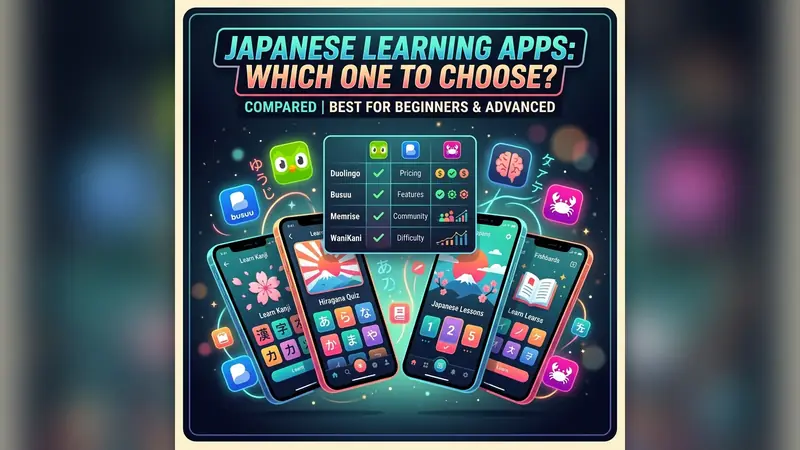
You've probably been there. You downloaded a Japanese learning app, built a 30-day streak, felt like you were making progress — and then realized you still couldn't read a single sentence from a real Japanese source. You're not alone, and it's not your fault. Most Japanese learning apps are fundamentally broken. This article explains exactly why — and what actually works instead.
The Dirty Secret of Language Apps
Language learning apps are not primarily education companies. They are engagement companies. Their business model requires daily active users and subscription renewals — not fluent speakers. This fundamental misalignment between business incentive and learning outcome explains why most apps are optimized to feel good rather than produce results.
The 7 Fatal Flaws of Most Japanese Learning Apps
Gamification Over Grammar Depth
⚠️ The Problem
Duolingo-style apps reward you for completing 5-minute sessions regardless of whether you understood anything. The dopamine hit from completing a lesson feels like learning — but without regular review, much of what you meet in a lesson fades within days.
📊 The Data
A 2012 study funded by Duolingo (Vesselinov and Grego, of Queens College, City University of New York, and the University of South Carolina) estimated that about 34 hours of Duolingo covered the material of a first college semester of Spanish. That is a good result for beginners, but the learners were volunteers, many dropped out early, and Spanish is far closer to English than Japanese is. Treat app time as a start, not a full course.
✅ The Solution
Real solution: Keep the XP and streaks for motivation, but make sure your system brings words back for review. Anki and WaniKani schedule reviews with spaced repetition; LenGaki's flashcard decks put the cards you haven't marked as known first in every round.
No JLPT Alignment (The Certification Problem)
⚠️ The Problem
Most apps teach 'general Japanese' — a mix of vocabulary and phrases without any connection to the official proficiency standard (JLPT). If you're learning to pass N5, N4, or any JLPT level, an app that isn't mapped to the official syllabus wastes your time teaching you vocabulary that won't appear on the exam.
📊 The Data
The JLPT doesn't publish official word lists, but N5 study lists usually have around 700–800 words (LenGaki's has 726) and roughly 80 grammar points (LenGaki's has 82). General-purpose apps rarely tell you which of their words belong to which level.
✅ The Solution
Real solution: Use a platform that explicitly maps every vocabulary item and grammar point to a JLPT level. LenGaki is built around this — every word and kanji is grouped from N5 to N1, and every grammar point from N5 to N2.
The Romaji Trap
⚠️ The Problem
Apps that keep showing Japanese only in Romaji (English letters) hold you back. Romaji is a fine crutch for your first days, but leaning on it delays kana acquisition, distorts pronunciation, and makes you look up words in ways that don't work in real Japanese environments (dictionary search, menus, signs).
📊 The Data
There's no shortcut around kana: menus, signs, dictionaries and every JLPT paper are written in it. Hiragana takes most learners only a week or two of daily practice, so the crutch isn't worth keeping for long.
✅ The Solution
Real solution: Learn hiragana in your first week or two and switch to reading kana as soon as you can. LenGaki's roadmap teaches hiragana and katakana in its first lessons, and its free kana course has 27 hiragana and 31 katakana units; romaji appears only as a helper next to the Japanese.
Passive Learning Illusion
⚠️ The Problem
Watching Japanese content, listening to music, or reading Japanese words in matching exercises are all passive activities. Your brain is not actively constructing Japanese — it's pattern-matching in a low-effort way that doesn't produce retrieval strength in long-term memory.
📊 The Data
Memory research on the 'testing effect' (Roediger and Karpicke, 2006, is a well-known example) has found that recalling an answer from memory makes it stick better over the following days than simply rereading it.
✅ The Solution
Real solution: Use apps that force active recall — blank the answer, make you type/speak it, then show the correct answer. This is the flashcard 'recall test' model that LenGaki and Anki use.
No Speaking Output
⚠️ The Problem
You cannot learn to speak Japanese by reading and listening alone. Speaking is a separate motor skill that requires muscle memory of mouth positions, breathing patterns, and real-time sentence construction. Apps that don't include output practice produce learners who understand Japanese but can't speak it.
📊 The Data
Many popular apps are mostly reading and listening, with little or no speaking. That gap is why so many 'advanced' app users freeze completely when they try to hold their first Japanese conversation.
✅ The Solution
Real solution: Supplement any app with output practice — ChatGPT roleplay, HelloTalk language exchange, or italki tutoring. LenGaki has free speaking practice: hear 200 everyday sentences, say them back and get a pronunciation score.
The Plateau Problem (No Difficulty Scaling)
⚠️ The Problem
Most apps don't adapt their difficulty. They have a fixed curriculum that everyone follows — regardless of whether you've already mastered the content or are completely lost. This means advanced concepts get introduced before foundations are solid, causing comprehension gaps that compound over time.
📊 The Data
This is why learners often feel 'stuck' at a certain level for months despite consistent study — the app isn't identifying and drilling their specific weak points.
✅ The Solution
Real solution: Use tools that show your weak spots and bring them back. Spaced-repetition apps like Anki and WaniKani do this automatically; LenGaki's analytics show your quiz accuracy by skill (with a tip for your weakest one), and its flashcards put the cards you don't know yet first.
The Vocabulary Size Myth
⚠️ The Problem
Apps often advertise how many vocabulary words they contain (10,000! 50,000!) without clarifying that vocabulary size is meaningless without retention. Having 10,000 words in a database you've 'seen once' is infinitely less useful than having 2,000 words you can recall instantly under pressure.
📊 The Data
A learner who can instantly recall 2,000 common words will understand far more everyday Japanese than one who has 'seen' 10,000 once and can recall only a fraction of them.
✅ The Solution
Real solution: Prioritize retention rate over vocabulary count. Track the words you can recall instantly — this is the real metric of progress.
The Warning Signs of a Bad Japanese App
| ⚠️ Red Flag | Why It's a Problem | What to Do |
|---|---|---|
| Shows Japanese only in Romaji | Creates dependency that delays kana acquisition; ruins pronunciation | Choose apps that show kana (and kanji with readings); treat romaji as a temporary helper |
| No regular review | Without review, most new words fade within days | Use an app that brings words back (Anki, WaniKani) or do a flashcard round every day |
| Rewards the streak but never tests recall | A streak shows you turned up, not what you remember | Keep the streak, but also track what you can recall (quiz scores, known cards) |
| Grammar only in English sentences | Japanese grammar requires Japanese context to make intuitive sense | Find an app that uses Japanese example sentences |
| No JLPT curriculum map | You're studying random vocabulary with no exam preparation strategy | Use an app that groups its content by JLPT level, such as LenGaki or Bunpro |
| Tight daily cap on the free tier | Too little practice time to build real proficiency | Check how much the free tier lets you practice each day before you commit |
What Actually Works — The Science-Backed System
Evidence-Based Japanese Learning Flow
Kana First (Weeks 1–2)
Learn all 92 basic hiragana and katakana characters before anything else. Use LenGaki's kana course. Most learners need one to two weeks of daily practice, and it unlocks the entire Japanese writing system.
Core Vocabulary with Flashcards (Months 1–3)
Learn the JLPT N5 vocabulary (around 800 words in most lists; LenGaki's N5 list has 726) with flashcards that test recall, such as LenGaki's decks or Anki. Active recall testing only — no passive review.
Grammar Alongside Vocabulary (Months 1–6)
Study N5 grammar points in parallel with vocabulary. Use LenGaki's grammar lessons + Bunpro for extra SRS drilling. Understand the structure, not just memorize patterns.
Add Kanji Systematically (Months 2–6)
Begin kanji practice with stroke order and readings. WaniKani or LenGaki's kanji pages (with animated stroke order). Map kanji to vocabulary you already know.
Speaking Output from Month 2 (Don't Wait)
Start speaking as early as Month 2, even badly. LenGaki's speaking practice, ChatGPT roleplay, language exchange apps, or italki tutors. Output forces your brain to actively construct Japanese.
Native Content Immersion (Month 6+)
Add reading native content (manga, NHK Web Easy, anime with Japanese subtitles). Use Yomitan for instant lookups. Add unfamiliar words to your flashcard deck.
🎯 Switch to a System That Actually Works
LenGaki was built around the fixes in this article: a JLPT-aligned course, kana from the first lessons, recall-based flashcards, speaking practice with a score, and analytics that show your quiz accuracy and a predicted JLPT score. Its XP and streaks are there to keep you coming back, not to replace the learning.