
For most people preparing for JLPT N5 or N4, the best app is an all-in-one JLPT course that teaches vocabulary, kanji and grammar in level order and finishes with timed mock exams in the official format. LenGaki is built for exactly that, and its first two N5 mock exams are free with no account. Add Anki or WaniKani if you want extra review, and keep Duolingo if the daily streak is what gets you studying.
Why the JLPT question is narrower
Most “best Japanese app” lists name the same handful of apps. The JLPT question is narrower: which app prepares you for this exam — timed papers taken in a fixed order, a listening section with its own pass mark, and an answer sheet filled in against the clock? Here is what a JLPT app must do, where each tool fits, and what we would use.
A note on bias: LenGaki is our product. The checklist below works for any app, so use it to check us too. For general Japanese apps rather than JLPT preparation, see our full Japanese app comparison.
What should a JLPT preparation app actually have?
The JLPT tests a fixed format. At N5 that means three papers — 20 minutes of vocabulary, 40 of grammar and reading, 30 of listening — scored out of 180, with a pass mark of 80 and separate minimums of 38/120 for language knowledge and reading and 19/60 for listening. N4 needs 90 overall, with the same section minimums. Miss either minimum and you fail, whatever your total.
An app earns the word “JLPT” when it trains you for that format. Check six things before committing months to one:
| Must-have | Why it matters on the exam | Two-minute check |
|---|---|---|
| Timed mock papers in the official format | Pacing and section order cost points, not just missing knowledge. | Is there a clock per paper, the real 問題 (mondai, question section) order and an answer sheet? |
| Vocabulary sorted by JLPT level | No official word or kanji lists have been published since the 2010 revision, so every list is a reconstruction; level sorting keeps you on syllabus. | Does the N5 list show a word count, kana readings and example sentences? |
| Kanji with readings and stroke order | At N5 and N4 the vocabulary paper opens with 問題1 漢字読み (kanji yomi, reading kanji) and 問題2 表記 (hyōki, writing a word in kanji). | Tap one kanji: on’yomi, kun’yomi, example words, stroke order? |
| Grammar explained, not just drilled | Grammar questions turn on near-identical patterns. You need the why, not only the answer. | Open one grammar point: an explanation, translated examples, a comparison with a similar pattern? |
| Listening at exam pace | Listening has its own minimum, so practise each recording on a single hearing. | Is there exam-style listening, not just audio for single words? |
| Progress by section | You need to know your weakest section, not just your streak. | Does it show results by section, or a predicted score? |
Grammar is where “explained” matters most, because a typical N5 grammar question turns on one particle. 図書館で勉強します (としょかんで べんきょうします, toshokan de benkyō shimasu, “I study at the library”) needs で (de), because it marks where an action happens. 図書館に行きます (としょかんに いきます, toshokan ni ikimasu, “I go to the library”) takes に (ni) or へ (e), because the library is a destination. An app that only marks you right or wrong teaches the answer. One that explains the contrast teaches the pattern.
Which apps do people use for the JLPT, and what is each good at?
Many learners use two or three tools, which is fine as long as one of them is shaped like the exam.
Duolingo: the daily habit
Duolingo is great for building a daily habit, and in the first weeks the habit matters more than any feature list. It is a general course, though: it doesn’t follow the JLPT structure, so it works best as a warm-up alongside something JLPT-shaped.
Anki: flexible flashcards you set up yourself
Anki is a flashcard program that schedules each card for review just before you are likely to forget it. It will hold any deck you like, which is both its strength and its cost: you choose or build the decks, and a course, grammar explanations and mock papers come from elsewhere. Superb for disciplined do-it-yourself learners; a lot of setup for a beginner.
Bunpro: grammar with spaced repetition
Bunpro focuses on grammar. Its grammar library is organised by JLPT level and reviewed on a spaced-repetition schedule, which makes it a good add-on if grammar is the section that costs you marks. Plan your kanji study and mock papers separately.
WaniKani: kanji through radicals and mnemonics
WaniKani is a kanji learning app: radicals first, a mnemonic for every radical, kanji and vocabulary word, and spaced reviews. It is excellent at making kanji stick, but it follows its own level order rather than the JLPT’s and is not a grammar course, so it works best next to a JLPT-structured app.
LenGaki: one JLPT path from kana to mock exam
LenGaki (lengaki.com) is a Japanese learning website and Android app that takes you from your first hiragana to the JLPT. It is built around the exam: a guided roadmap of 73 lessons and 10 phase tests from kana to N5; 7,788 vocabulary words and 2,057 kanji sorted by level from N5 to N1; 445 grammar points from N5 to N2; and full mock exams for N5 and N4. There are three sets per level, each with a vocabulary, a grammar & reading and a listening paper in the official 問題 structure, with an answer sheet. Analytics show your study time and a predicted JLPT score, and Lena, LenGaki’s AI tutor, answers questions, explains grammar and gives examples.
Where it is thinner: the mock exams stop at N4, the grammar stops at N2, and there is no iOS app. One account keeps your XP, streak, roadmap position and mock results in sync between the website and the Android app.
| Tool | Type | Organised by JLPT level? | Main strength | You still need |
|---|---|---|---|---|
| Duolingo | General course app | No | A daily habit | JLPT-level study and mock papers |
| Anki | Flashcard SRS | Only if your deck is | Flexible, custom review | A course, grammar explanations and mock papers |
| Bunpro | Grammar SRS | Yes (grammar library) | Grammar review | Kanji study and mock papers |
| WaniKani | Kanji SRS | No, its own levels | Making kanji stick | Grammar and mock papers |
| LenGaki | All-in-one JLPT path | Yes: vocabulary and kanji N5–N1, grammar N5–N2 | Kana-to-N5 roadmap plus N5 and N4 mock exams | Official workbooks for N3 and above |
Why do timed mock exams matter more than one more flashcard app?
Flashcards build knowledge. A mock tells you whether you can use it at exam speed, in exam order, against the clock. Those are different skills, and the second is where self-taught learners lose points. In the listening paper’s 問題3 発話表現 (hatsuwa hyōgen, utterance expressions) and 問題4 即時応答 (sokuji ōtō, quick response), the answer choices are spoken, not printed. Train for a single hearing: on any mock, answer after one listen and save replays for your review.
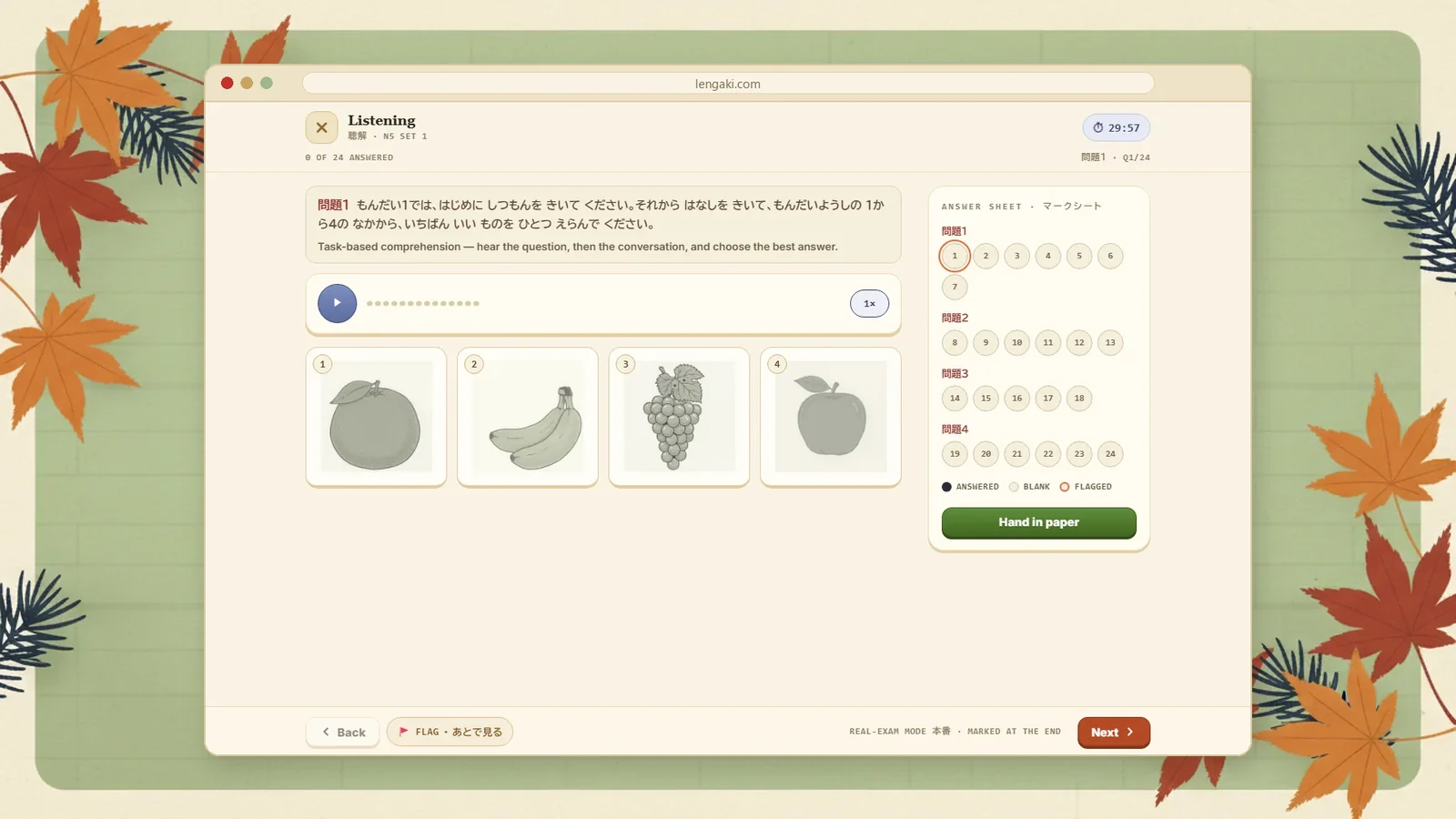
Three fresh mocks spread over the final two months work well: about eight weeks out as a baseline, six weeks out to check your fixes, and two weeks out as a dress rehearsal, each scored by section, with the last week kept for light review. Our guide to using JLPT mock tests covers the method.
LenGaki’s N5 mock sets 1 and 2 are free with no account: three papers each, on the official 20, 40 and 30-minute clocks, with an answer sheet grouped by 問題. N5 set 3 and the three N4 sets come with Pro.
Try a free N5 mockWhat is the best app for JLPT N5?
For N5 we would pick an all-in-one app, because the syllabus is small enough to follow from start to finish in one place. On LenGaki the N5 load is 726 words, 124 kanji and 82 grammar points, and the roadmap’s 73 lessons and 10 phase tests take you there from your first hiragana. The JLPT N5 guide sets out what the level covers.
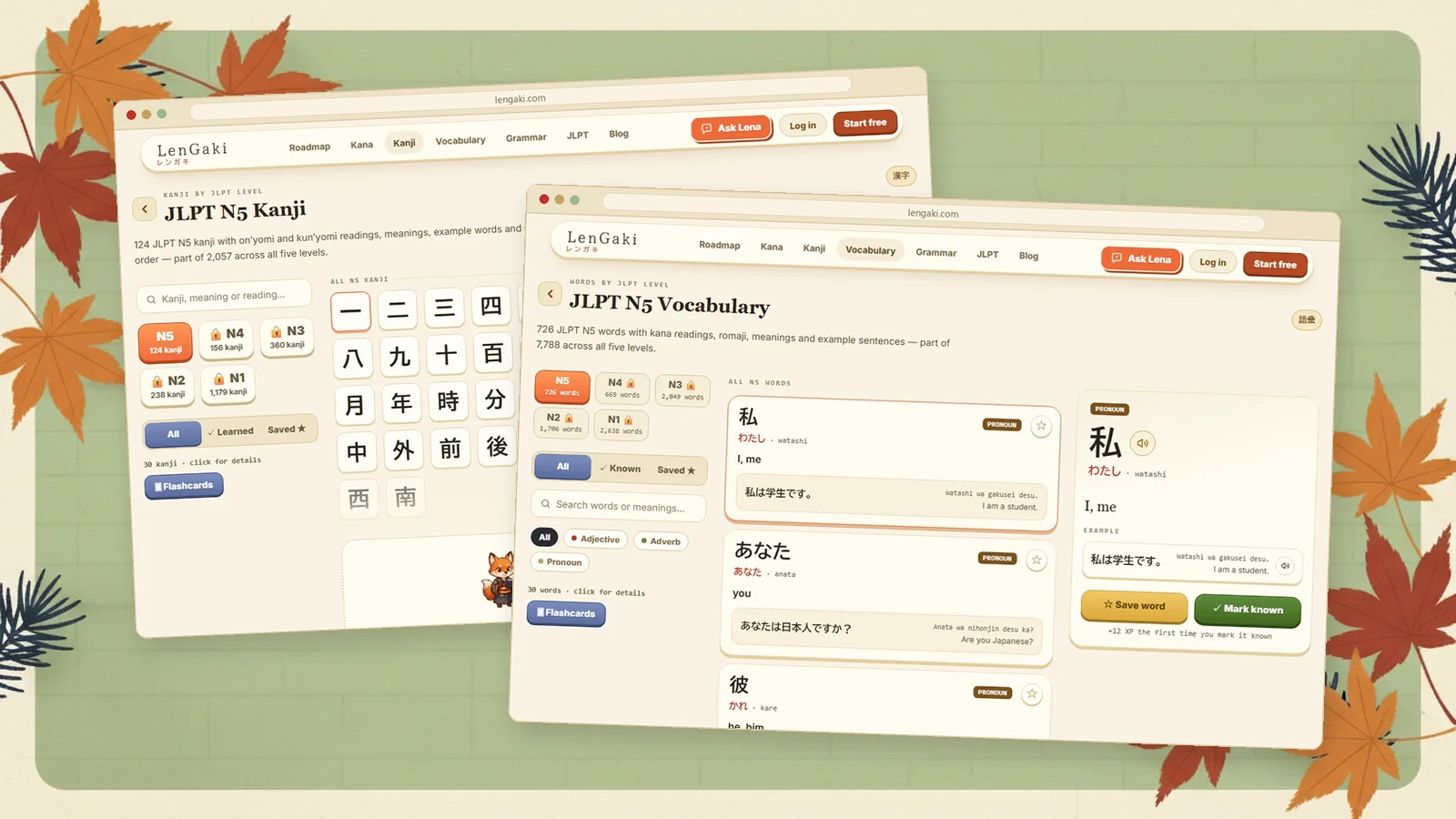
A free account is enough for most of N5. It includes all the N5 vocabulary, kanji, flashcards and quizzes, the first 13 roadmap lessons and two phase tests, the first four units of the N5 grammar path, and analytics. Pro costs a small monthly price, and you can cancel anytime. It adds the rest of the roadmap, the full grammar path, every mock exam and unlimited Lena.
Whatever app you choose, test it on what N5 actually examines. 問題1 漢字読み gives you a sentence such as 来週、友だちと映画を見ます。 (らいしゅう、ともだちと えいがを みます, raishū, tomodachi to eiga o mimasu, “Next week I’m seeing a film with a friend”) and asks for the kana reading of one underlined word, such as 来週, so an app should train readings inside sentences, not only as single words. Look-alike kanji need close attention too: 右 (みぎ, migi, right) has 口 (kuchi, mouth) at the bottom, while 左 (ひだり, hidari, left) has 工 (kō, craft), and even their first strokes differ: the slanting ノ in 右, the horizontal 一 in 左. Animated stroke order makes the difference stick; a meaning-only flashcard does not.
What about N4, N3 and the higher levels?
N4 is still well covered: Pro unlocks all N4 vocabulary, kanji, flashcards and quizzes, plus three full N4 mock sets. Above N4 you still get level-sorted vocabulary, kanji and flashcards through N1, quizzes at N3 and grammar through N2, but no LenGaki mock exams, so from N3 on:
- Practise the format with the official sample questions and the Official Practice Workbook from the JLPT organisers.
- Add a specialist for your weakest section: a grammar SRS such as Bunpro, or Anki for sentences you collect from your reading.
- Read and listen to real Japanese every day. At N2 and N1 the reading section rewards volume, and no app can do that part for you.
Which app should you pick, and what should you pair it with?
For most learners aiming at N5 or N4, our pick is LenGaki as the JLPT-shaped spine, plus at most one specialist for your weakest area. Collecting more tools than that usually means finishing none of them.
- Starting from zero, aiming at N5: the LenGaki roadmap from kana to N5, then the free N5 mocks. Add Duolingo only if a streak is what gets you to sit down.
- Kanji is your bottleneck: LenGaki’s kanji pages for readings and stroke order, plus WaniKani or an Anki deck for extra review.
- Grammar keeps costing you marks: LenGaki’s grammar path, whose lessons include comparisons of similar patterns, plus a grammar SRS such as Bunpro.
- You study on an iPhone: use the LenGaki website in your browser; there is no iOS app.
- You like paper: the LenGaki N5 books (Vocabulary, Kanji, Grammar and Mock Tests) follow the same N5 syllabus as the website and app, so a chapter in the book can be practised online.
How should you use a JLPT app day to day?
The plan matters more than the app. A routine that works for most N5 and N4 learners:
A 30-minute daily routine
- 10 minutes of review, with flashcards or SRS, before anything new.
- 10–15 minutes of new material: one roadmap lesson or one grammar point, with its example sentences read aloud.
- 5–10 minutes of listening at natural speed, replaying a clip at most once.
- Once a week, a mixed quiz to catch what review is missing.
- In the last eight weeks, three full mocks about two weeks apart, with every wrong answer sorted by cause: didn’t know, misread, or ran out of time.
When an explanation doesn’t click, ask rather than skip: on the LenGaki website you can highlight any text and tap “Explain with Lena” (3 messages a day free, unlimited with Pro).
Mistakes that cost points
- App-hopping. Two months each in three apps is less progress than six months in one.
- Living in romaji. Switch to kana in the first few weeks. The exam has no romaji.
- Skipping listening because vocabulary feels like faster progress. Listening has its own pass mark.
- Choosing an app for its speaking features. The JLPT has no speaking or writing section, so speaking practice is for real life, not for the score.
Frequently asked questions
What is the best app for JLPT N5?
The best JLPT N5 app follows the N5 syllabus and ends in timed mock exams in the official format. LenGaki has the full N5 load (726 words, 124 kanji and 82 grammar points), a 73-lesson roadmap from kana to N5, and two full N5 mock exams that are free without an account.
Is Duolingo enough to pass the JLPT?
Duolingo is great for building a daily habit, but it doesn’t follow the JLPT structure. Most learners need a JLPT-structured app or textbook, plus a few full mock exams, on top of it.
Is there a free app for JLPT preparation?
Yes. A free LenGaki account includes all JLPT N5 vocabulary, kanji, flashcards and quizzes, the first 13 roadmap lessons and analytics, and N5 mock sets 1 and 2 are free even without an account. The JLPT organisers also publish free official sample questions for every level.
Does LenGaki have mock exams for N3, N2 or N1?
No. LenGaki’s mock exams cover N5 and N4, with three full sets each. For N3 and above, use the official JLPT sample questions and practice workbooks alongside LenGaki’s level-sorted vocabulary and kanji.
Is LenGaki available on iPhone?
There is no iOS app; the LenGaki app is for Android. On an iPhone you use the LenGaki website in the browser, with the same account.
How much does LenGaki Pro cost?
LenGaki Pro is one small monthly subscription that you can cancel anytime; lengaki.com/pricing shows the current price. It unlocks every roadmap lesson, N4–N1 vocabulary and kanji, the full grammar path, all mock exams and unlimited messages with Lena.