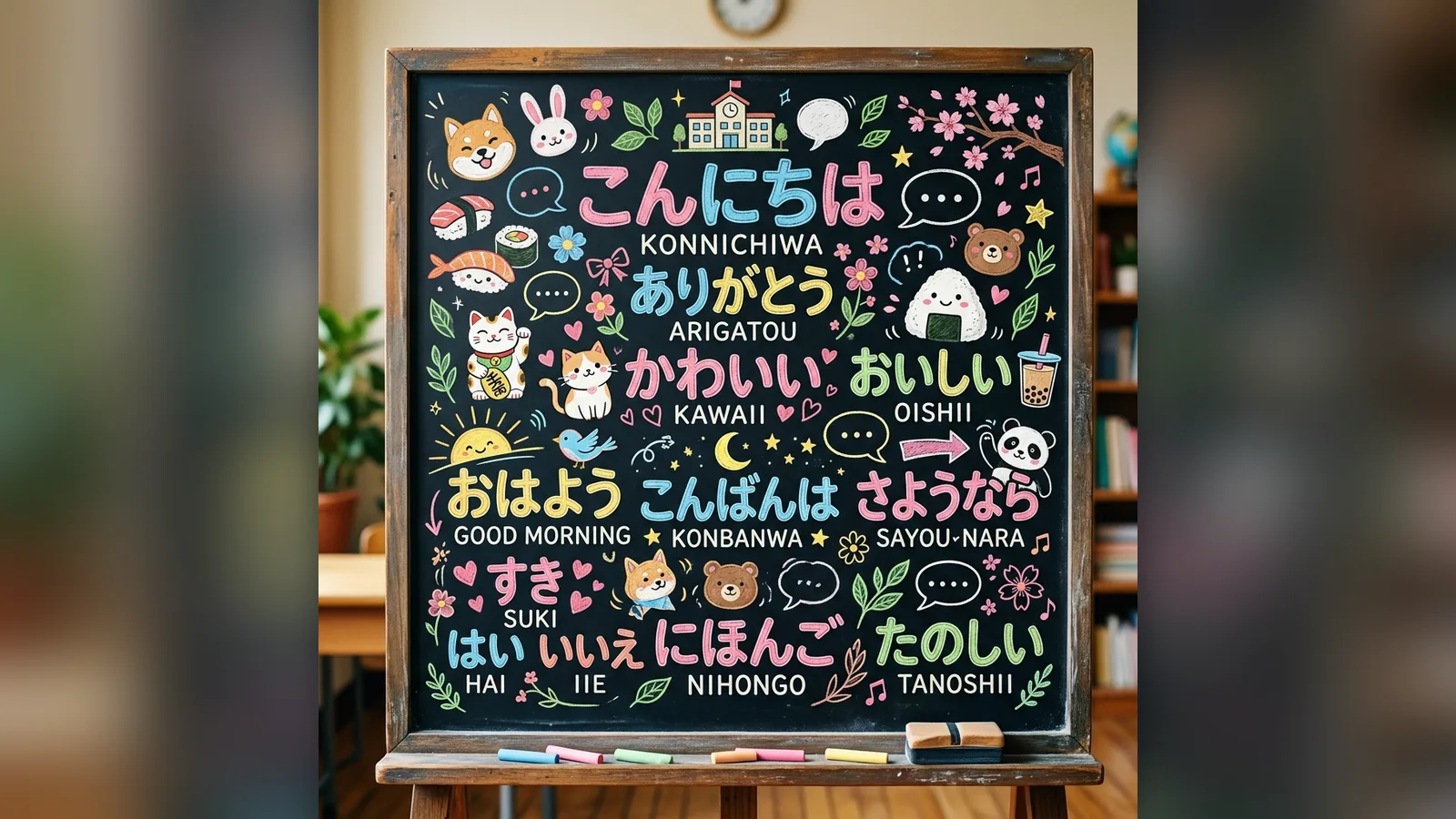
Learning the top 100 high-frequency words gives you instant recognition of nearly 50% of all basic Japanese conversation. This is the Pareto Principle applied to language learning — do the 20% work that gets you 80% of the results.
Below is the definitive, complete list of all 100 essential Japanese words every beginner must know, organized by category — with Japanese script, romaji pronunciation, and English meaning.
The Pareto Principle for Japanese
Research in corpus linguistics shows that the top 100 words in any language account for roughly 45–50% of all spoken text. Mastering these words means you can recognise half the words in any simple Japanese conversation before even picking up a grammar textbook.
Category Color Legend
All 100 Words — Complete Table
| # | Japanese | Romaji | Category | English Meaning |
|---|---|---|---|---|
| 1 | こんにちは | konnichiwa | Greeting | Hello / Good afternoon |
| 2 | おはようございます | ohayou gozaimasu | Greeting | Good morning |
| 3 | こんばんは | konbanwa | Greeting | Good evening |
| 4 | さようなら | sayounara | Greeting | Goodbye |
| 5 | ありがとうございます | arigatou gozaimasu | Politeness | Thank you very much |
| 6 | すみません | sumimasen | Politeness | Excuse me / Sorry |
| 7 | ごめんなさい | gomen nasai | Politeness | I'm sorry |
| 8 | はい | hai | Basic | Yes |
| 9 | いいえ | iie | Basic | No |
| 10 | どうぞ | douzo | Politeness | Please / Go ahead |
| 11 | はじめまして | hajimemashite | Greeting | Nice to meet you |
| 12 | よろしくお願いします | yoroshiku onegaishimasu | Politeness | Please treat me well |
| 13 | いただきます | itadakimasu | Politeness | I will receive (before eating) |
| 14 | ごちそうさまでした | gochisousama deshita | Politeness | Thank you for the meal |
| 15 | おやすみなさい | oyasumi nasai | Greeting | Good night |
| 16 | 私 (わたし) | watashi | Pronoun | I / me |
| 17 | あなた | anata | Pronoun | You |
| 18 | 彼 (かれ) | kare | Pronoun | He / him |
| 19 | 彼女 (かのじょ) | kanojo | Pronoun | She / her |
| 20 | 私たち (わたしたち) | watashitachi | Pronoun | We / us |
| 21 | あなたたち | anatatachi | Pronoun | You (plural) |
| 22 | 彼ら (かれら) | karera | Pronoun | They / them |
| 23 | する | suru | Verb | To do |
| 24 | 行く (いく) | iku | Verb | To go |
| 25 | 来る (くる) | kuru | Verb | To come |
| 26 | 食べる (たべる) | taberu | Verb | To eat |
| 27 | 飲む (のむ) | nomu | Verb | To drink |
| 28 | 見る (みる) | miru | Verb | To see / watch |
| 29 | 聞く (きく) | kiku | Verb | To listen / ask |
| 30 | 話す (はなす) | hanasu | Verb | To speak / talk |
| 31 | 読む (よむ) | yomu | Verb | To read |
| 32 | 書く (かく) | kaku | Verb | To write |
| 33 | 買う (かう) | kau | Verb | To buy |
| 34 | 売る (うる) | uru | Verb | To sell |
| 35 | ある | aru | Verb | To exist (things) |
| 36 | いる | iru | Verb | To exist (people/animals) |
| 37 | わかる | wakaru | Verb | To understand |
| 38 | 知る (しる) | shiru | Verb | To know |
| 39 | 思う (おもう) | omou | Verb | To think |
| 40 | 帰る (かえる) | kaeru | Verb | To return home |
| 41 | 寝る (ねる) | neru | Verb | To sleep |
| 42 | 起きる (おきる) | okiru | Verb | To wake up |
| 43 | 使う (つかう) | tsukau | Verb | To use |
| 44 | 入る (はいる) | hairu | Verb | To enter |
| 45 | 出る (でる) | deru | Verb | To exit / leave |
| 46 | おいしい | oishii | Adjective | Delicious |
| 47 | 大きい (おおきい) | ookii | Adjective | Big / large |
| 48 | 小さい (ちいさい) | chiisai | Adjective | Small / little |
| 49 | いい / よい | ii / yoi | Adjective | Good |
| 50 | 悪い (わるい) | warui | Adjective | Bad |
| 51 | 新しい (あたらしい) | atarashii | Adjective | New |
| 52 | 古い (ふるい) | furui | Adjective | Old |
| 53 | 高い (たかい) | takai | Adjective | Expensive / tall |
| 54 | 安い (やすい) | yasui | Adjective | Cheap / inexpensive |
| 55 | 難しい (むずかしい) | muzukashii | Adjective | Difficult |
| 56 | 易しい (やさしい) | yasashii | Adjective | Easy (kind is 優しい, also read yasashii) |
| 57 | 楽しい (たのしい) | tanoshii | Adjective | Fun / enjoyable |
| 58 | かわいい | kawaii | Adjective | Cute / adorable |
| 59 | かっこいい | kakkoii | Adjective | Cool / handsome |
| 60 | 暑い (あつい) | atsui | Adjective | Hot (weather) |
| 61 | 人 (ひと) | hito | Noun | Person / people |
| 62 | 友達 (ともだち) | tomodachi | Noun | Friend |
| 63 | 先生 (せんせい) | sensei | Noun | Teacher |
| 64 | 学生 (がくせい) | gakusei | Noun | Student |
| 65 | 家族 (かぞく) | kazoku | Noun | Family |
| 66 | 学校 (がっこう) | gakkou | Noun | School |
| 67 | 家 (いえ) | ie | Noun | House / home |
| 68 | 駅 (えき) | eki | Noun | Train station |
| 69 | 店 (みせ) | mise | Noun | Store / shop |
| 70 | 病院 (びょういん) | byouin | Noun | Hospital |
| 71 | 銀行 (ぎんこう) | ginkou | Noun | Bank |
| 72 | 公園 (こうえん) | kouen | Noun | Park |
| 73 | レストラン | resutoran | Noun | Restaurant |
| 74 | トイレ | toire | Noun | Toilet / restroom |
| 75 | 空港 (くうこう) | kuukou | Noun | Airport |
| 76 | 水 (みず) | mizu | Noun | Water |
| 77 | 食べ物 (たべもの) | tabemono | Noun | Food |
| 78 | お金 (おかね) | okane | Noun | Money |
| 79 | 時間 (じかん) | jikan | Noun | Time |
| 80 | 仕事 (しごと) | shigoto | Noun | Work / job |
| 81 | 名前 (なまえ) | namae | Noun | Name |
| 82 | 電話 (でんわ) | denwa | Noun | Telephone |
| 83 | 本 (ほん) | hon | Noun | Book |
| 84 | 電車 (でんしゃ) | densha | Noun | Train |
| 85 | 車 (くるま) | kuruma | Noun | Car |
| 86 | 天気 (てんき) | tenki | Noun | Weather |
| 87 | 言葉 (ことば) | kotoba | Noun | Language / word |
| 88 | 日本語 (にほんご) | nihongo | Noun | Japanese language |
| 89 | 何 (なに/なん) | nani / nan | Question | What |
| 90 | 誰 (だれ) | dare | Question | Who |
| 91 | どこ | doko | Question | Where |
| 92 | いつ | itsu | Question | When |
| 93 | なぜ / どうして | naze / doushite | Question | Why |
| 94 | どう | dou | Question | How |
| 95 | いくら | ikura | Question | How much |
| 96 | とても | totemo | Adverb | Very / extremely |
| 97 | 少し (すこし) | sukoshi | Adverb | A little / a bit |
| 98 | また | mata | Adverb | Again / also |
| 99 | でも | demo | Conjunction | But / however |
| 100 | だから | dakara | Conjunction | So / therefore |
How to Use This List Effectively
Simply reading through this list once won't help you remember the words. You need active recall. Follow this 5-step learning loop for maximum retention:
Active Recall Learning Loop
Study 10 words per day
Don't try to memorize all 100 at once — do 10 per day in groups by category
Make flashcards
For each word, create a flashcard: Japanese side → Meaning + Romaji on back
Test yourself (hide romaji)
Look at the Japanese script and recall the meaning WITHOUT looking at romaji
Use words in sentences
Write one example sentence per word using known grammar patterns
Review what hasn't stuck
In LenGaki's flashcards, mark each word "I know it" or "Review later" — the words you haven't marked as known come back first every round
Words by Category — Quick Reference
Different categories of words serve different functions in sentences. Here's how to prioritize:
| Category | Count in our list | Priority | Why important |
|---|---|---|---|
| Verbs | 23 | 🔴 Highest | Every sentence needs a verb. Learn these first. |
| Nouns | 28 | 🔴 Highest | Names for people, places, things — the core of vocabulary. |
| Greetings & Politeness | 15 | 🟠 High | Use these every single day from Day 1. |
| Adjectives | 15 | 🟡 Medium | Describe things. Important for expressing opinions. |
| Question Words | 7 | 🟡 Medium | Essential for asking basic questions and holding conversations. |
| Pronouns | 7 | 🟡 Medium | Refer to people without repeating their names. |
| Adverbs & Conjunctions | 5 | 🟢 Standard | Connect ideas and add nuance to simple sentences. |
Sample Dialogue Using These Words
Here's a natural self-introduction dialogue built entirely from the 100 words above:
Hajimemashite. Watashi wa Anuj desu. — Nice to meet you. I am Anuj.
Hajimemashite. Doko kara kimashita ka? — Nice to meet you. Where are you from?
Watashi wa Indo kara kimashita. Gakusei desu. — I came from India. I am a student.
Nihongo wa muzukashii desu ka? — Is Japanese difficult?
Sukoshi muzukashii desu ga, totemo tanoshii desu! — It's a little difficult, but very fun!
💡 Practice These Words with Flashcards:
Ready to drill these into long-term memory? Open the LenGaki vocabulary list to hear each word and save the ones you want to keep (saving needs a free account), then drill the N5 vocabulary flashcard deck, where every word you haven't marked as known keeps coming back until it sticks.