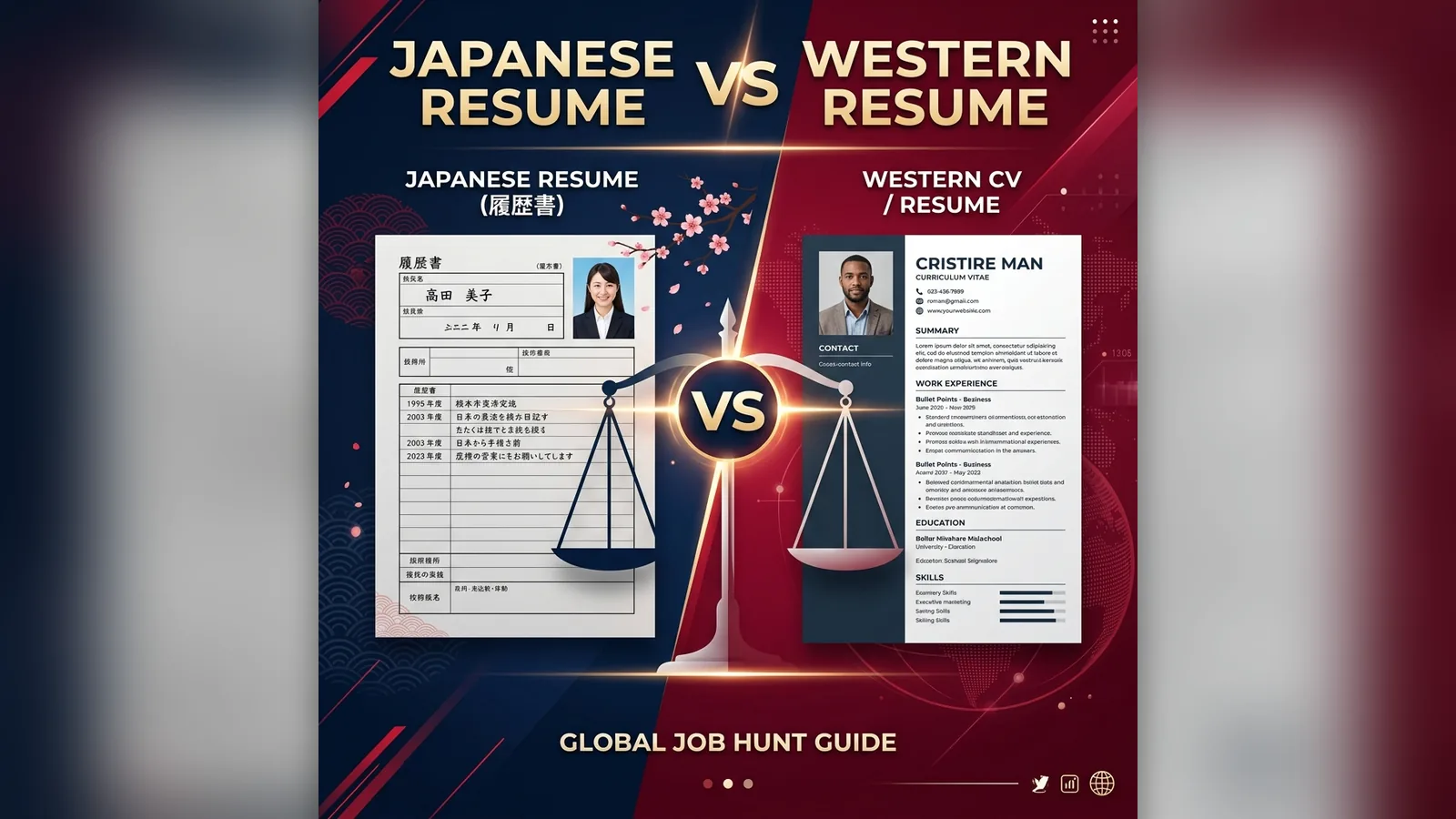
If you submit a standard Western CV to a traditional Japanese company, it will likely be thrown in the trash before anyone reads it. The fundamental philosophy behind a resume in Japan (Rirekisho) is entirely different from the West. A Western CV is a marketing document meant to highlight your unique achievements. A Japanese Rirekisho is an official record meant to prove your conformity, diligence, and background.
The Core Philosophy Clash
Western CV: "Look at how unique I am and how my specific accomplishments disrupted the industry."
Japanese Rirekisho: "Look at how cleanly I follow instructions, how stable my history is, and how well I will integrate into your corporate culture."
Key Differences at a Glance
| Element | Japanese Rirekisho | Western CV |
|---|---|---|
| Format | Strict standardized grid template. Cannot be altered. | Creative, custom designs allowed. Bullet points heavily used. |
| Photo | Expected by most employers. Professional headshot (a suit for office jobs). | Usually left off in the US, UK and Canada to avoid bias. |
| Personal Details | Name, date of birth (age), address and contact details. Gender is optional on the standard MHLW 2021 template, which no longer asks about commuting time, dependants or a spouse. | Usually left off; anti-discrimination rules discourage employers from asking for age, gender or marital status. |
| Chronology | Oldest to newest (Start with High School). | Newest to oldest (Start with most recent job). |
| Job Descriptions | Minimal. Just 'Joined Company' and 'Left Company'. | Detailed. Focuses on metrics, achievements, and impact. |
| Length | Exactly 2 pages (or front/back of 1 A3 sheet). | 1 to 2 pages, highly variable. |
| Medium | Typed is widely accepted; some small shops and traditional firms still prefer handwritten. | Almost always digital (PDF/Word). |
Deep Dive: The Photo Requirement
In many Western countries, including a photo on a resume is a severe faux pas that can cause HR to instantly reject your application due to anti-discrimination laws.
In Japan, most employers expect a photo, and many will not consider an application without one. The photo (Shomeishashin) shows that you can present yourself neatly. For office jobs, wear a dark suit, keep your hair tidy (traditional companies may frown on brightly dyed hair), and keep a neutral expression (no wide smiles).
Deep Dive: Achievements vs. History
A Western CV is dominated by bullet points like: "Increased Q3 revenue by 40% through targeted marketing campaigns."
A Japanese Rirekisho does not care about this. The employment section literally only allows space for the company name, the date you joined, and the date you left.
But how do I show my achievements in Japan?
This is where the Shokumukeirekisho (職務経歴書) comes in. While the Rirekisho is a standardized form for your basic history, professional jobs require a second document (the Shokumukeirekisho). This second document acts more like a Western CV, where you type out your specific project experiences, technical skills, and achievements. You submit both together.
Deep Dive: The "Shibou Douki" (Motivation Section)
In the West, cover letters are becoming optional, and the resume stands on its own. In Japan, the Rirekisho has a built-in "Motivation" (志望動機 - Shibou Douki) box.
This is arguably the most important section of the resume. Japanese companies hire for cultural fit and long-term loyalty over raw skill. If your motivation box looks copy-pasted or generic, you will be rejected. You must write a customized, passionate paragraph detailing exactly why you align with that specific company's corporate philosophy.
🎌 Don't Let Bad Japanese Cost You the Job
The Shibou Douki (Motivation) section of your resume must be written in flawless, polite Japanese (Desu/Masu form). LenGaki's free grammar library explains the polite forms you need, and Lena, LenGaki's AI tutor, can explain a phrase or suggest a more polite way to say something (3 free messages a day). Before you send it, have a native speaker read the final version.