Many learners start studying Japanese because of anime. But if you try to learn by watching full-speed battle shonen like Jujutsu Kaisen or Naruto, you will quickly get overwhelmed by bizarre slang, medieval dialects, and screaming that doesn't resemble natural Japanese speech.
To actually learn Japanese from anime, you need shows that feature clear pronunciation, everyday sentence structures, and slow-paced dialogue. Here are 5 outstanding titles that are perfect for study, complete with how to approach them.
Decision Flow: Which Anime fits your level?
Unsure where to start? Follow this simple decision flow chart to find your next study show:
Extremely slow, clear speech, lots of puns and basic vocabulary.
Already at N2 or above? Death Note's fast, dense dialogue is a real workout.
Anime Difficulty Breakdown
| Anime | Difficulty | Speech Speed | Key Focus |
|---|---|---|---|
| Shirokuma Cafe | N5 (Absolute Beginner) | Very Slow | Everyday items, animal vocabulary, puns |
| Takagi-san | N5-N4 (Beginner) | Slow / Moderate | Classroom talk, teasing, simple questions |
| Yuru Camp | N4 (High Beginner) | Slow | Nature, camping tools, relaxed chatting |
| Kimi no Na wa | N3 (Intermediate) | Normal | Casual youth speech, regional Hida dialect |
| Death Note | N2-N1 (Advanced) | Fast / Dense | Logical arguments, legal terminology, deduction |
Our 5 Anime Recommendations for Studying, Easiest First

Shirokuma Cafe (しろくまカフェ)
This show takes place in a cozy coffee shop run by a polar bear. The characters speak extremely slowly, use clear enunciation, and frequently make puns, which is amazing for understanding how Japanese wordplay and phonetics work.
Karakai Jouzu no Takagi-san (からかい上手の高木さん)
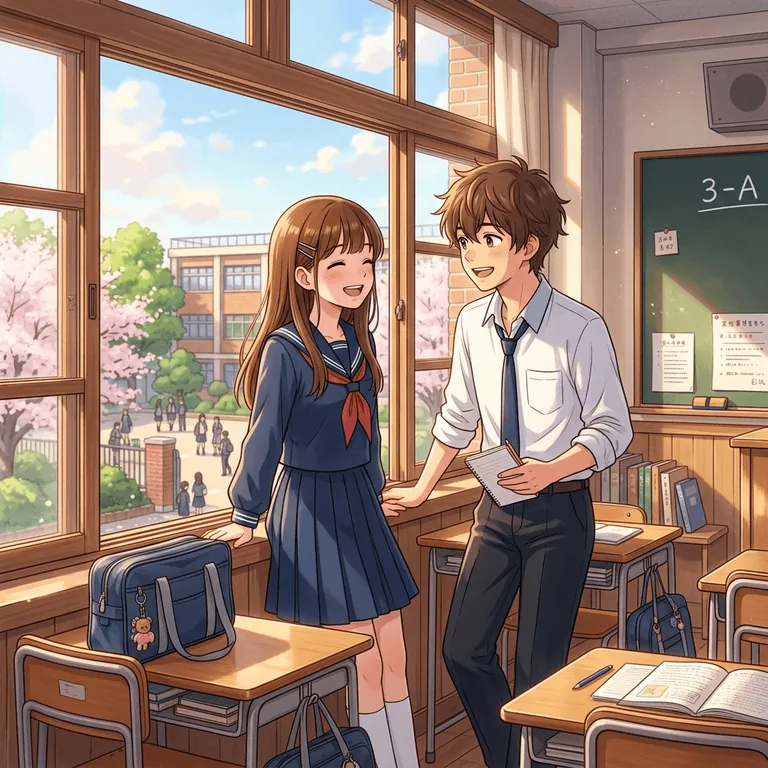
Takagi-san is a slice-of-life anime detailing the teasing dynamic between two middle schoolers. Because the context is simple, the sentences are direct, grammatically correct, and use everyday vocabulary that school children use.

Yuru Camp (ゆるキャン△)
Yuru Camp is a beautiful, relaxing show about high school girls camping around Mount Fuji. The speech is highly casual yet clear, making it a perfect transition show from textbook Japanese to natural conversational structures.
Kimi no Na wa (君の名は。)
Makoto Shinkai's 2016 film about two teenagers who swap bodies, one in Tokyo and one in a small mountain town. The speech is natural and casual, close to how young people really talk, and the countryside characters use the regional Hida dialect, which trains your ear for Japanese that departs from the textbook. Watch it after you are comfortable with Yuru Camp.
Death Note (デスノート)
A student finds a notebook that kills anyone whose name is written in it, and a brilliant detective sets out to catch him. The dialogue is fast and dense, with long chains of reasoning and plenty of police and legal vocabulary. Save it for N2 and above, and watch with Japanese subtitles so you can pause and read the arguments.
How to Study Japanese with Anime (3-Step Method)
Watching anime passively with English subtitles will do almost nothing for your language skills. You must be active. Follow this loop:
Watch with Japanese Subtitles
Turn off English subs. Use Japanese subtitles (or no subs) so you can match the spoken words to written Kanji and Kana characters.
Track & Look Up Unfamiliar Words
When a word is repeated or seems important, pause the video. Write it down, search its meaning, and study its Kanji representation.
Practice Shadowing
Rewind a sentence and repeat it aloud, mimicking the speed, pitch accent, and rhythm of the voice actor as closely as possible.