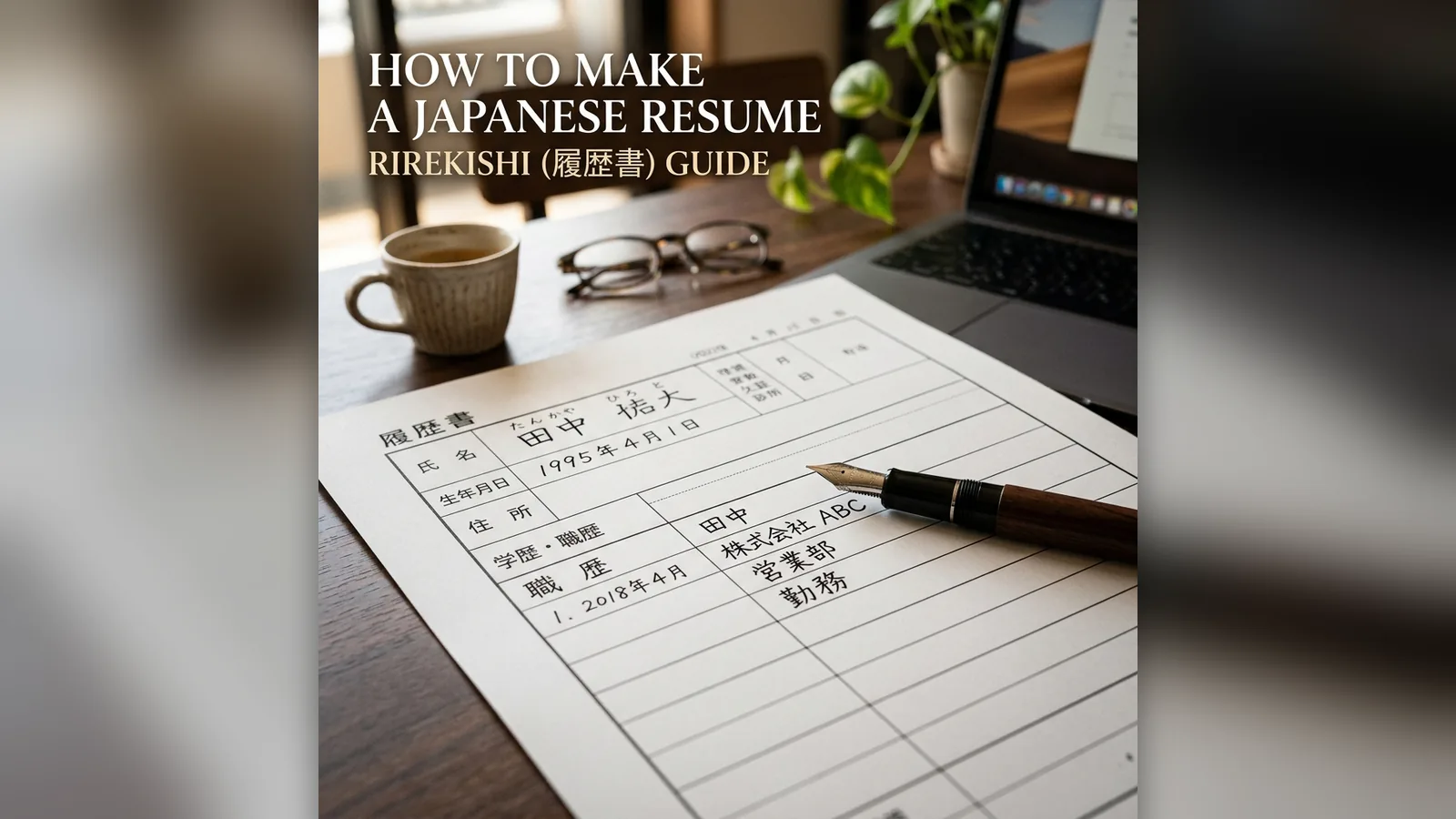
Applying for a job or part-time work in Japan? You cannot simply translate your English CV. You need a Rirekisho (履歴書), the highly standardized traditional Japanese resume. Unlike Western resumes that highlight personal flair, a Rirekisho is a strict, structured form where conformity and precision are valued above all else. This guide will walk you through exactly how to fill out every single section.
The Golden Rules of Rirekisho
- 1. No mistakes allowed: If writing by hand, you cannot use correction fluid. One mistake means you must start a new form from scratch.
- 2. Write in black ink: Black is the custom and the safe choice. Never use pencil or an erasable pen.
- 3. Chronological order: Dates must be written starting from the oldest (unlike Western resumes which start with the newest).
The Structure of a Rirekisho
A standard Rirekisho is divided into specific blocks. Do not alter the structure of these blocks. Today's standard form is the Ministry of Health, Labour and Welfare's template from April 2021, which replaced the old JIS sample: gender is optional, and it no longer asks about commuting time, dependants or a spouse. Here is exactly how to fill it out.
Step-by-Step Rirekisho Completion
Basic Info & Photo (基本情報・写真)
Write your name exactly as it appears on your Residence Card. Include Furigana above it. Attach a professional passport-style photo (about 4cm tall and 3cm wide) taken within the last 3 months. For office jobs, wear a dark suit; for part-time jobs, neat, plain clothes are fine.
Education History (学歴)
List your education starting from Junior High School graduation. Include the exact year and month of enrollment and graduation for each school. Do not mix Japanese era years (Reiwa/Heisei) with Western years; pick one and stick to it.
Work History (職歴)
Leave one blank line after Education, write '職歴' in the center, and begin your work history. Write the exact dates you joined (入社) and left (退社) a company. If you are still working there, write '現在に至る' (Up to present).
Licenses & Qualifications (免許・資格)
List your JLPT score first, followed by driver's licenses or technical certifications. Write the exact official name of the qualification, not an abbreviation.
Motivation & Special Skills (志望動機・特技)
This is the only section where you can show personality. Write exactly why you want to work for THIS specific company (not just any company). Keep it polite and enthusiastic (using Desu/Masu form).
Understanding the Date System
In Japan, dates on official documents can be written in the Western calendar (2026, 2027) or the Japanese Era calendar (Reiwa, Heisei, Showa). While many modern companies accept Western dates, traditional companies heavily prefer the Japanese Era system.
| Western Year | Japanese Era (Gengo) |
|---|---|
| 1989 - 2019 | Heisei (平成) 1 - 31 |
| 2019 (from May) | Reiwa (令和) 1 |
| 2020 | Reiwa 2 |
| 2024 | Reiwa 6 |
| 2025 | Reiwa 7 |
| 2026 | Reiwa 8 |
Handwritten vs. Digital: Which is Better?
Traditionally, Japanese resumes had to be handwritten. Employers believed that beautiful handwriting showed a diligent and careful personality.
Today, things have changed:
- Part-time jobs (Arubaito) & Traditional Companies: Typed resumes are widely accepted, but some small shops and traditional employers still prefer a handwritten one on a form from a convenience store or stationery shop.
- IT Companies, Startups, & Foreign Firms: Digital (Excel/Word/PDF) is the norm, and most applications are sent online.
When in doubt, follow the job ad. If it doesn't say and you are applying for a part-time job at a small local store, a neat handwritten resume is the safe choice; for a corporate or IT role, send a typed one.
The Shokumukeirekisho (職務経歴書)
If you are applying for a full-time, professional job (not a part-time student job), the Rirekisho alone is not enough. You must also submit a Shokumukeirekisho (Work Experience Resume).
While the Rirekisho is a strict timeline form, the Shokumukeirekisho is a 1-3 page typed document detailing your specific projects, skills, and achievements. It is closer in function to a Western CV, but still highly structured.
👔 Master Keigo for Your Interview
Your Rirekisho gets you the interview, but your spoken Japanese gets you the job. LenGaki's free grammar library explains the polite forms interviewers expect, such as いらっしゃる (irassharu) and いたします (itashimasu), and its speaking practice lets you say a self-introduction out loud and get a pronunciation score. Not sure how to phrase an answer politely? Ask Lena, LenGaki's AI tutor (3 free messages a day).