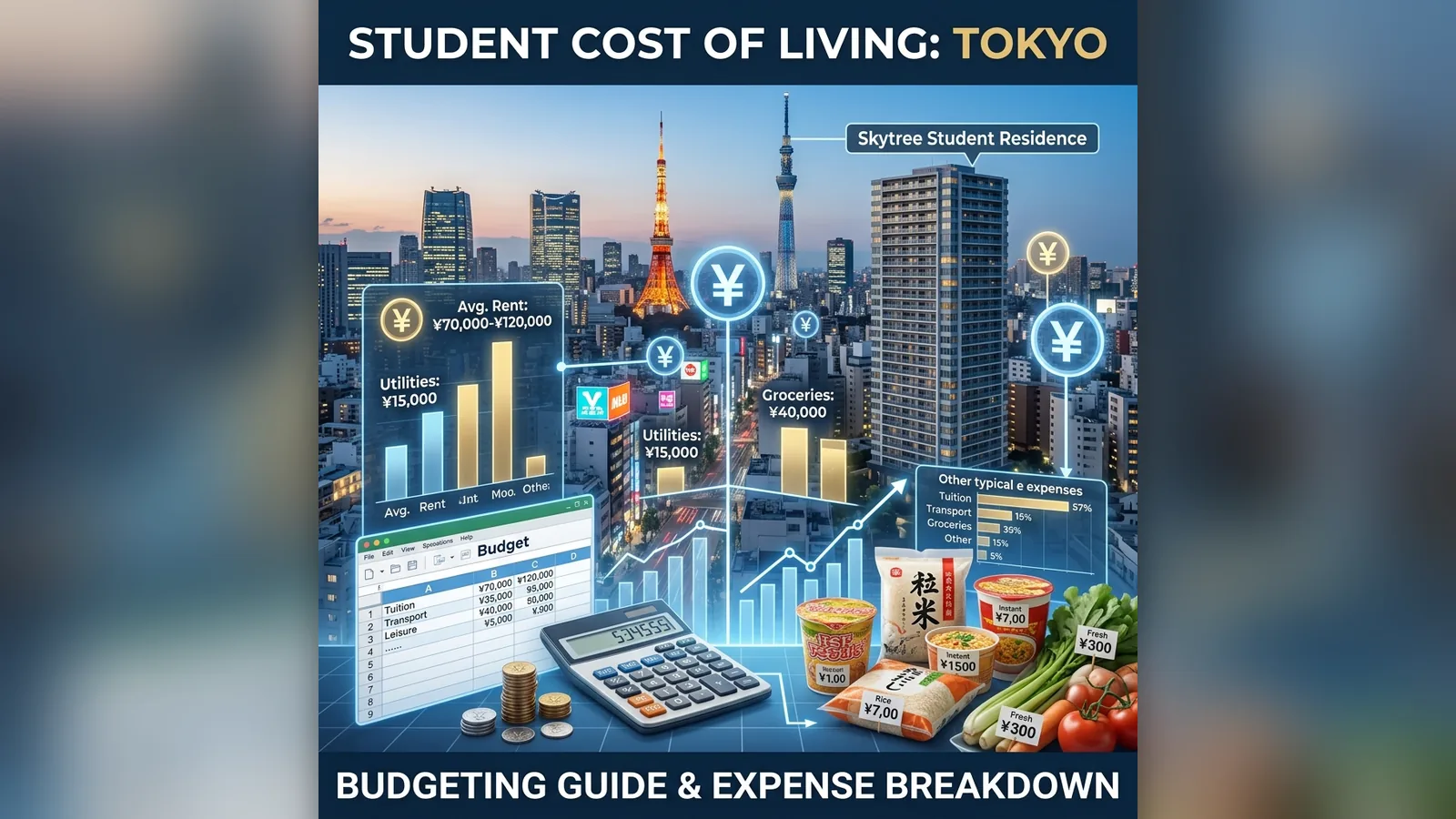
Tokyo is one of Asia's most expensive cities — but for students, it's surprisingly manageable with the right budgeting strategy. This complete breakdown covers monthly rent, food, transport, utilities, and hidden costs that international students often miss.
All figures are in Japanese Yen (¥) and approximate USD ($) equivalents. Exchange rate used: ¥150 = $1 USD.
The Good News for Students
Students in Japan benefit from several cost-cutting options: discounted student rail passes (学割, gakuwari), subsidized university cafeterias (学食, gakushoku), student housing (寮, ryō), part-time work rights (up to 28 hours/week on student visa), and Japan's government-subsidized health insurance (国民健康保険).
Complete Monthly Budget Breakdown
| Expense Category | Budget (¥/month) | Mid-Range (¥/month) | Comfortable (¥/month) |
|---|---|---|---|
| Rent (University Dorm) | ¥20,000–35,000 | ¥40,000–60,000 (share house) | ¥70,000–100,000 (private apartment) |
| Food & Groceries | ¥20,000–25,000 | ¥30,000–40,000 | ¥50,000+ |
| Transport (IC card) | ¥5,000–8,000 | ¥10,000–15,000 | ¥15,000–20,000 |
| Mobile Phone Plan | ¥1,500–3,000 (MVNO) | ¥3,000–5,000 | ¥6,000–8,000 (major carrier) |
| Internet (in dorm) | ¥0 (included) | ¥2,000–3,000 (if separate) | ¥4,000–5,000 (fiber) |
| Health Insurance (NHI) | ¥2,000–3,000 | ¥2,000–3,000 | ¥2,000–3,000 |
| Utilities (electric/gas/water) | ¥0 (dorm included) | ¥5,000–8,000 | ¥8,000–12,000 |
| Books & Stationery | ¥3,000–5,000 | ¥5,000–8,000 | ¥8,000–12,000 |
| Entertainment/Going Out | ¥5,000–8,000 | ¥10,000–15,000 | ¥20,000–30,000 |
| Clothing/Miscellaneous | ¥5,000–8,000 | ¥8,000–12,000 | ¥15,000–20,000 |
| TOTAL (approx.) | ¥61,500–95,000 (~$410–630) | ¥115,000–169,000 (~$767–1,127) | ¥198,000–280,000 (~$1,320–1,867) |
Rent in Tokyo — Your Biggest Expense
Rent is the single biggest variable in your Tokyo budget. Here's a breakdown of the main housing options for students:
| Housing Type | Monthly Cost | Pros | Cons |
|---|---|---|---|
| University Dormitory (寮) | ¥20,000–40,000 | Cheapest, includes utilities, on-campus community | Limited availability, strict rules, curfews possible |
| Share House (シェアハウス) | ¥40,000–65,000 | No key money/deposit, furnished, social, flexible contracts | Less privacy, shared kitchen/bathroom, varying quality |
| Gaijin House (外人ハウス) | ¥35,000–60,000 | No Japanese required for contract, foreigner-friendly | Basic amenities, older buildings, can be noisy |
| Private Apartment (1K room) | ¥70,000–110,000 | Full privacy, own kitchen/bathroom, quiet | Key money (礼金), security deposit (敷金), guarantor required |
| Monthly Mansion (マンスリー) | ¥80,000–150,000 | Fully furnished, flexible month-to-month, no guarantor | Expensive per month, limited long-term availability |
Food on a Student Budget
Food is where smart students save the most money. Tokyo has incredible cheap food options that most tourists never discover:
University Cafeteria (学食)
¥300–500/mealA full balanced meal for less than ¥500. The single best value food in Japan for students. Open for breakfast and lunch.
Convenience Store (コンビニ)
¥300–600/meal7-Eleven, Lawson, FamilyMart have surprisingly good hot food, onigiri, and sandwiches. Best value is discounted items after 9 PM.
Ramen Shops (ラーメン)
¥700–900/bowlA full meal for under ¥1,000. Many shops have ticket vending machines — no Japanese speaking required.
Gyudon Chains (牛丼)
¥380–500/bowlYoshinoya, Sukiya, Matsuya — beef bowl chains open 24/7. Fill yourself for under ¥500 anytime.
Supermarket Shopping
¥15,000–20,000/monthCooking at home using supermarket ingredients. Discount time (割引, waribiki) at 7–8 PM when fresh food gets 30–50% stickers.
Conveyor Belt Sushi (回転寿司)
¥110–180/plateBudget sushi restaurants. Each plate is ¥110–150. A satisfying meal costs ¥600–900.
Transport — Getting Around Tokyo
Tokyo's public transport network is the world's largest and most efficient. As a student, you can save significantly:
| Transport Type | Student Cost | Tips |
|---|---|---|
| Commuter Rail Pass (通学定期) | 30–50% discount vs regular price | Buy at ticket office with student ID. Valid for your school route only. |
| IC Card (Suica/Pasmo) | ¥5–20 per km | Reload as needed. Works on all trains, buses, and even at many convenience stores. |
| Bicycle (自転車, jitensha) | ¥10,000–30,000 one-time purchase | Most popular student transport for trips under 5km. Register with local police (required by law). |
| Tokyo Metro Day Pass | ¥600/day (metro only) | Useful for tourism days but not daily commuting — commuter pass is always cheaper. |
| Shinkansen (Student Discount) | 20% off the base fare (not the shinkansen charge) on trips over 100 km | Must request a gakuwari certificate (学割証) from your university. It covers the fare part of the ticket only. |
Money-Saving Flowchart for Students in Tokyo
Monthly Savings Decision Tree
Decision: Accommodation choice?
→ Prioritize university dormitory → saves ¥30,000–70,000/month vs private apartment
Decision: Food strategy?
→ Eat at gakushoku for lunch + cook dinner at home → saves ¥15,000–20,000/month vs eating out
Decision: Transport?
→ Use student rail pass + bicycle → saves ¥5,000–10,000/month vs full price IC card
Decision: Mobile plan?
→ Use MVNO SIM (IIJmio, Mineo, OCN) → saves ¥3,000–5,000/month vs major carrier
Decision: Part-time work?
→ 28hrs/week max on student visa → up to about ¥154,000/month at Tokyo's minimum wage (¥1,280/hr from October 2026)
📖 Learn Japanese to Unlock More Savings:
Speaking Japanese helps you negotiate with landlords, find local-only discounts, access Japanese-only resources, and work in better part-time jobs. Start your JLPT N5 journey with LenGaki today.