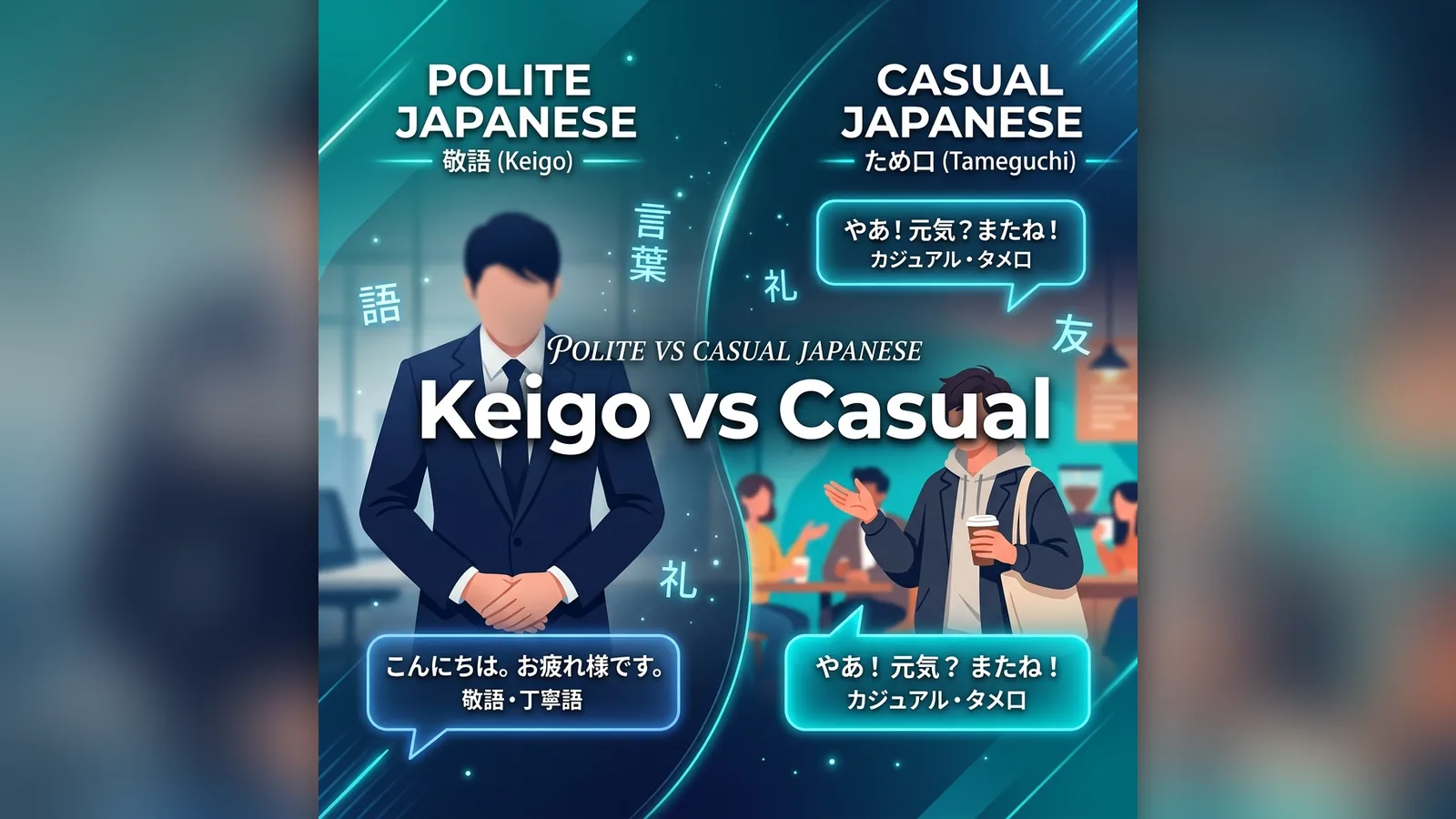
Textbooks teach you to end every sentence with "Desu" or "Masu". But if you watch anime, talk to a Japanese friend, or go to an Izakaya, you will rarely hear those words. Japanese has two completely different modes of speaking: Casual Form (Tameguchi, タメ口) and Polite Form (Teineigo, 丁寧語).
The Social Distance Scanner
Choosing between Casual and Polite form is a real-time calculation of your "Social Distance" from the listener. It factors in age, hierarchy, relationship, and the setting. Choosing wrong can either make you sound incredibly rude, or weirdly distant and robotic.
The Forms at a Glance
| English | Casual (Dictionary Form) | Polite (Desu/Masu) |
|---|---|---|
| To Eat | 食べる (Taberu) | 食べます (Tabemasu) |
| To Go | 行く (Iku) | 行きます (Ikimasu) |
| It is a cat | 猫だ (Neko da) | 猫です (Neko desu) |
| I won't drink | 飲まない (Nomanai) | 飲みません (Nomimasen) |
When to Use Polite Form (Teineigo)
This is your default shield. If you are ever unsure, use Polite form. You should use it with:
- Strangers and shop staff.
- Coworkers (especially those older or senior to you).
- Acquaintances you aren't close with yet.
When to Use Casual Form (Tameguchi)
This is where true friendship happens. Using polite form with a close friend actually pushes them away, implying you aren't close enough yet. Use casual form with:
- Close friends and family.
- People younger than you (in casual settings).
- When talking to yourself (Inner monologue).
- Grammar structures: Many advanced grammar points require the verb to be in casual form before adding the grammar particle!
The Awkward Transition Phase
How to Switch from Polite to Casual
The Mixing Phase
As you become friends with an acquaintance, you might start mixing casual and polite forms. 「今日忙しい?」「そうですね。」 'Kyou isogashii?' 'Sou desu ne.' (Busy today? Yes, I suppose so.)
The Permission Ask
Often, one person will explicitly ask: 「敬語抜きにしよう?」 'Keigo nuki ni shiyou?' (Shall we drop the polite language?). This is the green light for friendship.
Full Casual
You are now officially close friends. Using Desu/Masu now would be considered sarcastic or weird.
🗣️ Stop Sounding Like a Textbook
Traditional classes often stop at Desu/Masu. LenGaki's free grammar library covers both sides: the plain forms of casual speech (dictionary form, ない-form, た-form) and the polite and humble forms of keigo, each with example sentences. Not sure whether a sentence sounds too stiff or too casual? Ask Lena, LenGaki's AI tutor (3 free messages a day).