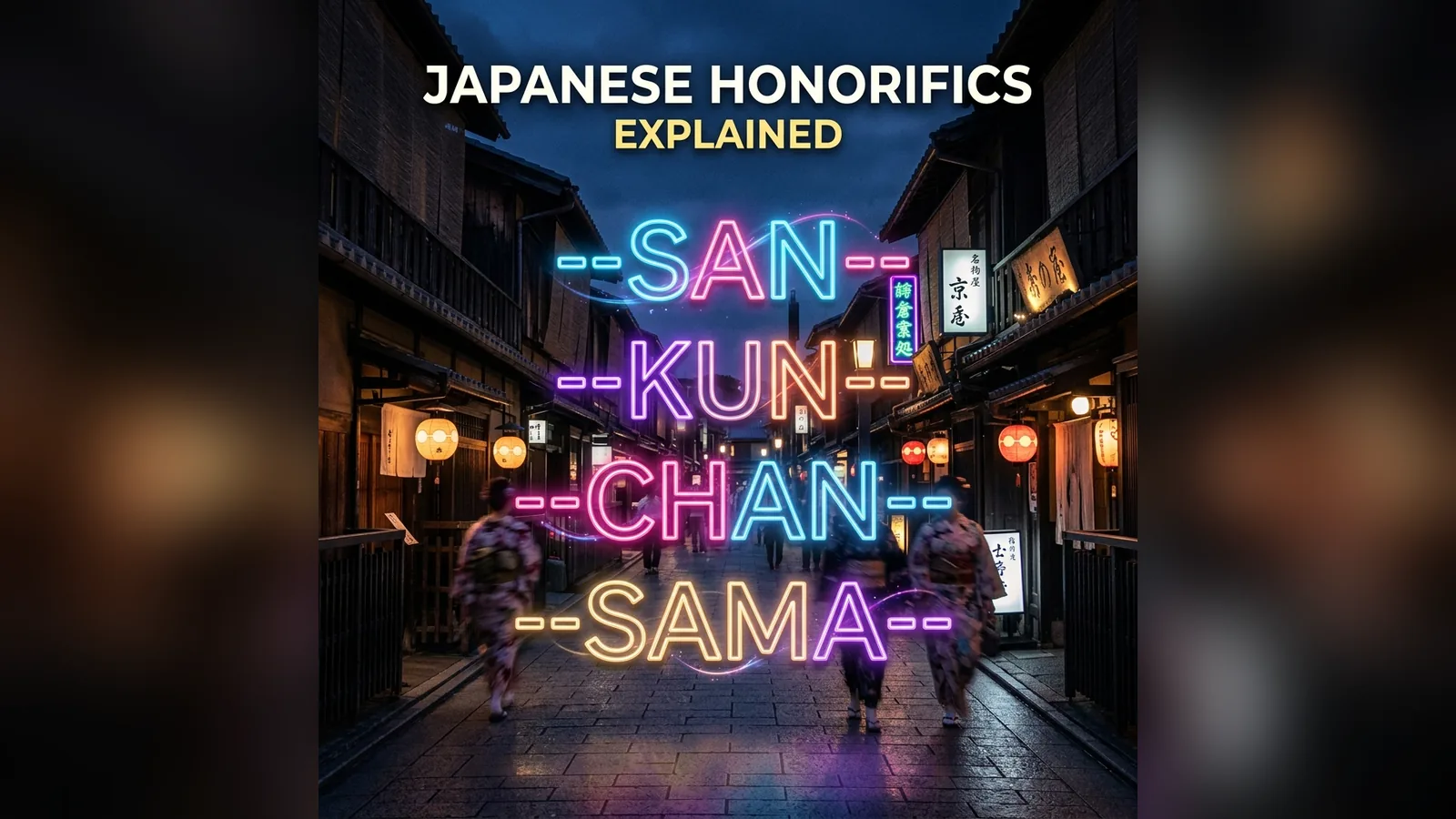
If you've ever watched anime or read manga, you've heard them: Naruto-kun, Sakura-chan, Levi-heichou. Japanese honorifics are suffixes attached to the end of names. They aren't just polite filler; they instantly establish the social hierarchy, relationship, and level of intimacy between two speakers.
The Golden Rule
NEVER use an honorific on yourself. You never introduce yourself as "Smith-san." Doing so implies that you consider yourself superior to the listener. When talking about yourself, use your name plain.
The "Big Four" Honorifics
| Honorific | Used For | Nuance & Feeling |
|---|---|---|
| ~San (さん) | Anyone (Men, Women, Strangers) | The default. Equivalent to Mr./Ms. Always safe to use when you don't know someone well. |
| ~Kun (くん) | Boys, Junior male coworkers | Friendly but slightly hierarchical. Used for young men, or by bosses addressing subordinates. |
| ~Chan (ちゃん) | Girls, Babies, Pets, Close friends | Cute and endearing. Using this on a stranger is overly familiar and can be creepy/rude. |
| ~Sama (さま) | Customers, Deities, High-ranking officials | Extremely respectful. Used by shop staff towards you (Okyaku-sama), or in business emails. |
Yobisute (呼び捨て): Dropping the Honorific
What does it mean when a Japanese person calls someone by their name without an honorific attached? This is called Yobisute.
In Japan, this is a massive deal. Dropping the honorific implies extreme closeness—like a spouse, family member, or lifelong best friend. In anime, the moment two characters switch to Yobisute is often used as a dramatic plot point indicating they have fallen in love or formed an unbreakable bond. If you do this with a Japanese coworker, they will be very shocked!
Job Titles as Honorifics
Used for teachers, doctors, and masters of a craft (like manga artists). "Tanaka-sensei" is correct. "Tanaka-san" for a teacher is rude.
Used for someone senior to you at school or work. Can be used alone ("Senpai!") or attached to a name ("Tanaka-senpai").
Used for the Company President. You do not call your CEO "Suzuki-san", you call them "Shachou" or "Suzuki-shachou".
Formal and written: certificates, official notices and internal company memos (田中殿, Tanaka-dono). In speech you mostly hear it in historical dramas. Don't use it for customers; write 様 (sama) instead.
👥 Navigate Social Hierarchies with Ease
Japanese isn't just about grammar; it's about social context. LenGaki's free grammar library explains the respectful and humble verbs of keigo, such as いらっしゃる (irassharu) and いたします (itashimasu), with example sentences, and Lena, LenGaki's AI tutor, can tell you which form fits your situation (3 free messages a day).