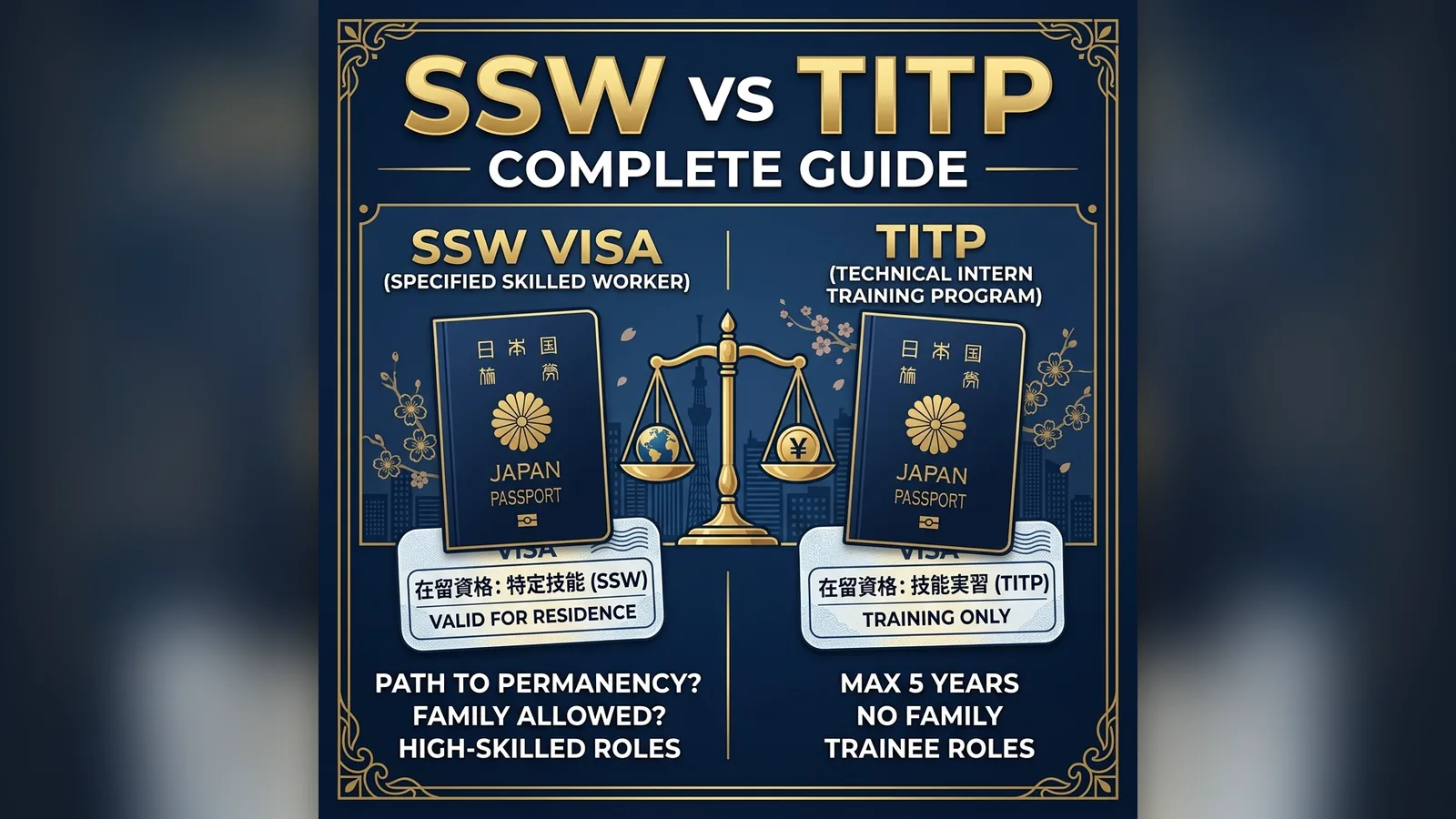
If you do not have a Bachelor's Degree but want to work in Japan, you have two primary options: the Specified Skilled Worker (SSW) Visa (Tokutei Ginou) and the Technical Intern Training Program (TITP) (Ginou Jisshuu). Understanding the difference is critical, as one offers a path to permanent residency, while the other has faced severe human rights criticisms and is being replaced in April 2027.
TITP Ends in April 2027
On 1 April 2027 Japan replaces the TITP with a new system, Employment for Skill Development (育成就労, ikusei shūrō). It trains workers for three years toward the SSW (i) skill and Japanese levels and, unlike the TITP, lets them change employer under set conditions. Until then, the TITP and the SSW visa run side by side.
Head-to-Head Comparison
| Feature | SSW Visa (Tokutei Ginou) | TITP (Intern Program) |
|---|---|---|
| Purpose | To hire foreign workers to fill severe labor shortages. | Officially: To 'transfer skills' back to developing nations. |
| Job Change | Allowed within the same job category (or another category with a shared skills test). | Not allowed in principle; only in exceptional cases such as the employer going bankrupt. |
| Language Requirement | Must pass JFT-Basic or JLPT N4 or higher (TITP (ii) graduates are exempt). | No entry test, except for nursing care (A2.2 level). |
| Skill Requirement | Must pass an industry-specific skills test (TITP (ii) graduates in the same field are exempt). | None. You learn on the job as a 'trainee'. |
| Salary Standard | Must be equal to or higher than a Japanese worker. | Often at or near the minimum wage, minus housing and other deductions. |
| Family Bringing | Allowed under SSW (ii) (spouse and children). | Not allowed. |
| Duration | Up to 5 years in total (SSW (i)); SSW (ii) can be renewed with no limit. | Up to 5 years (1 + 2 + 2). Graduates of TITP (ii) can move to SSW (i) in the same field without the tests. |
Why You Should Aim for the SSW Visa
The TITP system has gained a notorious reputation. Because trainees cannot change jobs, they are vulnerable to exploitation, unpaid overtime, and harassment.
The SSW Visa treats you as a proper employee, not a "trainee." If your boss treats you poorly, you have the legal right to quit and find another job in the same industry. Furthermore, moving up to SSW (ii) by passing its higher-level skills test lets you bring your spouse and children to Japan, renew your visa with no limit and work toward Permanent Residency (PR). From 1 April 2027, SSW (ii) applications from abroad also need Japanese at CEFR B1 level or above.
SSW (i) now covers 19 fields: nursing care, building cleaning, linen supply, industrial products manufacturing, construction, shipbuilding and ship machinery, automobile repair and maintenance, aviation, accommodation, automobile transportation, railway, logistics warehousing, agriculture, fishery, food and beverage manufacturing, food service, forestry, wood industry and resource circulation. Automobile transportation, railway, forestry and the wood industry were added in March 2024; linen supply, logistics warehousing and resource circulation in January 2026 (the last two open once their tests and rules are ready). Check the Immigration Services Agency's SSW page for the current list.
How to Get the SSW Visa in India (and other countries)
The 3-Step Process
Pass the Japanese Test
You must pass either JFT-Basic at A2.2 level or the JLPT at N4 or higher. JFT-Basic is a computer-based test booked through Prometric, and India is one of its test countries, with a test window every two months.
Pass the Skills Test
You must pass the skills test for one of the 19 SSW (i) fields (e.g., Nursing Care, Agriculture, Food Service, Construction). Skills tests are held in Japan and in several other countries, but not every field tests in every country, so check where your field's test is held.
Find an Employer
Apply to job openings directly or through a licensed recruitment agency. Once you are hired, your employer, or a Registered Support Organization (登録支援機関) it works with, must support you in Japan, for example with housing and orientation.
🛂 Pass the JFT-Basic & N4 Fast
For the SSW (i) visa you need two passes: your field's skills test and a Japanese test (JFT-Basic at A2.2, or JLPT N4). LenGaki covers the Japanese side: a 73-lesson roadmap from kana to N5, N5 and N4 vocabulary, kanji and grammar (N4 with Pro), and timed JLPT-format mock exams for N5 and N4.