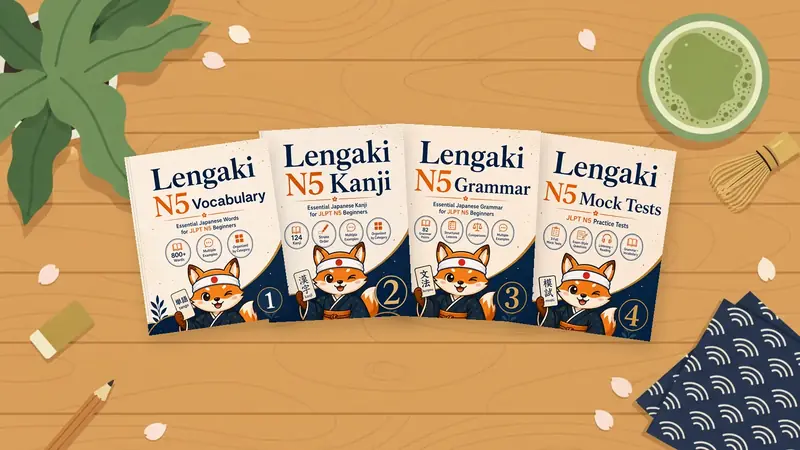
You need one textbook, not four. The most common way beginners waste a year is buying the popular ones, working through the first three chapters of each, and mistaking that for progress. Here is what each of the main N5 books is actually good at, and which one to commit to.
アフィリエイトについて:LenGakiはAmazonアソシエイト・プログラムの参加者です。このページのリンクから購入されると、お客様に追加の負担なく、LenGakiが少額の紹介料を受け取る場合があります。紹介するのは、紹介料がなくても学習者に購入を勧める本だけです。掲載の対価は誰からも受け取っていません。
The short answer
Self-studying in English: Genki I. Studying at a school or planning to move to Japan: Minna no Nihongo. Sitting N5 in under four months and you only care about the exam: TRY! N5. Any of the three works. Finishing one beats sampling all three.
What an N5 textbook actually has to do
N5 asks for roughly 700–800 words, 100–125 kanji and about 80 grammar points, depending on whose list you use (LenGaki’s has 726 words, 124 kanji and 82 grammar points). That is not much material — the difficulty is order and repetition, not volume. A good beginner textbook earns its price by sequencing that material so each chapter is usable immediately, and by recycling earlier grammar into later chapters so you meet it again before you forget it.
Which means the differences between the main options are smaller than the internet suggests. They differ in tone and teaching language, not in coverage.
The main options
Genki I (3rd Edition)
N5Banno et al.
The default first textbook in most university courses. Dialogue-led, English explanations, workbook sold separately.
- おすすめの人:
- Self-study in English, and anyone who wants explanations they can actually read.
- 私たちの評価:
- The safest default. Explanations are in English, the dialogues are natural, and the pacing is forgiving. Buy the workbook with it — the main text alone does not give you enough practice.
Minna no Nihongo I
N5All-Japanese main text with a separate translation book. Standard in Japanese language schools.
- おすすめの人:
- Classroom study, or self-study if you want to be pushed into Japanese early.
- 私たちの評価:
- Excellent material, but the main book is entirely in Japanese and the explanations live in a separate translation volume, so you are buying two books. Superb with a teacher; harder going alone.
TRY! JLPT N5
N5Grammar taught through short everyday dialogues, then JLPT-format practice and a mock test. Built for the exam rather than for a course.
- おすすめの人:
- Passing N5 on a deadline.
- 私たちの評価:
- Grammar taught through short everyday dialogues, with JLPT-format review questions and a full mock test, so it is built for the exam rather than for a course. Excellent as a second book alongside Genki; thin as your only one.
Whichever book you choose, the exam vocabulary is the same — LenGaki’s N5 list has all 726 words, free with an account, with readings, audio and example sentences, so you can check a book’s coverage before you buy it.
Check the N5 vocabularyGenki or Minna no Nihongo: the honest comparison
This is the only decision that matters, and it comes down to one question: do you have a teacher?
Minna no Nihongo is designed for a classroom. The main text deliberately contains no English, because a teacher is meant to supply the explanation. Alone, you are reading a translation booklet in one hand and the textbook in the other, which is slower than it sounds and quietly demoralising by week three.
Genki explains in English on the page. That is worse for immersion and better for finishing — and finishing is the thing almost nobody does. Choose the book you will still be using in month four.
What people regret buying
- A second beginner textbook. The overlap is roughly 90%. A second book feels like progress and is mostly re-reading.
- A kanji book in month one. Learn the kana properly first. Kanji before you can read kana fluently is a fight you picked early and will lose.
- The textbook without its workbook. Reading a grammar explanation is not practice. The workbook is where the learning happens.
- A paper dictionary, at N5. Free apps do this better. Buy the grammar dictionary at N4, when you have patterns worth disambiguating.
What you also need, and what you do not
Alongside the textbook, two things earn their place: a genkouyoushi practice notebook for handwriting kanji in proper squares, and a way to review vocabulary that schedules itself. Handwriting is what stops you confusing 待 and 持 later; spaced review is what stops you relearning week one in week six.
Genkouyoushi practice notebook
anySquared manuscript paper. Handwriting kanji in proper boxes is what fixes the shapes.
- おすすめの人:
- Anyone learning to write kana and kanji by hand.
- 私たちの評価:
- Cheap, and the squares matter more than they look — proportion is half of legible kanji. One notebook lasts most of N5.
What you do not need at N5: flashcard boxes, wall charts, or a second-opinion textbook. None of them are where the difficulty is.
A realistic order of purchase
- Nothing, for the first two weeks. Learn hiragana and katakana from free material first. If you quit in that fortnight — and many do — you have spent nothing.
- Genki I plus its workbook. One decision, made once.
- A genkouyoushi notebook, at the same time.
- TRY! N5 or a mock paper book, six weeks before the exam, and not before.
LenGakiで学ぶ:for N5
この内容を、すべて学べる
- JLPTの単語7,788語(N5〜N1)、読みと音声付き(N5は無料)
- 音読み・訓読み・書き順の練習付きの漢字2,057字
- 例文と間違えやすい表現の比較付きの文法445項目
- 本番形式のN5・N4模試。時間制限付きで、聴解は実際の音声で出題(N5の第1回・第2回は無料)

The summary
Genki if you are alone, Minna no Nihongo if you have a teacher, TRY! if you are on a deadline. Add the workbook and a practice notebook. Then stop buying and start finishing — the learners who pass N5 are not the ones with the best shelf.