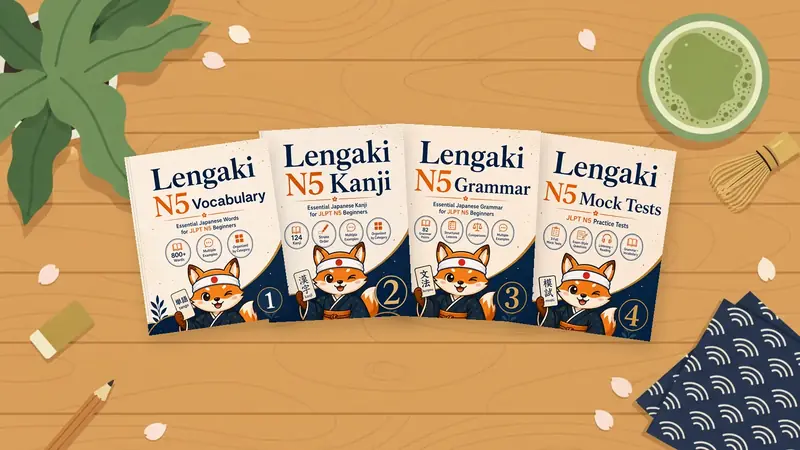
You can reach JLPT N5 having bought two books, or having bought eleven. The learners who buy eleven do not pass sooner. Here is how many books a complete Japanese library actually needs at each level, what is genuinely free, and the order to spend in so that nothing is wasted if you stop.
アフィリエイトについて:LenGakiはAmazonアソシエイト・プログラムの参加者です。このページのリンクから購入されると、お客様に追加の負担なく、LenGakiが少額の紹介料を受け取る場合があります。紹介するのは、紹介料がなくても学習者に購入を勧める本だけです。掲載の対価は誰からも受け取っていません。
The short answer
Two books gets you through N5. Four gets you through N4. At N3 you swap one book for a harder series instead of adding, so you are still working from four (five if you add a kanji book). Anything beyond that is a shelf, not a curriculum — and roughly half of what most people buy could have been free.
Spend nothing for the first two weeks
Learn hiragana and katakana before you buy anything at all. There is no book that teaches kana better than free material does, it takes one to three weeks, and it is the point at which a large share of beginners discover they are not going to continue.
If you are in that share, you have spent nothing. If you are not, you have proved to yourself that you will show up — which is a far better reason to buy a textbook than enthusiasm on day one.
All 142 hiragana and katakana characters with audio, a memory hook for every basic one and a test for every row, free, no account needed. Two weeks here before you spend anything.
Learn kana freeThe N5 library: two books
Genki I (3rd Edition)
N5Banno et al.
The default first textbook in most university courses. Dialogue-led, English explanations, workbook sold separately.
- おすすめの人:
- Your one and only beginner textbook.
- 私たちの評価:
- Buy this with its workbook and nothing else. The workbook is not optional — reading a grammar explanation is not practice, and the exercises are where the material actually lands.
Genkouyoushi practice notebook
anySquared manuscript paper. Handwriting kanji in proper boxes is what fixes the shapes.
- おすすめの人:
- Handwriting kana and kanji properly.
- 私たちの評価:
- Costs about as much as a coffee and does more for legible kanji than any app. One notebook lasts most of N5.
That is the whole N5 list. Not a kanji book, not a grammar reference, not a vocabulary list — your textbook contains all three at this level, and buying separates versions duplicates material you already own.
The N4 library: add two
Nihongo So-matome N4 Grammar
N4Six weeks, two pages a day. The gentlest structured route through N4 grammar.
- おすすめの人:
- A structured pass at N4 grammar.
- 私たちの評価:
- Two pages a day for six weeks. Gentle enough to finish, which matters more at N4 than depth does.
A Dictionary of Basic Japanese Grammar
referenceMakino & Tsutsui
The reference every serious learner ends up owning. Alphabetical by pattern, with contrast notes.
- おすすめの人:
- The reference that starts paying off exactly here.
- 私たちの評価:
- N4 is where patterns begin to look interchangeable — ので and から, のに and けど. This is the book that separates them. Buy it once; it stays useful to N1.
A kanji book also becomes worth it around here, once you have enough vocabulary for the characters to attach to. Basic Kanji Book is the usual choice.
The N3 library: swap, do not add
At N3 the move is a replacement, not an expansion. Shin Kanzen Master takes over from So-matome, because the gentler series stops carrying enough practice. Keep the dictionary. Add nothing else.
Shin Kanzen Master N3 Grammar
N3Denser and stricter than So-matome, with far more practice. The standard step up at N3.
- おすすめの人:
- N3 grammar, and preparation for how N2 is written.
- 私たちの評価:
- The step up that most stalled N3 learners delayed too long. Denser, stricter, and with the volume of practice the exam actually demands.
What is genuinely free, and just as good
- Kana. No book needed, ever.
- Vocabulary lists. Every JLPT level, with readings and audio. Paying for a word list in 2026 makes no sense.
- Kanji readings and stroke order. Animated beats printed, and costs nothing.
- Mock exams. Full timed papers with listening audio are available free — the official workbooks are nice-to-have, not need-to-have.
- Reading practice. NHK Easy News, graded readers online, manga with furigana.
Where paying is actually worth it
Three things are hard to get free and worth money: structured sequencing (a textbook that orders the material for you), practice volume (workbooks and drill books), and a good reference (contrast between confusable patterns).
Everything else — word lists, kana charts, kanji readings, stroke order, mock papers — is freely available at equal or better quality. If a book is mostly a list, you are paying for paper.
The spending order
- Weeks 1–2: nothing. Kana from free material.
- Then: beginner textbook + its workbook + a squared notebook.
- N4: grammar workbook + grammar dictionary. Kanji book if you want one.
- N3: replace the grammar workbook with the harder series. Buy nothing new.
- Six weeks before any exam: one mock paper book, if you want it on paper.
The rule that saves the most money
Do not buy the next book until you have finished the current one. It sounds obvious and almost nobody does it, because buying is easy and finishing is not. A half-read shelf is the single most common feature of learners who have been “studying Japanese” for three years and are still at N5.
LenGakiで学ぶ:from N5
この内容を、すべて学べる
- JLPTの単語7,788語(N5〜N1)、読みと音声付き(N5は無料)
- 音読み・訓読み・書き順の練習付きの漢字2,057字
- 例文と間違えやすい表現の比較付きの文法445項目
- 本番形式のN5・N4模試。時間制限付きで、聴解は実際の音声で出題(N5の第1回・第2回は無料)

The summary
Two books for N5, four for N4, still four at N3 — swap rather than stack at each step. Get kana, word lists, kanji readings and mock exams free. Pay for sequencing, practice and a good reference. Then finish what you bought before buying anything else.